
After the merger of regional rural banks (RRBs) under the "One State, One RRB" policy to improve their efficiency and minimise competition among public-sector banks (PSBs) that sponsor them, the government is planning to list at least five RRBs by the end of financial year 2026-27 (FY27). After the latest amalgamation that came into effect on May 1, there are 28 RRBs in 26 states and two Union Territories (UTs), with more than 22,000 branches covering 700 districts.

Do not shop around for loans immediately after getting a secured credit card. Such loan enquiries can also pull down credit score, as they are treated as a sign of credit-hungry behaviour.

The top 50 exposures, amounting to Rs 7.8 trillion, of government-registered non-banking financial companies (G-NBFCs) constitute about 40 per cent of corporate credit within the NBFC sector, indicating concentration risk, according to the Reserve Bank of India's report "Trend and Progress of Banking in India 2022-23". Notably, all the 50 are tied to the power sector, a domain fraught with inherent challenges, the report said. The report highlighted recognising the escalating systemic importance of G-NBFCs, the Prompt Corrective Action (PCA) framework had been expanded to include G-NBFCs excluding those falling within the base layer.

The pilot of Air India AI-915 Delhi-Dubai flight on February 27 allowed a woman friend to enter the cockpit, according to a complaint filed by a cabin crew member on the same flight.

Since 2014, the public sector banks' branch network in rural and semi urban has grown by a mere 4,000 while for private sector banks, it doubled from 9,673 to 18,437.

Public sector banks have raked in more profits in the three months ended June on the back of a persistent decline in bad loans and the trend may have a positive bearing on their balance sheets in the coming quarters. In the June quarter, Bank of Maharashtra (BoM) and State Bank of India (SBI) were in the lowest quartile as far as Gross Non Performing Assets (NPAs) and net NPAs were concerned, according to an analysis of the quarterly financial numbers published by the public sector lenders. Cumulatively, all the 12 public sector banks reported a profit of about Rs 15,306 crore in the three months ended June, registering an annual growth of 9.2 per cent. However, leading public sector lenders -- SBI and PNB -- posted lower profits in the June quarter.

A group of prominent personalities, including Premji, Keshub Mahindra and HDFC's Deepak Parekh, had in a letter to the national leaders earlier this month had expressed concerns over a series of scams leading to 'governance deficit', but had said that national challenges like fighting corruption cannot be solved by urban protests and posturing.

The government in the Budget 2021-22 has made an allocation of Rs 20,000 crore for the capital infusion in the state-owned banks. The capital position of banks would be reviewed in the next quarter, and depending on the requirement, the infusion will be made to meet the regulatory needs. In the current fiscal so far, all 12 public sector banks have posted a profit, which is being ploughed back to bolster the balance sheet of the banks, sources said.

Last month, the bank was placed under Prompt Corrective Action due to high level of bad loans, lack of sufficient capital to manage risks and negative return on assets for two consecutive years.

In a filing to stock exchanges, BoI said Reserve Bank of India has placed it under Prompt Corrective Action Framework, consequent to the onsite inspection under the risk based supervision model carried out for the year ended March 2017.

The banking regulator is seeking an early exit mechanism for private banks under Prompt Corrective Action.

The interim finance minister said the Insolvency and Bankruptcy Code was helping in recovery of non-performing loans.

To further strengthen the supervision on non-banking entities (NBFCs), the Reserve Bank on Tuesday issued revised guidelines on a Prompt Corrective Action (PCA) framework for such companies, excluding government-owned ones, effective from October 1, 2022, on the lines of what it had introduced for banks in 2002. The RBI came up with stricter supervisory norms under the PCA framework for banks after their bad loans mounted and balance-sheets bled badly. This involved restricting them from fresh lending, brand opening and, hiring, among others. The RBI said the revised PCA framework is also applicable to all deposit-taking non-banking financial companies (NBFCs), all non-deposit taking NBFCs in the middle, upper and top layers, including investment and credit companies, core investment companies, infrastructure debt funds, infrastructure finance companies and microfinance institutions.

The Centre should privatise all public sector banks (PSBs), except the State Bank of India (SBI). This is because private banks have emerged as a credible alternative to PSBs with substantial market share. Also, government ownership hinders the ability of the Reserve Bank of India (RBI) to regulate the sector, according to a report by the National Council of Applied Economic Research (NCAER).

The Cabinet on Wednesday gave in-principle approval for strategic disinvestment along with transfer of management control in IDBI Bank in line with the Budget announcement earlier this year. The central government and LIC together own more than 94 per cent equity of IDBI Bank. LIC, currently the promoter of IDBI Bank with management control, has a 49.21 per cent stake. The Cabinet Committee on Economic Affairs chaired by Prime Minister Narendra Modi approved the strategic sale of IDBI Bank, an official statement said on Wednesday.
The bank will now be in a position to resume normal lending activity, including corporate lending, with tightened risk management framework.

IndusInd Bank, Kotak Bank, ICICI Bank, Sun Pharma, Bajaj Finance and Ultratech Cement were prominent gainers. NSE Nifty rose 176.65 points to 14,867.35.
The bank expects to grow loan book by 10 per cent in the current financial year with calibrated exposure to corporate accounts and thrust on the retail segment.

'Without appropriate supervisory constraints in place, banks are in a position to delay the recognition of losses and engage in ever-greening or zombie lending, which is essentially the rolling over of debts of unviable borrowers that would have otherwise defaulted,' points out RBI Deputy Governor Viral Acharya.

The decision assumes significance in the wake of a scam in the PMC Bank affecting lakhs of customers who are facing difficulties in withdrawing their money due to restrictions imposed by the Reserve Bank of India.

The recapitalisation, the finance minister said, will enhance the lending capacity of state-owned banks and help them come out of RBI's Prompt Corrective Action framework.

Zero-coupon bonds don't give out interest but are issued at a deep discount to the face value, making it difficult to ascertain the net present value.
'Let them put their house in order first.' 'Let the RBI first rectify themselves.'

Tamil Nadu-based Lakshmi Vilas Bank (LVB) with pre-independence lineage on Friday lost its identity after its merger with the Indian subsidiary of Singapore's DBS Bank. The debt-ridden 94-year old old bank's fate was sealed with Union Cabinet headed by Prime Minister Narendra Modi approving Scheme of Amalagamation on Wednesday.

A day after the RBI put in public domain a draft scheme of merger of Lakshmi Vilas Bank (LVB) with subsidiary of Singapore-based DBS, public sector banks' officer union AIBOC on Wednesday said the amalgamation is not in the national interest and demanded the consolidation with any PSB. The proposed amalgamation of the cash-strapped LVB with DBS Bank India seems to be a ploy to provide entry of foreign banks into the country in a big way, All India Bank Officers' Confederation (AIBOC) president Sunil Kumar said. The Indian banking sector provides huge opportunity for growth, so the foreign banks have been looking at inorganic route to expand their presence for long, he said.

According to a government reply in Lok Sabha, as on June 30, 2017, there were about 109,598 cases pending across debts recovery tribunals, with recovery dues of Rs 635,500 crore.

The government has already announced infusion of Rs 10,086 crore in Bank of India, Rs 5,500 crore in Oriental Bank of Commerce and Rs 2,159 in United Bank of India.

Out of these seven PSBs, Bank of India is likely to get the highest amount of Rs 10,086 crore, followed by Oriental Bank of Commerce, which might get Rs 5,500 crore through recapitalisation bonds

While Dhanlaxmi Bank faces governance issues similar to those in Lakshmi Vilas Bank, the financial profile of the Kerala-based bank is better.

'We try to pick up stocks early and hold onto them for the long term.' 'We are not someone who buys and sells on a daily basis.'
The choice clearly is between prompt corrective action and slow but sure destruction, says Tamal Bandyopadhyay.

Bad loans, however, continued to rise in the micro, small and medium enterprises category

New norms are in place to strengthen regulations for this set of lenders which has been playing a critical role in Asia's third largest economy, notes Tamal Bandyopadhyay.

BoB now has over 9,500 branches, 13,400 ATMs, 85,000 employees to serve 12 crore customers.

After removing three PSBs - BoI, Mahabank and OBC from the framework, RBI, on Tuesday, took out three commercial banks - Allahabad, Corporation and Dhanlaxmi from the said list.

LVB had faced some serious flak in terms of bad loans, earnings and credit rating downgrades, since 2016.
From liquidity, monetary policy operations to financial inclusion, know about RBI monetary policy

Among sectoral indices, telecom led the chart, spurting 3.08 per cent, followed by oil and gas.
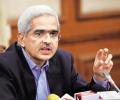
A staunch defender of demonetisation, it would be interesting to see how he handles the government's increasing demand for more cash from the RBI, and letting some weak banks get out of prompt corrective action.

The decision to do away with Rs 500 and Rs 1,000 notes accelerated the slowdown in economic activity with growth averaging 6.8 per cent in the seven quarters after it, as against an average of 8 per cent in the six quarters preceding it, says former chief economic advisor Arvind Subramanian.
 © 2026 Rediff.com - Investor Information - Advertise with us - Disclaimer - Privacy Policy - Sitemap - Feedback - About us - Terms of use - Grievances