
Brokerages were divided on Bajaj Finance after its 2025-26 (FY26) third-quarter (October-December/ Q3) results, with a few raising targets on valuation comfort, while others flagged concerns over the credit cost trajectory.

Weakness in the information technology (IT) sector hiring has weighed on Info Edge (India) over the past year, leading to a 13 per cent correction in the stock during this period. While the company's 2025-26 (FY26) third-quarter (October-December/Q3) performance showed a marginal improvement, brokerages believe the IT hiring outlook remains weak due to macroeconomic uncertainty in the US.

The shares of Titan Company hit its all-time high on the BSE and was the top gainer in the Sensex on Wednesday after the company released its business update for the third quarter of 2025-26 (Q3FY26). The stock closed at 4,272, up 3.94 per cent as compared to the Sensex, which was a tad down.

The stock of automative major Eicher Motors hit its all-time high on Wednesday, capping the year with gains of about 52.7 per cent. It has comfortably outperformed its sector index, the Nifty Auto, which jumped 22.7 per cent, as well as the benchmark Nifty, which rose 10 per cent during this period.

Colgate-Palmolive India's September quarter (Q2FY26) performance has reinforced concerns among brokerages about the company's continued market challenges.

Automotive (auto) stocks have been among the best performers in the BSE 200 index in recent months. More than half of the top 15 gainers over the past one, two, and three months have come from the sector.

Hero MotoCorp Ltd (HMCL) has been the best-performing auto stock over the last three months, gaining over 17 per cent during this period. Multiple tailwinds, especially on the rural front, are expected to boost its volumes. In addition to the demand drivers, new launches too should help drive growth both in the commuter and premium motorcycle categories.

A robust show during the March quarter of 2024-25 (Q4FY25) and hopes of a strong demand momentum have led to an upward revision of Mahindra & Mahindra's (M&M's) earnings. With a slew of launches lined up amid a steady demand environment, brokerages see M&M outperforming peers in passenger vehicles (PVs), tractors and commercial vehicles (CVs).

Listed paint majors posted another lacklustre showing in the January-March quarter (Q4) of 2024-25 (FY25), with average revenue growth under 3 per cent. Sales were weighed down by Asian Paints - the market leader and the only major to report a year-on-year (Y-o-Y) decline.

Investors should tilt their portfolios towards domestic-facing defensive sectors, which should help provide stability and shield them from geopolitical and tariff risks.
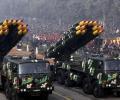
After lagging behind the broader market over the past three and six months, defence sector stocks have regained ground, reversing their performance from the past month. Concerns about slowing order inflows, execution hurdles, supply chain disruptions, and high valuations had weighed on the sector.

Brokerages expect a further slowdown in Indian firms' revenue and earnings growth in Q4FY25, following low single-digit growth in the preceding three quarters, as factors like weak consumer demand and credit growth linger on.

The stock of Crompton Greaves Consumer Electricals has shed about 12 per cent since the start of the month due to a muted near-term outlook. Demand slowdown across segments and pre-buying in cooling products in the June quarter are expected to weigh on revenues going ahead. In addition to pre-buying in the preceding quarter, demand conditions are soft on account of lower consumer spending due to inflationary conditions, weakness in rural demand and the fact that Q2 remains a soft quarter after a strong summer.

The stock of Godrej Consumer Products Limited (GCPL) fell about 3.7 per cent in trade after its Q3FY24 earnings disappointed brokerages and led to downgrades. Further, the stock, after a 15 per cent run-up over the past month prior to Monday's correction, had already factored in the upside from the business front. Its peer in the consumer space, Marico, too, saw a 4 per cent drop in its stock price.

The stock of Mahindra & Mahindra (M&M) has been touching successive all-time highs on the bourses and, over the past year, gained 81 per cent. While the S&P BSE Auto Index has not performed poorly, registering gains of 73 per cent, it still trails the company by 800 basis points (bps) during this period. There are multiple reasons why investors are beating a path to M&M's counter.

Over the past three trading sessions, the stock of Cummins India has gained about nine per cent on strong January-March quarter (Q4) results and good near-term prospects. Its Q4 performance was led by a healthy 29 per cent revenue growth over the year ago quarter. This was largely on the back of a 33 per cent jump in domestic revenues while exports witnessed a growth of 17 per cent.

The stock of the country's largest passenger vehicle maker, Maruti Suzuki India (MSIL) was down 1.06 per cent in trade on margin pressures in Q1FY24, mixed market share outlook, and earnings impact due to the buyout of Suzuki Motor Gujarat. While MSIL has decided to terminate the contract manufacturing agreement and acquire Suzuki Motor Gujarat, the quantum of payment and mode (cash/equity swap) has not been decided. If the cash option is opted for, there would be a 3.5-4 per cent hit to MSIL's FY25 earnings per share as the deal is expected to be completed by the end of the current financial year.

There is no near-term respite for the country's largest fast-moving consumer goods maker, Hindustan Unilever (HUL), which is facing multiple challenges on the growth front. With demand showing no signs of improvement, especially in the rural segment, the October-December quarter (Q3) of 2023-24 (FY24) is likely to be similar to the previous quarter, with volume growth in the low single digits. The stock, which is down 7 per cent over the past year compared to the 11 per cent jump for the S&P BSE Sensex, could underperform the benchmark in the near term as well.

The stock of LTIMindtree finished at Rs 5,001 a piece on Monday, which means it is down about 5 per cent from its all-time high as its June quarter results for the 2023-24 financial year (Q1FY24) missed estimates. A cautious note by the management, coupled with the fact that it will miss its double digit revenue growth target for FY24 weighed on the stock price. The company delivered revenues of just over a billion dollars in the quarter with constant currency growth of 0.1 per cent.

With sentiment for the automotive (auto) sector turning positive, stocks of two-wheeler auto majors have been hitting their 52-week highs. Hero MotoCorp, Bajaj Auto, TVS Motor Company, and Eicher Motors recently reached their yearly highs on strong sales in the festival season and the expectation of faster growth rates ahead. Since the start of this month, listed two-wheeler majors have delivered returns in the 12-17 per cent range, compared to the 7 per cent gains for the S&P BSE Auto Index and 3 per cent for the benchmark S&P BSE Sensex.

Irregular rainfall and a pick-up in commodity costs are expected to weigh on the demand and margins of fast-moving consumer goods (FMCG) companies. Most companies reported a sharp expansion in gross margins in the April-June quarter (first quarter, or Q1) of 2023-24 (FY24), given the lower prices of key raw materials and earlier price hikes. Furthermore, there were expectations that cost savings being passed on could reflect in volume growth going forward. However, these hopes could be dashed if demand recovery, especially in the rural segment, stalls, and gains on the raw material front start to recede.

Since its results for the first quarter of the 2023-24 financial year (Q1FY24) earlier this month, the stock of auto component major Bharat Forge is up nearly 15 per cent and hit its all-time high in the process. The recent gains have extended the returns over the last three months to over 34 per cent. After a strong Q1 performance which beat expectations, brokerages had revised their earnings estimates upwards to factor in the improved outlook.

The BSE Healthcare Index is up 19 per cent as compared to BSE Sensex returns of 11 per cent during this period. Nitin Agarwal of DAM Capital highlighted this trend in a report last month. "After a sustained period of underperformance over FY21-23, the BSE Healthcare Index has once again captured the spotlight. "The recent uptick in performance has been driven by hospitals and emerging green shoots in pharmaceutical exports, particularly to the US, along with sustaining momentum in domestic branded formulations," he said.

Following a strong performance in the 2022-23 January-March quarter, publicly listed paint industry giants displayed a mixed performance in the 2023-24 (FY24) April-June quarter. While Berger Paints India outperformed its peers and reported results in line with expectations, market leader Asian Paints and Kansai Nerolac Paints fell slightly short of expectations.

Organisers said last December that the entire cost of holding the Games would come to about $15.4 billion, including $2.8 billion in costs for the unprecedented postponement from 2020. Since then, the projected bill for postponement has risen to $3 billion.

India's largest two-wheeler maker by volume - Hero MotoCorp (Hero) - posted a better-than-expected operating performance in the January-March (fourth quarter, or Q4) quarter of 2022-23 (FY23). Riding on higher average selling prices which were up 5 per cent year-on-year (YoY) and volume growth of 7 per cent, the company registered a 12 per cent growth in revenue to Rs 8,306 crore. The company sold 127,000 units in the quarter, largely driven by domestic sales which were up 11.6 per cent, while exports saw a sharp fall of 57 per cent over the year-ago quarter.

Atanu Biswas explains the economics behind hosting a Games in pandemic times.

Here are some areas where costs have grown, and where income that had been expected will not materialise.
There are multiple near-term worries for the stock of India's largest listed consumer company, Hindustan Unilever (HUL). While inflationary pressures will weigh on its profitability, demand pressures - especially in the rural market - are expected to hit the firm's revenues. This is why brokerages have cut the earnings estimates for financial year 2022-23 (FY23) by 7-10 per cent.

Bajaj Auto and TVS Motor are the largest exporters in the listed space with export revenues of Rs 12,000 crore and Rs 5,000 crore.

A summary of major figures and facts at the Tokyo Games.
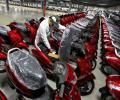
Retail sales of cars are back to January 2018 levels in August 2021. Two-wheeler retail sales are 22 per cent lower, nearly four years down the line.

India's electric mobility goal, which has so far been riding on two wheels, is all set to graduate to four wheels. At least, the journey has begun. Hyundai Motor India said it would invest Rs 4,000 crore till 2028 to launch half-a-dozen electric vehicles (EVs) in India. It would eventually straddle premium and mass segments. The first of these - the electrified version of an internal combustion engine (ICE)-powered model - will go on sale as early as next year.

Japan on Friday extended a state of emergency in Tokyo and other areas by about three weeks to June 20 as the COVID-19 pandemic shows no signs of easing less than two months before the Summer Olympics open.

The Reserve Bank of India's (RBI's) move to ban Mastercard from issuing new cards for not complying with the local data storage guidelines may hit five private banks, a non-bank lender, and a major card-issuing company. The impact is expected to be felt for a few months as these players transition to other card networks. According to Nomura Research, RBL Bank, YES Bank, and Bajaj Finserv are the ones most impacted by the ban as all their credit card schemes are allied to Mastercard. Among others, IndusInd Bank, Axis Bank and ICICI Bank have 35-40 per cent of their credit card schemes tied to Mastercard, the report said.

The company has launched only 3 new products during 2015 when compared to 14 launches in 2014

'When a new superhero film releases, China creates figurines based on the film and puts them out in the market along with the film's release.' 'Does our domestic manufacturing sector been able to do it so quickly? No.' 'We have a large millennial population and we have to make products that are more in line with the tastes of those people.' 'The MSME sector can win back its customers only this way.' 'When they change with the consumers's needs, there will be a move towards Indian products.'

E-vehicles may face pollution hurdle with hazardous batteries. One lithium-ion battery has a potential to poison the whole water aquifer of Delhi.

It expects the Indian market to grow to 10 million units annually by 2030 and it intends to control half the market then, like it does now.

The major reason for the policy confusion over e-vehicles is the lack of conviction within government about the utility of this disruptive technology and its role in India's larger Paris Agreement climate change commitments.
 © 2026 Rediff.com - Investor Information - Advertise with us - Disclaimer - Privacy Policy - Sitemap - Feedback - About us - Terms of use - Grievances