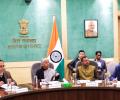
Parliament's Budget Session will be held from January 31 to April 4, with Finance Minister Nirmala Sitharaman set to table her eighth straight budget on February 1. The session will begin with President Droupadi Murmu's address to a joint sitting of the Lok Sabha and Rajya Sabha on January 31, followed by the tabling of the economic survey. The first part of the Budget Session will have nine sittings from January 31 to February 13, after which Parliament will break for recess to examine the budget proposals. The session will reconvene on March 10 to discuss the demands for grants of various ministries and complete the budgetary process, concluding on April 4.

Finance Minister Nirmala Sitharaman on Saturday said Rs 1.5 lakh crore will be provided towards 50-year interest free loans to states, for infrastructure development. Also, an asset monetisation plan will be launched for 2025-30 period to infuse Rs 10 lakh crore capital in new projects.
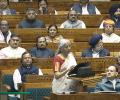
The fiscal deficit for FY25 has been pegged at 4.8 per cent of GDP and at 4.4 per cent for FY26, Finance Minister Nirmala Sitharaman said on Saturday. Presenting the Budget 2025-26, she said net market borrowings are estimated at Rs 11.54 lakh crore for next fiscal year.

'My protest was in the interest of the nation.' 'I am just doing my duty as a citizen of this country.'
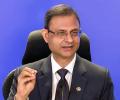
Reserve Bank Governor Sanjay Malhotra on Saturday said that the market forces decide the value of rupee with respect to the US dollar and the central bank is not worried about day-to-day movement of the currency value.

The best solution would be the one followed in 2018 -- allow cost indexation until March 31, 2024 -- but exit at any time. The second-best alternative would be to allow time until March 31, 2025 for investors to exit their investments under the old indexation regime, points out Harsh Roongta.
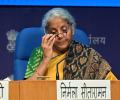
Finance Minister Nirmala Sitharaman on Friday presented the Economic Survey 2024-25 in the Lok Sabha. The Economic Survey is an annual document presented by the government ahead of the Union Budget to review the state of the economy.

Netizens broke out into a meme fest as they welcomed Nirmala Sitharaman's tax break.
Finance Minister Nirmala Sitharaman on Saturday said the GST rates will come down further and the work on rationalising tax rates and slabs has "almost reached a finale". She said that the revenue neutral rate (RNR) has come down from 15.8 per cent at the time of the launch of GST on July 1, 2017, to 11.4 per cent in 2023.
Issues related to the proposed free trade agreement (FTA) and bilateral investment treaty between India and the UK are expected to figure during the three-day visit of Finance Minister Nirmala Sitharaman to London from April 8-10, official sources said. The minister will attend a host of meetings, including the India-United Kingdom Economic and Financial Dialogue, in London.

She said that earlier governments used to sell dreams to people while the present regime is fulfilling the dreams.

Finance Minister Nirmala Sitharaman on Saturday announced the government's plan to transform India into a large logistics organisation with 1.5 lakh rural post offices.

The time limit is proposed to be extended from the current two years to four years.
The government aims to initiate "transformative reforms" across six domains, including taxation and financial sector, in Union Budget 2025-26, Finance Minister Nirmala Sitharaman said on Saturday.

The Indian women's Kho Kho team secured a quarterfinal berth in the Kho Kho World Cup with a dominating 100-16 victory over Iran.
Now that the economy is growing at a higher-than-expected rate, it is time to accelerate the pace of fiscal consolidation, and the Budget could be a good starting point, argues Rajesh Kumar.
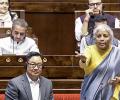
Union Finance Minister Nirmala Sitharaman introduced the Income Tax Bill, 2025, in the Lok Sabha on Thursday and urged Speaker Om Birla to refer it to a select committee of the House. Opposition members opposed the Bill at the introduction stage but the House passed a motion by voice vote for its introduction.
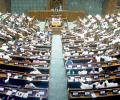
Parliament's approval of the Waqf (Amendment) Bill, a contentious piece of legislation aimed at reforming Waqf bodies, has sparked strong reactions from the opposition, who allege that the bill was "bulldozed" through Parliament. The bill, considered the government's most consequential legislation in its third term, was passed with comfortable majorities in both the Lok Sabha and Rajya Sabha despite opposition claims of a lack of consultation and an intrusion into religious affairs. Other notable bills approved during the session included the Finance Bill, Appropriation Bill, Immigration and Foreigners Bill, and Tribhuvan Sahkari University Bill. The session, which saw high productivity, also witnessed debates on issues such as economic distress, delimitation, and the three-language policy. While the government touted its achievements, the opposition criticized the government's approach and vowed to challenge the Waqf bill in court.

According to a senior officer, during the two-week deadline for surrender of arms and ammunition, a total of 990 arms were surrendered with 11,526 ammunition.
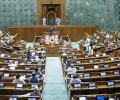
The deportation of Indians from the United States, deaths in the Maha Kumbh stampede and the joint Parliamentary committee report on the Waqf bill were among the issues that led to heated exchanges and some disruptions in an otherwise smooth first part of the Budget session that ended on Thursday.

The resilience of the economy and strength of domestic demand will continue to make India an engine of growth amid the rapidly evolving global trade landscape as a result of US tariffs, Finance Minister Nirmala Sitharaman said in London on Tuesday.
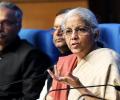
'The voice which came wherever I travelled was that we are proud taxpayers. We are honest taxpayers. We want to continue to serve the country by being good taxpayers.' 'But what do you think about the kind of things you can do for us?'

Real estate developers are hoping that the slew of tax concessions announced in Union Budget 2025, set to take effect this financial year, will spur demand for affordable and mid-segment housing, even as the broader housing market shows signs of fatigue.
'It is not as if Hindus are not being touched at all, and only Muslims are.'

The RBI added roughly 3 tonnes in 2025, taking its gold reserves to 879 tonnes as of January 31, 2025.

'It won't be a V-shaped recovery. It'll be consolidation.' 'Investors might exit during that grind. It'll be painful.'

The President will address both the Houses of Parliament assembled together in the Lok Sabha chamber on Friday and Finance Minister Nirmala Sitharaman will present the General Budget on Saturday.
The interim Budget proposals that will be presented on February 1 in the backdrop of the general elections scheduled in April/May 2024 are likely to have a hint of populism, believe analysts, but are unlikely to derail the government from its path of fiscal prudence.

Finance Minister Nirmala Sitharaman on Saturday presented Union Budget 2025-26, envisaging an expenditure of Rs 50,65,345 crore, an increase of 7.4 per cent over the current fiscal.

The Union Budget 2025-26 has allocated Rs 3,481.27 crore for security-related expenditure (SRE) and the Special Infrastructure Scheme for Left Wing Extremist (LWE) areas. The BJP-led Centre has set a target of March 2026 to end the Maoists menace in the country. The allocation is considered significant in the wake of Union Home Minister Amit Shah's repeated statements that the Narendra Modi government has resolved to end Naxalism in the country by March 2026. This year, till January-end, 40 Naxalites have been killed in separate gunfights in the worst Naxal-hit state of Chhattisgarh. Last year, 219 Naxalites were neutralized by security forces in separate encounters in Chhattisgarh. Six Maoists were killed in Odisha in 2024, while eight were arrested and 24 had surrendered. According to the home ministry's data, 48 Naxals have so far been killed this year in all Naxal-affected states, 290 were killed in 2024 and 50 in 2023. The government has also established 290 camps of security forces in Naxal-affected areas since 2019 and 88 more are proposed to be set up in 2025.

Opposition MPs in India's Rajya Sabha raised concerns about US President Donald Trump's tariff threats, demanding the government clarify its response and engage in discussions with opposition parties. Leaders like P Chidambaram and Sagarika Ghose warned of potential economic repercussions, including depressed exports, lower FDI, and a significant tariff burden. The debate also touched on other issues such as the government's economic policies, demonetization, and the impact of GST on common citizens.
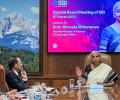
Finance Minister Nirmala Sitharaman on Saturday said India is looking for a "good" trade agreement with the US to promote economic growth and ensure smooth supply chains. She also said that amid a growing global tariff war, India will have to move "smartly" to guard against possible dumping of goods from countries that are facing higher US tariffs.
Prime Minister Narendra Modi has lauded the Union Budget as a "people's budget" that fulfills the dreams of every Indian and said that it is a "force-multiplier" that will boost consumption, investment and growth. He highlighted a host of measures for different sectors, including welfare initiatives for gig workers, tax relief for the middle class, and support for the manufacturing sector.
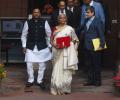
Finance Minister Nirmala Sitharaman on Saturday unveiled 'transformative' tax reforms that ranged from a simpler income tax law to higher TCS threshold for remittances and income tax benefits for middle class.

Finance Minister Nirmala Sitharaman on Monday said action will be taken in case there are violations of well laid down processes for auctioning of gold by banks and NBFCs when a borrower fails to pay the gold loan. During Question Hour in Lok Sabha, she said Non Banking Financial Companies (NBFCs) and Scheduled Commercial Banks (SCBs) are guided by similar rules.

The government will introduce a new Income Tax bill next week to take forward the "trust first, scrutinise later" concept, Finance Minister Nirmala Sitharaman said on Saturday. In another major reform move, the minister announced that the Foreign Direct Investment (FDI) in the insurance sector will be increased to 100 per cent from 74 per cent.

'The answer is not for me to give. The answer either way has to be heard from the industry itself. Tell us why not if you are not doing it; tell us if you are doing it -- why should this question remain unanswered?'

As per the Budget memorandum, the government has proposed amendment to Sub-Section 2 of Section 23 of Income Tax Act, which relates to determination of annual value of house properties.

For every rupee in the government coffer, the biggest pie of 66 paise will come from direct and indirect taxes, according to the Union Budget 2025-26 documents. Around 24 paise will come from borrowings and other liabilities, 9 paise from non-tax revenue like divestment, and 1 paise from non-debt capital receipts, the Budget documents said.

Anticipating US action on tariffs, India seems to have made the first move by revamping its tariff structure by reducing the slabs to eight rates, points out Mukesh Butani.
 © 2026 Rediff.com - Investor Information - Advertise with us - Disclaimer - Privacy Policy - Sitemap - Feedback - About us - Terms of use - Grievances