
The mood in Delhi is this: Seal the deal when Bush is around, for who knows what the Democrats will demand?

Former Under Secretary of State Nicholas Burns, who was the star diplomat in the Bush Administration who negotiated the Indo-US civilian nuclear deal, has rubbished Pakistan's request for a similar accord saying the A Q Khan network was the mother of all nuclear technology proliferators and said Pakistan's concerns over India's involvement in Afghanistan are over-rated.
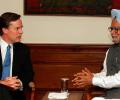
The India-US nuclear deal was aimed at ending India's nuclear isolation and nuclear apartheid, recalls Rup Narayan Das.
Dr Anil Kakodkar, chairman of India's Atomic Energy Commission and his agency was the 600-pound gorilla in the room that vetoed the compromise language on the stalled bilateral civilian nuclear cooperation accord, known as the 123 Agreement.

The Chinese army's Eastern Theatre Command stated in a terse statement that it had conducted 'combined combat readiness patrols and joint firepower strike drills' surrounding Taiwan.

Garcetti, 50, who served as the co-chair of Biden's presidential campaign, was initially considered for the Cabinet.
The relationship between New Delhi and Tehran has caused some concern on Capitol Hill.

China on Wednesday said it will take "strong and effective" countermeasures against the US and Taiwan for violating the "One-China policy", as the US House of Representatives Speaker Nancy Pelosi successfully completed her visit to Taipei disregarding Beijing's vociferous threats.

China urged the US to immediately address its wrongdoings, take practical measures to undo the adverse effects caused by Pelosi's visit.

A former top American diplomat, considered to be the architect of the Indo-US civilian nuclear deal, on Friday urged US President Barack Obama to reach out to India's prime minister-designate Narendra Modi for an early meeting.

China has been an aggressor against India along the Himalayan border, a top American diplomat nominated by President Joe Biden as his next envoy to Beijing has told lawmakers, stating that the US must hold the Chinese government accountable for failing to play by the rules.

One Chinese source informed ANI that 10 million new infections are probably occurring daily in China.
Noting India's strategic importance in American efforts to limit the Chinese influence, a former top diplomat on Friday said the United States should include New Delhi in its East Asia policy.
Karl F Inderfurth, who was Assistant Secretary of State for South Asian Affairs in the Clinton administration, and Nicholas Burns, who was Under Secretary of State in the Bush Administration, told rediff.com that Obama's endorsement during his address to a joint session of Parliament thus made his visit to India transformational too in a sense as had the trip by Clinton in March of 2000 and Bush in March 2006.
Nicholas Burns, the lead negotiator on the US-India nuclear deal in the Bush administration, has said that Washington must reassure New Delhi that it is a "valued strategic partner."
In a scathing indictment of the nuclear liability bill passed by Indian Parliament, Nicholas Burns, former under secretary of state in the Bush administration, has warned that if the bill was not amended it could sound the death knell of the historic Indo-US nuclear deal and adversely impact on the envisaged US-India strategic partnership.
Former Indian Foreign Secretary, Shyam Saran will headline a major conference this week on the expectations and consequences of the US-India Nuclear Agreement, hosted by The Brookings Institution,
Among key Congressional leaders, the Foreign Secretary met included Jim McDermott, co-chair of the India caucus at the Congress; Howard L Berman, Chairman of House Committee on Foreign Affairs; and Senator Richard Lugar, Ranking Member of the powerful Senate Committee on International Relations

Trump offered to be the "mediator" between India and Pakistan on the Kashmir issue as he met Prime Minister Imran Khan at the White House.
'Pakistan,' says former US Under Secretary of State for Political Affairs R Nicholas Burns, 'has an obligation to work with India and to give India the type of support needed to ensure that these types of attacks will not occur again. Therefore you cannot hide behind the definition of non-state actors. Every government has a responsibility to control the situation on its own territory. India needs the kind of reassurances from Islamabad that has not yet been forthcoming.'
Former foreign secretary Shyam Saran, who was the original Indian interlocutor of the US-India civilian nuclear deal negotiations with erstwhile US Under Secretary of State for Political Affairs Nicholas Burns, is unapologetic about his recent remarks at the India Habitat Centre lecture series in New Delhi which left many foreign policy experts both in India and the US puzzled.
India is particularly interested in modifying provisions pertaining to conditional access to fuel reprocessing and caveats about future nuclear tests
Burns was responding to the opening remarks by Senator John F Kerry, Massachusetts Democrat, who said it was imperative that the United States "...must consider Pakistan's relationship with India, especially when it comes to Kashmir."
Both sides, however, refused to provide a timeline.
'This nuclear agreement is a sign for the rest of the world of the great American respect for India,' says US Under Secretary of State R Nicholas Burns.
Part of the focus of the current discussions is also on the "next steps" that are involved in the civilian nuclear initiative such as status of India's negotiations with the International Atomic Energy Agency on India-specific safeguards and the NSG
According to sources in the Ministry of External Affairs, the text will be simultaneously released in Washington and New Delhi.
US Under Secretary of State for Political Affairs Nicholas Burns -- the chief interlocutor of the US-India civilian nuclear deal -- who will resign in March, has said he is elated that India has asked its Ambassador to Washington Ronen Sen to stay on for another year, describing it as "good karma".
Venkayya, who announced that he will join the Bill and Melinda Gates Foundation, becomes the second Indian American to walk away, following close on the heels of Karan Bhatia, who resigned as deputy United States trade representative in October.
Burns said, "We'll continue to watch India's relations with Iran, and we'll obviously respond very respectfully to any concerns by members of our own Congress as we should do."
US Undersecretary of State for Political Affairs Nicholas Burns will resign, a senior US official said on Friday.
No dilution of language in the House and Senate bills is likely during the House-Senate conference that will meet on the United States-India civilian nuclear agreement when Congress reconvenes this week.
"We hope that India, as well as all other states -- China, Russia, France, Britain and Japan -- will diminish their economic relations with Iran," US Under Secretary of State Nicholas Burns said.
Nicholas Burns noted that the Administration had been informed the Senate and House would meet in the early part of December to reconcile both bills.
In what diplomatic observers have described as "a make or break" round of negotiations, senior US and Indian officials held several hours of intense discussions at the State Department on Tuesday in an attempt to seal the 123 Agreement.
White House Deputy Press Secretary Tony Fratto was asked in his briefing as to where the two sides stand on the accord, given that Washington's pointsman for the deal, Under Secretary of State for Political Affairs Nicholas Burns, is scheduled to depart the State Department by the end of March. "We'll continue our cooperation in order to achieve that goal of getting the agreement completed," Fratto said.
It will end India's nuclear isolation, he noted. Ahead of his visit here, Burns said last week that 90 per cent of the work has been completed and he would be making the "final effort".
 © 2026 Rediff.com - Investor Information - Advertise with us - Disclaimer - Privacy Policy - Sitemap - Feedback - About us - Terms of use - Grievances