The Reserve Bank of India on Wednesday retained the economic growth projection for the current financial year at 10.5 per cent, while cautioning that the recent surge in COVID-19 infections has created uncertainty over the economic growth recovery. In its last policy review, the RBI had projected a GDP growth rate of 10.5 pc for FY'22. Taking various factors into consideration, it said, "the projection of real GDP growth for 2021-22 is retained at 10.5 per cent consisting of 26.2 per cent in Q1, 8.3 per cent in Q2, 5.4 per cent in Q3 and 6.2 per cent in Q4."

The economy, though projected to grow 9.6 per cent in the next financial year in year-on-year growth term, may grow just 1 per cent in real terms to Rs 147.17 lakh crore as against Rs 145.66 lakh crore in 2019-20, at the 2011-12 prices, according to a report by India Ratings. The size of the economy, as per the National Statistical Office's data, had stood at Rs 145.66 lakh crore in 2019-20, at the 2011-12 prices. According to the rating agency, the country's gross domestic product (GDP) is expected to contract 7.8 per cent to Rs 134.33 lakh crore in 2020-21, but may grow 9.6 per cent to Rs 147.17 lakh crore in 2021-22.

The report on 'Household Social Consumption: Education in India as part of 75th round of National Sample Survey -- from July 2017 to June 2018' provides for state-wise detail of literacy rate among the persons aged seven years and above.

India's industrial production grew by 1 per cent in December, official data showed on Friday. According to the Index of Industrial Production (IIP) data, the manufacturing sector output grew by 1.6 per cent in December 2020.

BSE-listed companies' market capitalisation reached Rs 197.7 trillion on January 21, against India's nominal GDP of Rs 190 trillion during 12 months ended December 2020.

Macroeconomic management is usually a lot more comfortable with lower fiscal deficits. The sooner we get there, the better for the economy, says former Chief Economic Adviser to the Government of India Shankar Acharya.
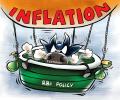
The RBI, which mainly factors in CPI for arriving at its bi-monthly monetary policy, has been mandated by the government to ensure that inflation remains at 4 per cent, with deviation of 2 per cent on either side.

There should have been a focus on sanitation and not on littering or garbage. Absence of sanitation affects the health of children, explains Aakar Patel.

The Reserve Bank's growth projection for next financial year is lower than 8-8.5 per cent projected by the finance ministry in the recent Economic Survey which was tabled in Parliament on January 31. Unveiling the bi-monthly policy, RBI governor Shaktikanta Das said, "Recovery in domestic economic activity is yet to be broad-based, as private consumption and contact-intensive services remain below pre-pandemic levels."

Most rating agencies had projected contraction in India's GDP for the first quarter of 2020-21.

As per use-based classification, primary good registered a growth of 7.4 per cent, intermediate goods 22.4 per cent, and infrastructure/construction goods 0.1 per cent in February 2020 as against the same period a year ago.

Pushed by rising prices of essential kitchen items, the retail inflation rose to an eight-month high of 7.34 per cent in September, making the RBI's task to push growth by reducing the interest rate even more difficult in coming the days. The Consumer Price Index (CPI)-based inflation was 6.69 per cent in August and 3.99 per cent in September 2019. Inflation has been hovering above 4 per cent since October 2019.

GVA growth in the manufacturing, farm and construction sectors tumbled.

The substantially increased economic dualism may exert lasting negative influences which could include a reduced potential for economic growth; the persistence of a very weak employment and poverty situation; rising social and political discord; and heightened vulnerability to geopolitical challenges, cautions Shankar Acharya, former chief economic adviser to the Government of India.

Expect a more modest out-turn of around 5 per cent (if not less) because of the longer-term scarring effects of the Covid shock, the sharply slowing growth in the pre-Covid years and some scepticism about the growth-efficacy of some of recent official policy initiatives, explains Shankar Acharya, former chief economic advisor to the government.
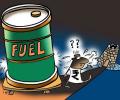
The wholesale price-based inflation accelerated to a record high of 12.94 per cent in May, on rising prices of crude oil and manufactured goods. Low base effect also contributed to the spike in WPI inflation in May 2021. In May 2020, WPI inflation was at (-) 3.37 per cent. This is the fifth straight month of uptick seen in the wholesale price index (WPI)-based inflation. In April, 2021, WPI inflation hit double digit at 10.49 per cent. "The annual rate of inflation, based on monthly WPI, was 12.94 per cent for the month of May, 2021 (over May, 2020) as compared to (-) 3.37 per cent in May 2020.

Is the worst over for Indian banks? The past two years saw them ride on treasury trades as deposits soared and credit growth dipped sharply. Gross and net non-performing assets (NPAs) moved south, and the provision coverage ratio (PCR), capital buffers, and profitability indicators are back at pre-pandemic levels. So, what's the plot ahead?

India's industrial production contracted by 3.6 per cent in February, official data showed on Monday. According to the Index of Industrial Production (IIP) data released by the National Statistical Office (NSO), manufacturing sector output declined by 3.7 per cent in February 2021. Retail inflation rose to 5.52 per cent in March, mainly on account of higher food prices, government data showed on Monday. The consumer price index (CPI) based retail inflation stood at 5.03 per cent in February.
The NCEAR has indicated some improvement in the fourth quarter of the current financial year.

To enable widen the fiscal deficit beyond the permissible limit under the present legislation, the government may have to propose amendment to the FRBM Act in the Finance Bill.
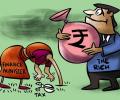
While the tax-to-GDP ratio of 9.88 per cent has been assumed for FY21, the same as last year, when it touched a decadal low, for FY22 a ratio of 10.7 per cent has been assumed, an average of the last five years.

India's GDP estimates for 2020-21 show that the economy is expected to perform much better than earlier projections by different agencies, indicating a sustained V-shape post-lockdown recovery, experts said. The first Advance Estimates (AE) by the National Statistics Office (NSO) has projected a contraction of 7.7 per cent in the real GDP during 2020-21. This was better than the projections by certain international agencies like the IMF and World Bank.

However, the government has enacted an important change to the fixed-term employment framework that may help companies in handing out contractual jobs to its existing permanent workforce.

India's factory output climbed 22.4 per cent in March, benefiting from the base effect of the lockdown-marred month a year back as well as a turnaround in the manufacturing sector, while retail inflation slipped to a three-month low of 4.29 per cent in April. The high positive annual growth in the index of industrial production (IIP) in March 2021 came on back of a contraction of (-)0.9 per cent and (-)3.4 per cent in January and February 2021 respectively, according to the data released by the National Statistical Office (NSO) on Wednesday. This turnaround was led by recovery in the mining, manufacturing and electricity sectors.

Experts warn of over-interpreting the numbers and said their sustainability needed to be watched beyond November, says Indivjal Dhasmana.

'This encourages escapism through the politics and economics of nationalism, made worse by tribalism or nativism, the package accompanied inevitably by the erosion of institutional bulwarks and therefore State capture by powerful businessmen,' notes T N Ninan.

The Seventh Pay Commission had decided to choose the CPI-IW as the index for adjusting inflation for central government employees.

India's economy grew by 1.6 per cent in the fourth quarter of 2020-21, restricting the full-year contraction to 7.3 per cent, official data showed on Monday. The fourth quarter growth was better than the 0.5 per cent expansion in the previous October-December quarter of 2020-21. The gross domestic product (GDP) had expanded by 3 per cent in the corresponding January-March period of 2019-20, according to data released by the National Statistical Office (NSO).

India's likely medium-term potential growth will almost certainly be markedly lower than that experienced in pre-pandemic years, warns Shankar Acharya, former chief economic advisor to the Government of India.
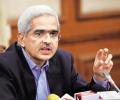
Softening inflation, Das said would make available more policy space to the central bank to address risks to the growth going forward.

Declining vegetable prices brought down the retail inflation to a 15-month low of 4.59 per cent in December and within the comfort zone of the Reserve Bank, government data showed on Tuesday. It is for the first time during the current fiscal that the Consumer Price Index (CPI) based inflation print is below 6 per cent or in the RBI's target range of 2 to 6 per cent. The central bank factors in the CPI-based inflation while arriving at its monetary policy. The inflation in December 2020 came down from 6.93 per cent in November, mainly on account of 10.41 per cent decline in vegetable prices over the year-ago period.
During the six-month period (April-September 2019), the Indian economy grew 4.8 per cent as against 7.5 per cent in the same period a year ago.

India's economy recovered faster than expected in the September quarter as a pick-up in manufacturing helped GDP clock a lower contraction of 7.5 per cent and held out hopes for further improvement on better consumer demand. The gross domestic product (GDP) had contracted by a record 23.9 per cent in the first quarter of the 2020-21 fiscal (April 2020 to March 2021) as the coronavirus lockdown pummelled economic activity.

After contracting for two quarters in a row, the Indian economy entered the positive territory with a growth of 0.4 per cent in the October-December quarter, mainly due to good performance by farm, services and construction sectors, official data showed on Friday. Trade and hotel industry registered a contraction of 7.7 per cent during the third quarter this fiscal, as the sectors continued to suffer on account of coronavirus pandemic. According to the data released by the National Statistical Office (NSO), the farm sector recorded a growth of 3.9 per cent, and the manufacturing sector output grew by 1.6 per cent in the quarter under review.

India's GDP is estimated to contract by a record 7.7 per cent during 2020-21 as the COVID-19 pandemic severely hit the key manufacturing and services segments, as per government projections released on Thursday. Amid overall decline in economic activities, some respite was provided by the agriculture sector and utility services like power and gas supply, which have been projected to post positive growth during the current fiscal ending March 2021.
Risk aversion is currently a dominant depressant to economic recovery, points out Shankar Acharya, former chief economic advisor to the Government of India.
RBI Governor Shaktikanta Das on Friday said that inflation is on a declining trajectory, as it has fallen by 170 basis points from its January 2020 peak. Retail inflation fell to four-month low of 5.91 per cent in March over the previous month, mainly due to easing food prices.

Beside manufacturing, deceleration was also witnessed in sectors like agriculture, construction and electricity, gas and water supply.

Going forward, the February factory output may be impacted as several industries such as automobiles, technology, pharma and fashion have some exposure to imports of raw and intermediate materials from China.

If the government cuts wasteful expenditure as it is trying now, the deficit would at most fall to 8 per cent, not less than that.
