
Maruti Suzuki sold more cars than ever before, earned more money, and saw many first-time buyers choosing small cars again.

The operating performance of the country's largest passenger carmakers, Maruti Suzuki India (MSIL) and Hyundai Motor India (HMIL), in the July-September quarter (Q2) of 2025-26 (FY26) outpaced brokerage expectations.

'The market is still very bullish. The demand is so strong that for eight models, we have no units in our factories to dispatch to dealers,' said Partho Banerjee, senior executive officer, marketing & sales, Maruti Suzuki India (MSIL).

Since the Indian government reduced GST on small cars on September 22, the small car segment's share in Maruti's overall sales has risen to more than 25 per cent, up from 16.6 per cent earlier in FY26.

A deep split has emerged within India's auto industry over the proposed CAFE exemption for small cars, with only Maruti Suzuki and Renault backing the move in the final SIAM vote.

'In the January-August period, the share of hatchback in the overall PV industry sales was about 22.4 per cent. In the September-October period, the share of hatchbacks has come down to 20.4 per cent. In just October, their share was just 20 per cent. This is simple wholesale data from industry body SIAM.'

'If the targets become unscientific and unjust, Then, just to meet CAFE-III regulation, a small car -- which produces a very low absolute carbon dioxide -- will have to be discontinued.'

Automotive (auto) stocks have been among the best performers in the BSE 200 index in recent months. More than half of the top 15 gainers over the past one, two, and three months have come from the sector.

'We are seeing a lot of people with helmets visiting our showrooms.'
The growing rift between MSIL and rival automakers has complicated the government's efforts to finalise the CAFE norms.

Maruti Suzuki India (MSIL) said on Thursday its operations are unaffected by the global rare earth magnet shortage, but added that the situation is "uncertain and evolving". The firm said it is exploring multiple solutions to maintain continuity in operations and will notify stakeholders in case of material impact.

The January-March quarter (Q4) results for 2024-25 (FY25) from the country's largest passenger vehicle (PV) maker, Maruti Suzuki India (MSIL), were a mixed bag, with revenues broadly in line but operating profit missing Street expectations. Given cost pressures, margins at the operating level were the lowest in the past seven quarters.

Sluggish urban demand, a high base effect, and weak sales of hatchbacks and sedans weigh down passenger vehicle sales in FY25.

Car purchases in India are largely limited to the top 12 per cent of households with an annual income exceeding Rs 12 lakh, while even small cars have become unaffordable for the remaining 88 per cent, said R C Bhargava, chairman of Maruti Suzuki India Limited (MSIL), on Friday. "How can you get high car sales growth if 88 per cent of the country are below the levels of income where they cannot afford these cars costing Rs 10 lakhs and above?
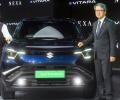
MSIL, which currently has a subscription service that allows customers to lease its petrol-run and strong hybrid vehicles on a flexible, long-term basis without ownership commitments, will introduce a leasing service as well.

However, the company has not provided a timeline for the launch of the small electric car.
Tata Motors is the leader in the electric car market with about 62 per cent share.

Maruti Suzuki India Ltd (MSIL), the largest passenger vehicle manufacturer in India, has set a road map to expand its global presence by targeting exports of 800,000 units by the end of this decade -- almost double the approximately 280,000 units sent abroad in 2023-24, Rahul Bharti, executive director, corporate affairs, told Business Standard. The company's upcoming electric vehicle (EV) strategy is expected to play a crucial role in its global ambitions.
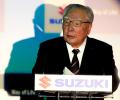
'Without his vision and foresight, his willingness to take a risk that no one else was willing to take, his deep and abiding love for India, the Indian automobile industry could not have become the powerhouse that it has become.'
Maruti Suzuki India (MSIL) plans to open new Arena Satellite showrooms as the country's largest carmaker aims to tap small towns and new markets, said a senior company executive, amid signs of recovery in rural demand and an approaching festival season. Senior executive officer for marketing and sales MSIL, Partho Banerjee, told Business Standard the company was aiming to penetrate deeper into markets and reach closer to its customers. "We have already had a concept of mobile showrooms in the Arena channel.

Risks emerging from the US have left automotive investors worried. US President Donald Trump has announced 25 per cent tariffs on automotive imports, while global electric carmaker Tesla has taken its first steps towards entering India. While these developments are sentimentally negative for related stocks, it may be too early to conclude the eventual impact, analysts said.

After a successful tie up in traditional ICE and strong hybrid models, Suzuki and Toyota are now set to take their partnership to the next level: the electric vehicle segment. Both the Japanese auto giants recently announced a plan to produce Suzuki eVX-based SUV which will be sold under Toyota brand across the globe. This electric SUV, bearing Toyota's logo, will go for production at Suzuki Motor Group (SMG) facility in Hansalpur, Gujarat beginning the spring of 2025, marking the first EV launch for both companies in India.

Auto majors report positive sales figs for November.
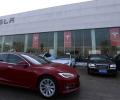
Tesla needs to either sell the same models with reduced features to lower the cost for Indian market, or incur losses.

India's used car market, which has been growing steadily at 10-12 per cent over the last 2-3 years, is expected to reach $40 billion in FY26.

Hyundai Motor India (HMIL) raised Rs 8,315 crore from anchor investors on Monday, setting the stage for the country's biggest-ever maiden share sale. The Indian arm of the South Korean carmaker Hyundai Motor Company (HMC) allotted 42.4 million shares to 225 funds at Rs 1,960 apiece, the higher end of its price band. Among the investors receiving allotments were the Singapore government's sovereign wealth fund (GIC), New World Fund, and Fidelity.
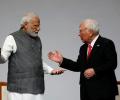
Osamu Suzuki, the man who took a risk and bet on India when no one else believed in having a viable automobile company in the country, has died at the age of 94, according to information shared by Japan's Suzuki Motor Corporation on Friday.

For the first time, the event will take place across three locations in Delhi: Bharat Mandapam at Pragati Maidan, Yashobhoomi Convention Centre at Dwarka, and India Expo Mart at Greater Noida.
Indian passenger vehicles market registered record wholesales of 43 lakh units in 2024, with companies like market leader Maruti Suzuki, Hyundai, Tata Motors, Toyota Kirloskar Motor, and Kia posting their best-ever annual domestic sales. The continued growth of SUVs, along with rural markets playing a key role in driving up car sales, helped the industry better the previous best of nearly 41.1 lakh units posted in 2023.

India's second-largest passenger vehicles firm will be valued at Rs 1.59 trillion at the top-end of the price band of Rs 1,865-Rs 1,960.

Sedans and hatchbacks have both lost market share to SUVs, which now account for more than 50% share of the 4 million-odd-unit PV market in the country.

Toyota Kirloskar Motor (TKM) has reported a consolidated net profit of Rs 4,787 crore for 2023-24 (FY24) - more than three times the earnings recorded the previous year. This growth can be attributed to robust demand for its vehicles, particularly hybrid models and cross-badged cars from the Toyota-Suzuki alliance.

The board of Maruti Suzuki India (MSIL) on Tuesday approved a proposal to issue shares worth Rs 12,841 crore to parent company Suzuki Motor Corporation (SMC) for acquiring Suzuki Motor Gujarat (SMG). The Gujarat manufacturing plant - with an annual capacity of 750,000 units - is owned by SMG, a wholly-owned subsidiary of SMC. The shares issued to SMC will raise its ownership in MSIL from 56.48 per cent to 58.19 per cent--India's largest carmaker stated in a notice to BSE.
Maruti Suzuki India (MSIL) has ambitious plans to increase capacity. It is also seeking shareholders' approval for a complex swap transaction, which would acquire Suzuki Motor Gujarat (SMG), a subsidiary of Suzuki Motor Corporation (SMC) through a preferential offer. SMC already holds 56.37 per cent of MSIL's equity.

Maruti Suzuki India (MSIL) will hold discussions with the Centre and state governments on how the production of compressed biogas (CBG), which can be used in vehicles that run on compressed natural gas (CNG), can be expanded in the country, its majority shareholder Suzuki Motor Corporation (SMC) said. The demand for CNG vehicles has been rising significantly in the country. MSIL sold 145,000 CNG vehicles in the first quarter of 2024-25, marking a 28.3 per cent year-on-year (Y-o-Y) growth.

...But sales of domestic passenger vehicles dropped 2% to 3% year-on-year in August owing to low demand.

Compact sedans (Maruti Dzire, Hyundai Aura, Tata Tigor)' share in the overall sedan category grew from 68% in 2021 to 74.6% in 2024. Mid-sedans' (Honda City, Maruti Ciaz, Volkswagen Virtus) share declined from 26.2% in 2021 to 20.2%.

The average car price in India has increased rapidly in the last 5-6 years due to new emission regulations and demand for more spacious and comfortable cars loaded with advanced technology.

Maruti Suzuki India (MSIL) will issue equity shares on a preferential basis to parent Suzuki Motor Corporation (SMC) to acquire 100 per cent stake in the latter's Gujarat plant. This deal is expected to increase the share base of MSIL by about 4 per cent. And consequently, it will raise SMC's shareholding in Maruti by around 1.8 percentage point. "Whether it is in terms of PAT (profit after tax) or earnings per share (EPS) or dividend per share (DPS) of MSIL, the share-swap option will give shareholders a better deal than any other option such as cash payment," MSIL chairman RC Bhargava told reporters during a press conference.

Tata Motors surpassed Maruti Suzuki (India) (MSIL) to become the most-valuable automobile company, in terms of market capitalisation (mcap), after a gap of seven years. With this, the company's stock hit a new high on the BSE on Tuesday (January 30). The combined mcap of Tata Motors (Rs 285.51 crore) and Tata Motors DVR (Rs 29,119 crore) stood at Rs 3.146 trillion.
 © 2026 Rediff.com - Investor Information - Advertise with us - Disclaimer - Privacy Policy - Sitemap - Feedback - About us - Terms of use - Grievances