
Moody's Investors Service on Tuesday slashed India's growth forecast for the current financial year to 9.3 per cent saying that the second wave of coronavirus infections hampers economic recovery and increases risk of longer-term scarring. Moody's, which has a 'Baa3' rating on India with a negative outlook, said obstacles to economic growth, high debt and weak financial system contrain sovereign credit profile. The US-based rating agency had in February forecast a 13.7 per cent economic growth for the current fiscal (April 2021-March 2022).

India's CLI has been on the rise since October 2014.

The NSE 50-share after moving between 10,309.85 and 10,261.50 on alternate bouts of selling and buying, finished at 10,298.75, with paltry gains of 15.15 points, or 0.15 per cent.

Chief Economic Advisor Krishnamurthy Subramanian said India's economy will witness a decline in the current fiscal, but the drop will be limited if there is an economic recovery in the October-March period.

For 2020 calendar year, it reduced the estimate by a similar measure to 6.7 per cent.

Fitch Ratings director Thomas Rookmaaker said India's debt-to-GDP ratio is likely to rise to 76 per cent from 70 per cent currently due to wider fiscal deficit and low economic growth.

Reliance is in the market with a benchmark issue to sell 30-year US dollar-denominated Reg S fixed rate senior unsecured notes.

The government's second round of stimulus will spur consumer spending in the near term but support to economic growth will be minimal, Moody's Investors Service said.

Moody's Investors Service on Thursday downgraded subordinated debt ratings of 11 Indian banks, including SBI, ICICI Bank and HDFC Bank.

Steel firms brace for good times on the back of better demand.

The report did not specify the impact the rate hike will have on India.

The Reserve Bank of India (RBI) cut its key repo rate by a bigger-than-expected 50 basis points.

Speaking at industry association CII's annual session, PM Modi said the government has taken tough steps to fight the coronavirus pandemic and has also taken care of the economy. "On the one hand we have to safe the lives of our people and on the other hand we have to stabilise the economy and speed up the economy," he said. "Yes, we will definitely get our growth back," he asserted.

Finance Minister Arun Jaitley presented his maiden budget last week in which he vowed to contain fiscal deficit at 4.1 per cent this year and lower it to 3 per cent by 2016-17.
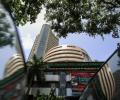
Market sentiment suffered a jolt after other Asian markets closed with widespread losses and European markets dropped in early trade

Earlier this month, Parliament approved the Insolvency and Bankruptcy Code, 2016.

Billionaire Mukesh Ambani's Reliance Industries has announced the contours of carving out of its oil-to-chemicals (O2C) business into an independent unit with a USD 25 billion loan from the parent, as it looks to unlock value by selling stakes to global investors like Saudi Aramco.

Country's biggest lender State Bank of India had proposed merger of five associate banks.
Moody's assigns 'Baa3' rating on India, with a stable outlook.

India would be a major beneficiary of softer oil prices among the G20 economies as the country is a major crude importer.

The country's GDP grew at the fastest pace in seven quarters at 7.7 per cent in the January-March period, retaining the fastest growing major economy tag on robust performance by manufacturing and service sectors as well as good farm output.

Moody's said it reflects India's weaker performance on fiscal.
Moody's Investors Service on Friday slashed its estimate of India's GDP growth during the 2020 calendar year to 2.5 per cent from an earlier estimate of 5.3 per cent, on account of the rising economic cost of the coronavirus pandemic.

For 2021-22, it projected the economy to clock a growth of 10.6 per cent.

Moody's, which cut its FY14 growth estimate to 4.5 per cent recently, said economic growth will be lowest in a decade.

Credit rating agencies have been raising red flag over high debt to GDP ratio of India.

India's GDP is estimated to contract by a record 7.7 per cent during 2020-21 as the COVID-19 pandemic severely hit the key manufacturing and services segments, as per government projections released on Thursday. Amid overall decline in economic activities, some respite was provided by the agriculture sector and utility services like power and gas supply, which have been projected to post positive growth during the current fiscal ending March 2021.

Moody's on Monday slashed India's growth forecast for 2020 to 5.4 per cent from 6.6 per cent projected earlier, on slower than expected economic recovery. In its update on Global Macro Outlook, Moody's Investors Service said India's economy has decelerated rapidly over the last 2 years and economic recovery is likely to be 'shallow'.

Moody's Investors Service on Friday said India's economy is expected to contract for the first time in more than four decades saying economic damage owing to the coronavirus-induced lockdown will be significant with lower consumption and sluggish business activity. Even before the coronavirus outbreak, Indian economy already was growing at its slowest pace in six years and with the stimulus measures announced by the government falling short of expectations, the disruptions are likely to be greater. "We now expect India's growth to register a real GDP contraction for the fiscal year ending in March 2021 (fiscal 2020-21), from our earlier projection of zero growth," it said in a research note.

Pointing out that these recent measures are incremental rather than radical, Moody's said, these steps will sustain higher gross domestic product growth and address some of the constraints on the country's sovereign credit profile.

The agency noted that the reviews of these banks' sub-debt ratings were not indication of any change in the affected banks' fundamental credit quality.

Moody's expects macroeconomic policies to contribute to sustained robust growth.

S&P Global Ratings has forecast India's economy to shrink by 5 per cent in the current fiscal. It, however, has projected GDP growth to be 8.5 per cent in 2021-22 and 6.5 per cent in 2022-23.
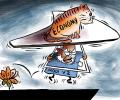
India's growth outlook has weakened sharply this year, with a crunch that started with the non-banking finance institutions spreading to retail businesses, car-makers, home sales and heavy industries.

Moody's on Thursday said the new 'inflation targeting' mechanism is a "credit positive" move.

Bank shares were the top gainer in early trades with Bank of Baroda up over 4%.
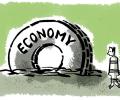
Moody's Investors Service on Friday projected India's growth at zero per cent for the current fiscal and said the negative outlook on sovereign rating reflects increasing risks that GDP growth will remain significantly lower than in the past. The outlook also partly shows weaker policy effectiveness to address economic and institutional issues, it noted in the update to its November 2019 rating forecast.
.jpg)
The depreciation of the rupee, it said, reflects the wider CAD as well as lower net capital inflows.

The world's biggest lockdown that shut a majority of the factories and businesses, suspended flights, stopped trains and restricted movement of vehicles and people, may have cost the Indian economy Rs 7-8 lakh crore during the 21-day period, analysts and industry bodies said.

Moody's said the asset quality of the banks will remain under pressure.
 © 2026 Rediff.com - Advertise with us - Disclaimer - Privacy Policy - Sitemap - Feedback - About us - Terms of use - Grievances