
The spike in food prices at the onset of the monsoon season has corroborated the Reserve Bank of India's (RBI's) view that the fight against inflation is far from over, the State of the Economy report of the central bank said. At the same time, the report said that the country is poised to become the fastest-growing major economy in the world, notwithstanding some sequential moderation in economic activity in June. Consumer Price Index (CPI)-based inflation rate increased to 4.8 per cent in June 2023, from 4.3 per cent in May, primarily on account of an increase in food inflation.
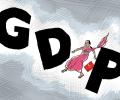
The Reserve Bank of India on Friday slashed the growth projection to 7 per cent for the current fiscal from the earlier forecast of 7.2 per cent, citing aggressive tightening of monetary policies globally and moderation in demand. Unveiling the fifth monetary policy for this fiscal, RBI Governor Shaktikanta Das said the central bank remains committed to price stability to put the country on the sustained path of growth.

Only investors with a higher risk appetite should enter these funds.

There hasn't been any dramatic moment in the first act (the Budget) but nobody would complain. It's par for the course as long as the figures don't change in the main Budget, which will be presented after general elections.

Retail inflation declined to a three-month low of 5.1 per cent in January, mainly due to subdued prices of vegetables, fruits and other food items, according to government data released on Monday. The fall indicates that retail inflation is inching towards the Reserve Bank's comfort level of 4 per cent. The Consumer Price Index (CPI) based inflation was on the rise for two straight months after touching a trough of 4.9 per cent in October 2023. In December, it stood at 5.69 per cent.
GDP growth of 7.7 per cent in the first half of this fiscal has "left sceptics gasping and woefully behind the curve", an RBI article said on Wednesday. It also stressed the buildup in the growth momentum is likely to be sustained. The article on the state of the economy published in the Reserve Bank's December Bulletin on Wednesday also said CPI-based retail inflation is expected to ease to 4.6 per cent in the first three quarters of 2024-25 from 5.6 per cent in November.

Interim Budget, the US Federal policy decision and quarterly earnings will be the major drivers for stock markets which may also see some consolidation this week, say analysts. Besides, investors would also focus on the trading activity of foreign investors and global trends for further cues. From the macroeconomic front, the PMI (Purchasing Managers' Index) data for the manufacturing sector is scheduled to be announced on Thursday.

'India is an equity market with a breadth and depth of companies to invest in.'

The Reserve Bank of India on Thursday opted for a pause second time in a row, maintaining key benchmark policy rate at 6.5 per cent as inflation moderates. The rate increase cycle was paused in April after six consecutive rate hikes aggregating to 250 basis points since May 2022. Announcing the bi-monthly monetary policy, RBI Governor Shaktikanta Das said the Monetary Policy Committee (MPC) unanimously decided to keep the rate unchanged at 6.5 per cent.

Analyst are cautious about the performance of IT services sector from January to March quarter (Q4) of FY24 and the first half (H1) of FY25. While the Bloomberg consensus on revenue implies the market is expecting 2-3 per cent growth on a quarter-on-quarter (Q-o-Q) basis for the IT majors through FY25, the H1FY25 is likely to see even flatter returns, and Q4FY24 is likely to be poor. There is likely to be some recovery in the second half (H2FY25) but even so, there's a chance that the market will be overall disappointed.

India's foreign exchange reserves increased to $604 billion as on December 1, surpassing the $600 billion mark after a gap of about four months. The forex reserves were last above the $600 billion mark on August 11 this year. "India's foreign exchange reserves stood at $604 billion as on December 1, 2023.

If Chinese growth starts falling, sharply or otherwise, the risk on trade might reverse.

In a tightening cycle, a premature pause in monetary policy action would be a costly policy error, Reserve Bank Governor Shaktikanta Das opined while voting along with five other members of the MPC for raising the key lending rate by 35 basis points earlier this month, according to the minutes of the meeting released on Wednesday. Prior to the December hike in repo rate, the RBI had raised the key short-term lending rate by 190 bps in four tranche.

Fundraising via initial public offers (IPOs) dropped 52.2 per cent to $147.2 billion in the first eight months of calendar year 2023 (CY23), suggests a recent report by GlobalData, a London-based analytics and consulting company. At the country level, the report suggests, India topped the charts with 152 transactions worth $3.8 billion during this period, primarily due to a higher number of SME IPOs, followed by the US with 99 deals totaling $16 billion, while China ranked third with 88 transactions worth $32.3 billion. "An analysis of GlobalData's Deals Database reveals that there were 750 IPO listings registered with an aggregate deal value of $147.2 billion in the first eight months of 2023 on the stock exchanges worldwide.

HCL Technologies was the biggest gainer in the Sensex pack, rising 5.58 per cent, followed by Tata Consultancy Services and Infosys, State Bank of India, Tech Mahindra, Tata Steel, NTPC and Wipro. In contrast, Nestle, Bharti Airtel, Maruti and ITC were among the laggards.

If the concerns over risking political capital are overcome, the long-term gains for the Indian economy will be immense, asserts A K Bhattacharya.

Benchmark indices--Sensex and Nifty--were 0.7-0.8 per cent higher from the Saturday closing. Among the widely-tracked Nifty 50 stocks, 39 advanced and the rest 11 declined at the opening bell. Among the individual stocks, Cipla, ICICI Bank, Sun Pharma, Power Grid Corp, and Bharti Airtel were the top five gainers, while Asian Paints, Hindustan Unilever, Britania, HDFC Bank, and BPCL the losers, NSE data showed. On Monday, Indian stock exchanges were closed for trading on the occasion of Pran Pratistha of Ram Temple in Ayodhya.

Quarterly earnings, global trends and trading activity of foreign investors will drive stock markets in this holiday-shortened week, analysts said. It will be a trading holiday on January 22, with the Maharashtra government announcing a holiday in connection with the consecration of the Ram Temple in Ayodhya. Equity markets would also remain closed on Friday for Republic Day.

However, since the banking system is facing tight cash conditions due to payment for spectrum for high speed telecom and broadband services and advance tax outgo, some experts are also of the view that RBI would wait for liquidity to ease before going for rate hikes.

Equity benchmark Nifty scaled the psychological milestone of 21,000 in afternoon trade on Friday, and the Sensex touched its all-time intraday high of 69,888.33 after the central bank's decision to keep policy rates unchanged in line with market expectations. The 50-share benchmark index opened on a bullish note, after taking a breather on Thursday, and rose to 21,006.10. As many as 25 stocks were trading in the green, and 24 stocks defied the broader market and were trading in the negative territory.

Announcing the bi-monthly monetary policy, Reserve Bank of India Governor Shaktikanta Das said the RBI's internal survey says manufacturing, services and infrastructure sector firms are optimistic of the business outlook.

While the economy seems to be on a firm growth path, the fight against inflation is not over yet. Shaktikanta Das seems to be in no hurry. After playing well through a five-year Test match, he doesn't want to get out hit wicket, observes Tamal Bandyopadhyay.

Fitch Ratings on Thursday retained India's growth forecast for the current fiscal at 6.3 per cent citing economic resilience despite tighter monetary policy and exports weakness, but upped year-end inflation projection on El Nino threat. The Indian economy grew 7.8 per cent in the April-June quarter of current fiscal on strong services sector activity and robust demand. "The Indian economy continues to show resilience despite tighter monetary policy and weakness in exports, with growth outpacing other countries in the region," Fitch said, while projecting 6.3 per cent growth for current fiscal (April-March), and 6.5 per cent for next fiscal.

Global trends and trading activity of foreign investors would largely dictate terms in the equity markets this week amid a lack of major domestic triggers, analysts said. Markets may face near-term consolidation due to elevated valuations, they noted. "While the previous week was predominantly shaped by developments in the US Federal Reserve policy, attention will now shift to the Bank of Japan's policy decision on December 19," Santosh Meena, Head of Research, Swastika Investmart Ltd, said.

An end to easy money policy could lead to higher cost of funds, which could hurt investments and stunt growth.

Monetary policies worldwide has to deal with issues like controlling inflation, promoting growth and financial stability.

Market participants do not expect any immediate impact on the rupee from the Reserve Bank of India's (RBI's) a "comprehensive" master direction aimed at strengthening the framework for hedging foreign exchange risks. RBI Governor Shaktikanta Das, in his monetary policy statement, revealed that the central bank is poised to issue a master direction to consolidate guidelines for all types of forex transactions. But this development, according to market players, is more of a directional guidance than a mandatory directive.

Wholesale price-based inflation remained in the negative territory for the fifth straight month in August at (-)0.52 per cent, but prices of food articles and fuel showed an uptick. The wholesale price index (WPI) based inflation rate has been in the negative since April and was (-)1.36 per cent in July. In August last year it was 12.48 per cent. Inflation in food articles remained in double digit at 10.60 per cent in August, lower than 14.25 per cent in July.

In a major decision, the RBI on Friday announced that UPI payment limit to hospitals and educational institutions will be raised to Rs 5 lakh from Rs 1 lakh at present and hiked the cap for e-mandates for recurring payments to Rs 1 lakh. Unveiling the December bi-monthly monetary policy, Reserve Bank Governor Shaktikanta Das said the limit for various categories of Unified Payments Interface (UPI) transactions has been reviewed from time to time. "It is now proposed to enhance the UPI transaction limit for payment to hospitals and educational institutions from Rs 1 lakh to Rs 5 lakh per transaction," he said.

The members of the Reserve Bank of India's (RBI's) Monetary Policy Committee (MPC) voiced different views on the interest rate and stance, with two of them indicating they may not vote for further rate increases even if Governor Shaktikanta Das and Deputy Governor Michael Patra maintain bringing down inflation as their primary objective, the minutes of the December review of the monetary policy showed. The other two members remained neutral. The MPC increased the policy repo rate by 35 basis points (bps) - which was lower than the previous three hikes of 50 bps. The repo rate has been hiked by 225 bps to 6.25 per cent since May this year.

Tactical investors should have an investment horizon of around six months to one year, long-term investors should stick around for 10 years or more.

The IMF on Tuesday projected a growth rate of 6.1 per cent for India in 2023, which is a 0.2 percentage point upward revision compared with the April projection. This is reflective of the "momentum" from stronger-than-expected growth in the fourth quarter of 2022 as a result of stronger domestic investment, the International Monetary Fund (IMF) said. "Growth in India is projected at 6.1 per cent in 2023, a 0.2 percentage point upward revision compared with the April projection," it said in its latest update of the World Economic Outlook.
The continuing global uncertainity has complicated the fight against inflation, opined Reserve Bank Deputy Governor Michael Debabrata Patra during the Monetary Policy Committee meeting held on February 8. According to the minutes of the MPC meeting released on Wednesday, RBI Governor Shaktikanta Das also mentioned that there is considerable uncertainty due to a host of global factors such as rising non-oil commodity prices. The RBI on February 8 hiked the key short-term lending rate by 25 basis points to 6.5 per cent, citing sticky core inflation.

The finance ministry has cautioned that global and regional uncertainties and domestic disruptions may keep inflationary pressures elevated in the coming months, warranting "greater vigilance" by the government and the Reserve Bank of India (RBI). "Russia's decision to terminate the Black Sea grain deal, along with dry conditions in major wheat-growing areas, caused a price spike in cereals. Domestic factors like white fly disease and an uneven distribution of monsoon exerted pressure on vegetable prices in India," the ministry said in its latest Monthly Economic Report for July, released on Tuesday. However, the report maintained, the recent price surge in certain food items "is expected to be transitory". "Tomato prices are likely to decline with the arrival of fresh stocks by the end of August or early September.

Titan surged 2.98 per cent, followed by IndusInd Bank, ITC, JSW Steel, Infosys, Tech Mahindra, Tata Consultancy Services and Maruti. Hindustan Unilever, Asian Paints, Bharti Airtel and HDFC Bank were among the laggards.

'While Indian markets are indeed not inexpensive, the valuations of largecap stocks are still a considerable distance from being overstretched.'

Less-than-expected rainfall and a poor spatial distribution, experts say, can rekindle fears of a rise in food and fuel inflation that can have an impact on the RBI's monetary policy. The fear of less than optimal rainfall due to El Nino this year, analysts believe, is the biggest short-term risk for the markets, which they said has not been fully priced in yet by them. Monsoon set over Kerala on June 08, a week later than its scheduled date.

Among major Sensex movers, ITC rose the most by 1.70 per cent, Wipro by 1.43 per cent, Tech Mahindra by 1.36 per cent and Nestle India by 1.27 per cent. Other gainers included HCL Tech, Asian Paints and Reliance. On the other hand, ICICI Bank, NTPC, UltraTech Cement and Tata Steel traded with a loss of up to 0.82 per cent.

The S&P BSE Midcap and the S&P BSE Smallcap indices have managed to stay afloat in a volatile January that saw the frontline indices hit their respective 52-week high levels and then slip. While the S&P BSE Sensex has lost over 2 per cent thus far in January, the S&P BSE Midcap and the S&P BSE Smallcap indices have gained nearly 2.5 per cent and 4 per cent, respectively during this period.

'More than investors, fund houses, and advisors have raised caution and limited flows on small-and mid-caps.'
 © 2026 Rediff.com - Investor Information - Advertise with us - Disclaimer - Privacy Policy - Sitemap - Feedback - About us - Terms of use - Grievances