
The prospect of India Post turning into a bank sounds like a capital idea, especially since we are talking about inclusive banking.

The country's foreign exchange reserves crossed the $600 billion mark for the first time after increasing by $6.842 billion in the week ended June 4, RBI data showed on Friday. The reserves surged to a record $605.008 billion in the reporting week, helped by a rise in foreign currency assets (FCA), a major component of the overall reserves, as per weekly data by the Reserve Bank of India (RBI). In the previous week ended May 28, 2021, the reserves had swelled by $5.271 billion to $598.165 billion.
It is generally felt that DCTs are a more efficient system than, say, physical subsidies. This does hold when conditions are ideal and back-end structures are in place.

'We should look at is full year's growth rather than quarter numbers.'
While UPA has been more pro-farmer, and delivered better GDP growth while the NDA was steadier on the fiscal and industrial side.

This may come as a surprise to many. Retail price inflation in petrol was the lowest at 10.21 per cent in March since November 2020. In diesel, it scraped the bottom of the barrel at 5.19 per cent in the last month of 2021-22 since February 2020. Even liquefied petroleum gas (LPG) was at a nine-month low of 9.97 per cent in the month.

Their implementation is expected to create investment owing to improving ease of doing business as well as initiating pro-worker measures.

The economy has shown sharp resilience in the past and has also bounced back in good time. We could hence expect a similar trajectory next year, observes Madan Sabnavis, chief economist, CARE Ratings.

Investors and companies should brace for higher commodity prices over the next few weeks in the backdrop of Russian troops attacking Ukraine on Thursday. Meanwhile, US President Joe Biden threatened new sanctions against Russia for an act of aggression against Ukraine. All this, analysts believe, can push prices of key commodities such as crude oil, ammonia, urea, potash, and phosphates higher.

Uncertainty looms over India's export outlook, with the new Covid-19 variant Omicron spreading rapidly across the country's key shipment destinations. With the US and parts of Europe witnessing more than 100,000 Covid-19 cases a day, exporters expect some disruption. However, there may not be an immediate decline in exports from India because the order books remain strong at least for the next few weeks, they said.
While RBI is right to worry about the share of outstanding ECBs in our reserves, firms need these to finance investment -- some prudent limits need to be set, says Madan Sabnavis.

Gross value added in agriculture and allied activities clocked a healthy growth rate of 4.5 per cent at constant prices in the second quarter of FY22, up from 3 per cent during the same period last fiscal year and 3.5 per cent in Q2 of 2019-20. In the first quarter of FY22, gross value added in the sector was also 4.5 per cent. Growth in current prices was also a healthy 7.9 per cent in July-September 2021-22, up from 7.3 per cent in the same quarter last fiscal year. It was slightly less than the 8.7 per cent of the second quarter of 2019-20.

India's exports are unlikely to get an immediate boost from a depreciating rupee, which touched an all-time low on Monday, driven by rising commodity prices. The rupee fell to 76.97 against the dollar earlier in the day, settling 1.05 per cent weaker than the previous close. Oil prices soared to their highest since 2008 on Monday at $139 per barrel, after the US and European allies explored a Russian oil import ban, while delays in the potential return of Iranian crude oil to global markets increased supply fears.

The external environment has worsened further. While the Finnish economy entered into a recession, Swedish economic growth also dipped. The Finnish gross domestic product (GDP) dropped 0.6 per cent in October-December, 2022. It was the second quarter of negative growth, which is a technical definition of recession.
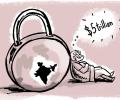
The wait for India to become a $5-trillion economic powerhouse by 2024-25 (FY25) is going to take longer than what the finance ministry had originally intended, according to the International Monetary Fund (IMF). The vision will instead be achieved in 2028-29 (FY29), reveals the IMF data, illustrating a four-year delay. Chief Economic Advisor (CEA) V Anantha Nageswaran had in February said India would become a $5-trillion economy by 2025-26 or the following year, on the back of 8-9 per cent sustained growth rate in real gross domestic product (GDP). However, the IMF data conveys that the economy will be $4.92 trillion in FY28, clearly alluding to the fact that the target will be realised in FY29.

Since January 2021, the inflation rate in health has stood in the range of 6.08-8.44 per cent.

'We will have to wait for one more year to cross the 7% mark, which should be possible in the absence of any disruptive reform,' points out CARE Ratings Chief Economist Madan Sabnavis.

The biggest headwind to the consumption story in FY23 is a sharp decline in government subsidies on food, fertiliser and fuel, and overall decline in revenue expenditure net of interest payments. This, analysts say, will adversely impact purchasing power of households at the lower end of the income pyramid, translating into lower spending on consumer goods and services.

The sudden stop in economic activity led to a sharp decline in employment-intensive sectors like construction, manufacturing and trade, hotels, transport etc.

According to Ajai Sahai, director-general and CEO of Federation of Indian Export Organisations, rising cases are a cause for concern as it adds to the uncertainty and may impact exports.

However, it may still not change its stance on the policy rate as inflationary pressures are coming from high commodity prices.

Evidently, the economy has come out of the low growth phase in the past two years and it does appear the economy will continue to remain in the plus-five per cent range.

Emerging markets such as India have always run higher inflation rates than developed economies such as the US and countries of Western Europe. But for the first time in the past 30 years, the US reported a higher consumer price inflation (CPI) rate than India in five consecutive months. The US reported a CPI rate of 7.5 per cent in January 2022 against 6.01 per cent in India and analysts expect the trend to continue for at least a few months more

Monsoon in August was almost 24 per cent below normal, which was the sixth driest August since 1901. It came on the back of a 7-per cent monsoon shortfall in July.

Infra segment, refinery product impacted the most, even as contraction narrows in latest month.

Stemming from the default of IL&FS in September, on various debt instruments including commercial papers, bonds and loans, the financial sector has been facing a liquidity crunch for the last eight to ten weeks.

However, the growth, driven largely by a bumper rabi harvest and facilitated by relaxation in lockdown, may not have resulted in a big rise in income for a section of farmers.

However, the hike in salary for government officials may take some time as the Centre had earlier this year decided to put a freeze on any hike in the DA of its employees till July, 2021, owing to the Covid-19 pandemic.

Completed projects saw an improvement of 29.2 per cent over the June quarter, which is valued at Rs 0.31 trillion.

Experts attribute the lower target to increased allocation under the credit guarantee scheme for small businesses. Out of the Rs 3.21 trillion worth loans sanctioned under the Pradhan Mantri Mudra Yojana (PMMY) in the last financial year, Rs 3.12 trillion were disbursed to entrepreneurs, according to official data.

As the growth figures relate to pre-Covid lockdown period it does not reflect the real picture of distress which unfolded from April onwards in the sector, when acute supply disruption led to sharp drop in prices of many commodities largely perishables impacting farmers.

There is a near consensus that at least a 25 basis points cut, if not 50, can be expected in the June policy.

If the fiscal deficit for the year can be maintained at Rs 7.04 trillion, the deficit as a percentage of GDP will slip to 3.44 per cent

Direct economic stimulus measures such as tax cuts for individuals and industry would have helped to prop up the Indian economy which was hit hard by the lockdowns across several states in India, say economists and corporate leaders. While the measures announced on Monday are focussed more on the supply side, these steps would take a lot of time to move the needle for the economy.

No change in retail prices as oil marketing firms to absorb increase

Revenue from divestment has fetched Rs 40,000-50,000 crore against target of Rs 2.10 trillion.

Categories such as washing machines, refrigerators and television sets have seen sales growth of around 8-10 per cent in August compared to last year, industry sources said, with September also reporting a similar growth trajectory.

October infrastructure output, which contributes nearly 38 per cent to the industrial output index, was up 3.2 per cent annually.

To meet the revised estimates for 2019-20, the central government will have to garner Rs 5.03 trillion in total revenues in March, which has seen the worst phase of the coronavirus pandemic so far and the resultant lockdown.

Other countries with a large number of cases including Brazil, Russia, Spain and the United States of America, all have more people heading to work.
 © 2026 Rediff.com - Advertise with us - Disclaimer - Privacy Policy - Sitemap - Feedback - About us - Terms of use - Grievances