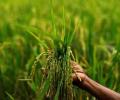
However, the estimates could change in the coming months, as full impact of excess rainfall and floods on the standing soybean and urad crops in central and western India in late August and September has not yet been fully taken into account.

The reserves rose to $501.70 billion helped by a whopping rise in foreign currency assets, the latest data from the Reserve Bank of India.
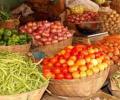
The core stir issues of remunerative prices and a basic income for farmers has taken a political turn with three major agrarian states of Madhya Pradesh, Rajasthan and Chhattisgarh going to the polls in the next few months
With the gradual opening up of shops, hotels, restaurants and catering services with limited number of participants, milk consumption has improved by 5-10 per cent from the lowest level.
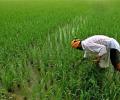
A pick-up in farmer income could have a cascading impact on the rural economy, though agriculture is becoming a smaller part of India's overall rural incomes.
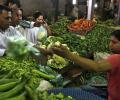
'If you see the composition of items which are causing this spike in prices, most of them have little to do with the kharif harvest, except for pulses and vegetables to some extent.' 'I don't know on what basis the government is claiming that food prices will moderate in the weeks to come.'
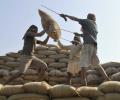
For many farmers, though, a bumper harvest isn't good news, as they have been forced to sell their produce, particularly pulses, dirt cheap.

Experts say a large part of the expenditure in April was spent on heads such as creating infrastructure for testing capacity and procuring testing kits, among other things.
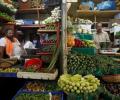
Since March 2020, WPI food inflation rate continued to fall but the CPI-food inflation rose, signaling a breakdown in supply chain from the mandis to the final household.

The government clarified that the majority of industrial establishments had reported nil production, and cautioned that the numbers should not be compared with those of previous months. "It is not appropriate to compare the IIP of April 2020 with that of earlier months, and users may like to observe the changes in the IIP in the following months," said the ministry of statistics & programme implementation.

The latest official numbers on the price of agricultural produce gives an idea of what's fueling the farmers' protest in Delhi.

The GDP has been estimated at Rs 126.54 lakh-crore (Rs 126.54 trillion).

Till June 30, the southwest monsoon was 33 per cent lower than normal, which is among the worst in the last five years, with 28 of the 36 meteorological divisions recording deficient rain.

The return of private investment now struggles with lack of funds and election-driven uncertainty.
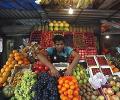
Softening of global commodity prices might not help much
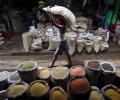
Acreage of these crops is likely to fall as prices drop below MSP in mandis; area under cotton, maize may increase on better realisation

After the government sought Parliament's nod for a second batch of supplementary demand for grants that will cause a hit of Rs 2.99 trillion to the exchequer, doubts suddenly arose about the government's ability to meet the Budget projections of reining in its fiscal deficit at 6.8 per cent of gross domestic product (GDP), or Rs 15.06 trillion, for the current financial year. Till now, many were of the opinion that the government would succeed in checking the deficit at a much lower figure than what was given in the Budget Estimates (BE). The government had sought Parliament's approval to spend Rs 3.74 trillion extra, but Rs 74,517.01 crore will be matched by equal savings on other heads.

The rates of price rise in many services used by the common man, including hospital and nursing, cook, domestic help and bus (fare), among others, have also touched double digits during the last four years, putting a burden on disposable income.

The gains will be gradual as the measure will be executed over 12 months or so.

Welcoming the latest round of stimulus announced by Finance Minister Nirmala Sitharaman on Thursday, experts said the measures will support the economic recovery boosting demand, job creation and by providing funds to the MSME and stressed sectors. The fiscal impact of the stimulus is likely to be around 0.25-0.6 per cent of GDP in the current fiscal, they said.

'The effect will be seen two-three quarters down the line.'

On the basis of Budget projections, the Centre needs Rs 7.3 trillion revenue during December-March and its expenditure must be limited to Rs 6.7 trillion.

'While collections under the Income Disclosure Scheme explain it partly, indirect tax numbers not showing any effect of the withdrawal of high denomination currency notes was puzzling.'

Cascading effect of rising raw materials will result in inflation, high rates, slow capex
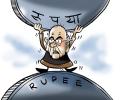
For the first eight months of the current financial year, the figure stood at Rs 7.17 trillion.

Gold import in the December quarter is estimated to come down.

With RBI holding on to rates, investors should avoid longer duration funds for the near future, experts tell Joydeep Ghosh
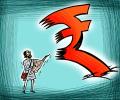
Historically, there has been no correlation between growth in bank credit to industry and lower benchmark interest rate
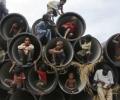
If the industrial sector expanded, growth rate is likely to rise in the remaining quarters to reach 7.6-7.8 per cent for 2017-18.

If the government cuts wasteful expenditure as it is trying now, the deficit would at most fall to 8 per cent, not less than that.

Much of the rural recovery story is based on the premise of agriculture doing well. Even if it clocks a growth of 2.5-3 per cent this year, it is still just around 15 per cent of the overall GDP. The non-farm sector, which constitutes a bigger portion of the overall rural economy, is now hampered by disruptions and lockdowns.

For development finance institution to succeed now, the government must stand like a rock behind it and be patient.

The reason why private banks will play the deposit pricing game strategically is the weakening of banks' deposits base given the competition from MFs and insurance companies due to tax-savings schemes.

India's balance of payments in negative territory.

While the positive surprise has been the high growth in agriculture, the negative surprise is in the trade, transport, hotels segment where growth came lower than expected, says Madan Sabnavis.
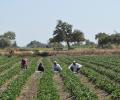
While the farmers are not getting remunerative prices for their produce, at the same time they are forced to pay high prices for items they consume.

If imputed inflation for April and May is used, then you have inflation of over 6 per cent for two consecutive quarters, which is a worrying signal for the RBI.

The highest number of jobs were created in the age group of 18-21 at 1.29 million, followed by 22-25 years of age at 1.12 million during these seven months.

The main reason was that CPI inflation would likely remain below 4 per cent till July.
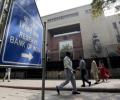
According to Soumya Kanti Ghosh, chief economic advisor of the State Bank of India group, a 50 bps rate cut is a possibility, but 25 bps is more likely.
 © 2026 Rediff.com - Advertise with us - Disclaimer - Privacy Policy - Sitemap - Feedback - About us - Terms of use - Grievances