
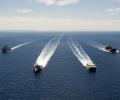
"Two destroyers, one maritime patrol aircraft and a helicopter of the Japanese Maritime Self Defence Force (JMSDF) will participate in the exercise whereas INS Rana, INS Shivalik, INS Karmukh and fleet tanker INS Shakti will represent India," the Indian Navy said on Friday.

Indian Admirals say Malabar 2018 will involve unprecedented complexity, featuring enemy threats in all three dimensions, but especially underwater threats from submarines -- a key Chinese strength. For the first time, officers from all three navies will be posted on other navies' warships. That means Indian Navy officers will obtain the unprecedented benefits of operating on US nuclear attack submarines and Japan's highly regarded Soryu submarines.
In the lead up to this week Indo-US Strategic Dialogue, for which United States Secretary of State, John Kerry, will be coming to Delhi, the Indo-US defence engagement is even more intense than usual.

The India-Japan 2+2 dialogue added strategic heft to the special relationship in the wake of growing Chinese assertiveness on regional affairs, points out Dr Rajaram Panda.

When a Chinese warship entered Japanese waters, the Indian commander called on China to maintain discipline at sea. Dr Rajaram Panda explains the significance of the Malabar exercises between India, Japan and the US.

India and Japan are natural partners at sea, and Narendra Modi's recent visit underlined the need to keep the association going
 © 2026 Rediff.com - Advertise with us - Disclaimer - Privacy Policy - Sitemap - Feedback - About us - Terms of use - Grievances