
The gold reserves remained unchanged at $18.691 billion in the week.

Brazil, Russia, India & China (known collectively as BRIC) on Sunday sought a re-balancing of representation on the executive board and the International Monetary and Financial Committee of the International Monetary Fund (IMF). The committee is the policy-making arm of the IMF.

The Reserve Bank has entered into an agreement buy up to $10 billion (over Rs 45,000 crore) worth notes from the IMF to help the multilateral agency shore up its resources for assisting countries hit by the global financial meltdown.

The unusual gift for a visiting foreign dignitary was presented to Mohammad during his first official visit to Islamabad.
Foreign currency assets surged $2.541 billion to $284.571 billion in the period.

The IMF Board of Governors have approved a general allocation of special drawing rights equivalent to $250 billion to provide liquidity to global economic system by supplementing its member countries' foreign exchange reserves.

"When you have two relatively large economies growing at 7 and 10 per cent, respectively, India and China, they are contributing quite a lot to global growth," IMF deputy director, Asia and Pacific department, Kalpana Kochhar, said during a teleconference in Washington.

US economy saw massive job losses and falling demand last year.
It might help alleviate the economic crisis by addressing the root cause of the unwillingness to spend, says Robert J Shiller.
Intervening in a Security Council debate on post-conflict peace-building, Indian Ambassador Nirupam Sen roundly criticised Bretton Woods institutions, including the International Monetary Fund, for non-involvement of such nations in the planning for development.

Mahinda Rajapaksa, along with his wife and family, fled his official residence -- Temple Trees -- and took shelter at the naval base in Trincomalee.
Godl has reached an all-time high recently when it crossed the Rs 18,000 per 10 gram level. A guide on why and how to invest in gold now.

Gold struck another historic peak of Rs 18,000 per ten gram in the national capital today on sustained buying by stockists for the current marriage season amid a weakening dollar and reports that more central banks might purchase gold from the International Monetary Fund.

For the 2009-10 fiscal, Pranab said, he expects the economy to grow by 7.2 per cent.
International Monetary Fund has warned emerging markets, which have so far weathered the ongoing financial crisis, that they may not be completely insulated, while noting that risks to India's financial sector appeared manageable. The top international organisation has raised the assessment of market risks for the emerging markets including on capital flows. It said that despite generally strong external positions, some concerns have arisen about dollar funding in Asia.
Asian economies are unlikely to undergo a sustained recovery until mid-2010 and can not rely on China to pull the region out of its current slump, a senior International Monetary Fund official said on Wednesday, casting doubts on a "green shoots" theory that has helped bolster Asian stock markets recently.
A look at who own the most amount of gold in the world.
The International Monetary Fund (IMF) and the World Bank (WB) has said the current global economic crisis is turning into a human calamity as it has hit millions of poor people across the world.
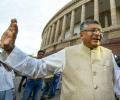
Prasad claimed that one part of his statement had been 'completely twisted out of context', and said 'being a sensitive person, I withdraw this comment'.
Headline inflation will come down under the 6 per cent mark in July itself but will stay at an elevated level of over 5 per cent for some time, Chief Economic Advisor K V Subramanian said on Thursday. Such an outcome will get the price rise back into the upper-end of the target band given to RBI, he said, adding that consumer price inflation had breached the mark for three consecutive quarters last fiscal because of supply side issues like challenges in movement of goods. "With reasonable probability, I expect this month the (inflation) print to come less than 6 per cent," Subramanian told a conference organised by industry lobby Ficci. Right after data for May showing inflation at 6.4 per cent had come out, Subramanian said he had predicted it will cool down in internal meetings and also during "deliberations with the regulator".
The fund said oil prices are still at double the levels recorded in end-2006, even after the 40 per cent fall in prices from the peak they reached in July this year. Food prices too are still above end-2006 levels. Because of this, fuel importing low-income countries will see their import bill increase by 3.2 per cent of their GDP, while food importing countries will spend additional amount equivalent to 0.8 per cent of GDP on food.
It will depend on how the Fund chooses to deploy its newfound power, asks Dani Rodrik.

Gulf Cooperation Council member countries will see their gross domestic product grow at 5.2 per cent in 2010 on the back of rising oil revenues, the IMF has said.
This week's Group of 20 meeting already has a packed agenda: maintaining demand, repairing the global financial system and increasing the International Monetary Fund's resources.
Finance Minister P Chidambaram held informal consultations on Wednesday on possible candidates for the Reserve Bank deputy governor's post.

Country's foreign exchange reserves declined sharply by $3.433 billion to $351.920 billion.

The FATF continuing Pakistan in the 'Grey' list means its downgrading by IMF, World Bank, ADB, EU and also a reduction in risk rating by Moody's, S&P and Fitch.
IMF has predicted a slowdown of world economic growth and approves of Fed Reserve's move of cutting its interest rate.

Kaushik Basu, the C Marks Professor of International Studies, professor of economics, and director of the Center for Analytic Economics at Cornell, has been asked informally if he would consider becoming Chief Economic Advisor (CEA), a post that will fall vacant after Arvind Virmani ends his tenure and leaves to join the International Monetary Fund at the end of the month.

The announcement has been enabled by the IMF's recent announcement of a framework for issuance of notes to the official sector. These notes will allow investments in the IMF to be treated as international reserves. Therefore, RBI will be able to invest a portion of its foreign reserves in the IMF.

Until now the Fund has sold 212 metric tonnes of gold but it was limited to central banks.
In any downturn, the turnaround comes only when investors feel asset prices have bottomed out; when consumer demand has fallen so much that it has nowhere to go but up; and when bankers feel that businesses (or those that remain) are on even keel.
.jpg)
In the previous week, total reserves increased by $950.9 million to $313.536 billion.

In the previous week, reserves had declined by $1.03 billion to $353.33 billion.
Pakistan has appointed Saleem Raza, a former international banker, as central bank governor.
The International Monetary Fund has ended its annual meetings without doing anything to enhance its credibility and effectiveness. In the process, as Finance Minister P Chidambaram warned in Washington, it risks becoming irrelevant.
As the duration of the FRBM Act, enacted in 2003, has come to an end, the government would be required to replace it with another law on fiscal consolidation.
The green signal would pave the way for additional funds to the IMF and reforms related to the country representation at the multilateral lending agency, among others. The IMF would get more funding to tackle the global crisis under an expanded borrowing arrangement. The US has committed to increase its credit line by up to $100 billion.
'I don't see any relationship between them and ex-army or ex-ISI as has been happening in the past,' says strategic analyst Shuja Nawaz, who is convinced the Pakistan army and its intelligence wing, the Inter-Services Intelligence, are not complicit in the Mumbai terror attacks.

The Indian economy is expected to grow around 10 per cent during the current financial year on the likelihood of fewer COVID-19-linked supply disruptions and buoyancy in the global economy, said Poonam Gupta, director general of economic think-tank NCAER. The real challenge, however, would be to sustain a growth rate of 7-8 per cent in years to come, she said. "We could see annual growth in the ballpark range of about 10 per cent. "The reasons for this perceived optimism are: fewer supply disruptions; increased pent-up demand in the traditional and contact-intensive services; and a buoyant global economy.
