The Centre had set up a Commission under former Reserve Bank of India Governor Bimal Jalan to suggest steps to rationalise subsidy and help the government in effectively bringing down the fiscal deficit.
The Economic Survey states that the rationalisation and reprioritisation of subsidies through better targeting would play a vital role in fiscal consolidation and in targeting expenditure more towards inclusive development.

The finance minister's Budget Speech has come as a surprising blessing as he has maintained the rates as they were last year.
Petroleum Minister Jaipal Reddy said these measures would cost the government Rs 49,000 crore in the current financial year.

The empowered committee of state finance ministers has approved the position paper of the Centre on the information technology network for the proposed indirect tax regime.

Inching towards rolling out of GST, the GST Council on Saturday approved a law to compensate states for any loss of revenue from the implementation of the new national sales tax but deferred approval for enabling laws to next meeting.

Exemptions, and the fact that farm income is outside the tax net, ensure that India's tax-GDP ratio stays low.

The government spends nearly 4.2 per cent of the gross domestic product in subsidising various commodities and services.

Till such time that a new governance framework comes into being, the progress of reforms in health, education, land, labour, electricity and agriculture could remain fraught with problems, agitations and delays, observes A K Bhattacharya.
Currently, income between Rs 1.6-5 lakh (Rs 160,000-500,000)attracts 10 per cent tax; Rs 5-8 lakh (Rs 500,000-800,000)20 per cent and beyond Rs 8 lakh 30 per cent.

Addressing the Lok Sabha on Wednesday, Finance Minister Pranab Mukherjee called for the inclusion of petroleum products in proposed goods and services tax so that sharp domestic price movements can be checked.

Finance Minister Nirmala Sitharaman on Monday assured the industry that momentum of economic reforms will continue to make India a hotspot of global investment. India has turned the crisis created by COVID-19 pandemic into an opportunity to push the economic reforms, which remained pending for decades, she said while addressing the National MNC's Conference 2020 organised by industry chamber CII.
Only after its recommendations will the central GST, integrated GST and state GST Bills be taken up

The e-commerce sector is also fraught with redundant taxation laws that need immediate overhaul

The government has set a revenue target of Rs 9 lakh crore during the current financial year, a top official said.

The government on Wednesday said the total tax collections--both direct and indirect--for 2010-11 have exceeded even the revised estimate on the back of strong economic activities.

The earnings are, however, expected to be down around 2 per cent on a sequential basis due to pent-up demand getting exhausted and the adverse impact of rising metals and energy prices on consumer goods and manufacturing companies.

The CJI said tax judiciary plays a very important role in resource mobilisation of the country and expressed concern over pendency of cases.
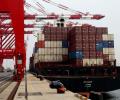
The FIEO on Thursday reiterated that the Customs authorities at several ports in India had ordered a sudden examination of Chinese consignments without any official word from the government, and this may have led to the Chinese retribution.

Never before in post-reforms India have Union Budgets seen a steady reduction in fiscal deficit for five consecutive years, points out A K Bhattacharya.

The penalty can be a maximum 50 per cent of the tax.
Finance Minister Pranab Mukherjee's Budget had quite a few tax-related proposals, although initially they did not appear to be too significant. However, read on to find out what are the proposals related to Direct and Indirect taxes that he has made and how the two affect you!

Parliamentary Standing Committee on Finance Chairman Yashwant Sinha wants the government to first introduce goods and services tax (GST) at the central level and set example for states to implement the indirect tax reform.
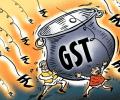
The shortfall in the Centre's GST collections has raised concerns over it meeting the fiscal deficit target of 3.3 per cent of GDP, reports Ishan Bakshi.
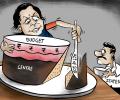
Every option before the finance minister comes with a price tag, observes T N Ninan.

The much awaited new indirect tax regime Goods and Service Tax (GST) is unlikely to be implemented from the scheduled date of April 1, 2011, a top government official said on Tuesday.
Finance Minister Pranab Mukherjee has said that the successful implementation of the Goods and Services Tax (GST) can give a trillion-dollar boost to the economy, taking the total output to $2 trillion in a short span of time.
Finance Minister Pranab Mukherjee on Wednesday proposed a three-rate structure for the Goods and Services Tax -- which will simplify the indirect tax regime -- under which goods will attract 20 per cent levy, services 16 per cent and essential items a concessional 12 per cent.

'This is happening regardless of the Budget.'

Considering double-digit peak and normal power deficit, and the industry seeks direct and indirect tax incentives to facilitate acceleration in the pace of capacity additions.
Finance Minister Pranab Mukherjee said 'yes' in a written reply to the Rajya Sabha when asked whether the chairman of the Empowered Committee of the State Finance Minister has expressed the opinion that it was not feasibile to implement GST from April 1, 2010.

'The challenge is particularly daunting in the case of services, where it is often hard to define the exact amount of the service rendered.'

The government had budgeted revenue realisation for 2012-13 fiscal at Rs 10.38 lakh crore (Rs 10.38 trillion).
The annual Finance Bill may soon become far less exciting as the government plans to lift the veil of secrecy surrounding tax proposals in Budget. Once the Direct Taxes Code (DTC) and Goods and Services Tax (GST) are in place, the finance ministry will adopt a public discussion approach for most future decisions, while confining the annual exercise to a few procedural changes.

After comments from the Parliamentary panel, the bill could have been placed in the winter session, and once passed in that session, GST legislation could have been tabled in the Budget session.

The average listed company has to comply with several laws as it goes about conducting its business. Of these, there are three pieces of legislation that arguably have the most impact on its business.

Of the seven surveys presented under Modi govt, predictions of three were quite close to the actual GDP growth rate, one saw the base year change in between, but the last three were way off the mark.

The Empowered Committee of state finance ministers is meeting under the chairmanship of West Bengal finance minister Asim Dasgupta to work out agreements on various aspects of the GST.

The Centre and the states are yet to reach at an agreement for goods and services to be included in the GST regime. The decision on a lower levy on food products and exemption to some of them is also yet to be taken.

Prakash Karat, general secretary of Communist party of India-Marxist, termed the Budget 'flawed'. While speaking to rediff.com, he said, "The increase in indirect taxes will add to inflation. The government is neither going to achieve growth nor it will be able to contain inflation with this budget."
 © 2026 Rediff.com - Advertise with us - Disclaimer - Privacy Policy - Sitemap - Feedback - About us - Terms of use - Grievances