
India's gross GST collection increased by 8.1 per cent to over Rs 1.83 lakh crore in February, driven by higher import revenues and improved domestic sales. Despite some states reporting negative or below-average growth, experts see the overall trend as a sign of a maturing tax ecosystem and a confident domestic market.

Base revisions are technical exercises, but history shows they can significantly reshape the narrative around India's growth performance.

After the last Budget's announcement of a major tax relief for those earning an annual salary of less than Rs 12 lakh, there is not much that individuals can look forward to in the forthcoming Budget, points out A K Bhattacharya.

The government expects indirect tax collection to be lower than the Budget Estimate (BE) of Rs 13.38 trillion this fiscal year, despite prospects of netting goods and services tax (GST) in large amounts, Revenue Secretary Tarun Bajaj has said. "Indirect tax collection may see lower realisation than budgeted on account of cuts in excise and customs duties. "We could see a shortfall of about Rs 1.5 trillion on account of those," he told Business Standard.

'Tax cases are technical in nature... Many high courts do not have a tax bench, which also contributes to the delay.'

Any reduction on purifiers would need consensus among state finance ministers.

India's economy experienced a growth of 7.8 per cent during the October-December quarter of 2025-26, according to the new series of national accounts with 2022-23 as the base year.

Here are the key numbers to watch out for in the Union Budget for 2025-26:

'Repeated adjournments are one of the largest contributors to lengthy litigation cycles.'

While recalling the order, the bench agreed to the contention of the law officer that there was a "breach of principle of natural justice" as the government department was not accorded the hearing.
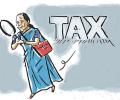
The net indirect tax collection in 2020-21 grew 12.3 per cent annually to Rs 10.71 lakh crore, thereby exceeding the target set in revised estimates, the Finance Ministry said on Tuesday. The mop-up through indirect taxes, which include GST, Customs and excise duties, was Rs 9.54 lakh crore in 2019-20. In the Revised Estimates (RE) for 2020-21, the target was set at Rs 9.89 lakh crore. Net collections from Goods and Services Tax (GST) stood at Rs 5.48 lakh crore during 2020-21, an eight per cent drop compared to Rs 5.99 lakh crore in the previous fiscal year.

The Indian economy is growing at a robust pace, driven by strong domestic demand, low inflation, and the healthy balance sheets of banks, said a Reserve Bank report released on Wednesday.

The GST Council at its next meeting may consider a reduction in taxes on air and water purifiers as air quality across the country worsens and access to safe drinking water remains uneven.

Customs regimes can lead to labyrinthine legal disputes. Budget 2026 must recognise that an excessively defensive Customs posture can itself become a trade barrier, point out Mukesh Butani and Shankey Agrawal.

'Global uncertainty is something which definitely occupies the minds of officials when we are preparing for the Budget.'

The move, he said, would enable the Authority for Advance Rulings set up under the Income Tax Act 1961 to also function as the Authority for Advance Rulings for Indirect Taxes. The AAR was established to address the taxability issues of NRI assessees. The assessees can put in an application to the authority and seek judgement on their tax issues.

All the three components of indirect tax excise, customs and service tax have posted negative growth in collections.

The Union Budget for 2026-27, presented by Finance Minister (FM) Nirmala Sitharaman on Sunday, which was a first, had an excellent domestic macro backdrop. According to the first advance estimates, gross domestic product (GDP) in constant prices is projected to grow 7.4 per cent in the current financial year, against 6.5 per cent in 2024-25.

To digitise Customs processes, the Union finance ministry is planning to integrate the Indian Customs Electronic Gateway (ICEGATE), Risk Management System (RMS), and Indian Customs Electronic Data Interchange System (ICES) into a single unified national Customs platform, according to government sources.

Indirect tax revenues rose marginally by 5.6 per cent in the April-October period to over Rs 2.85 lakh crore, mainly on account of increase in service tax and customs collections.

The fiscal tilt towards capex benefits companies in investment-related sectors like capital goods, defence equipment, engineering & construction and metal & mining. The planned cut in revenue expenditure will weigh on companies in consumption sectors like FMCG, consumer durables and retail.

He, however, acknowledged the need for further efforts from the revenue department.
'This Budget has a one-year agenda, which you can call the sprint, and the marathon is towards Viksit Bharat.'

The budgeted indirect tax collection target is Rs 9.26 trillion, and the Centre has collected around Rs 5 trillion in the first 8 months. So it needs another Rs 4.2 trn in the last four months

After increasing the direct tax collections target in 2010-11 by Rs 20,000 crore (Rs 200 billion), the finance ministry now plans to raise the indirect tax receipts by at least Rs 10,000 crore to Rs 3,25,000 crore (Rs 100 to Rs 3,250 billion) for the same period.

The Election Commission has directed enforcement agencies and security forces to take proactive measures during the Bihar elections to prevent the use of drugs, liquor, and cash to influence voters.

Government has set indirect tax collection target of Rs 5.65 lakh crore for 2013-14

Indirect tax collection, which includes excise, customs, and services tax, was Rs 2.57 lakh crore.

With the Union Budget three months away, major industry chambers have submitted to the government proposals on common taxes, seeking simpler compliance and a quicker resolution of tax disputes.

The government has fixed the target of indirect tax collection, comprising customs, excise and service tax, at Rs 5.65 lakh crore for 2013-14.

Ahead of Union Budget, the government on Thursday said it hopes to exceed the indirect tax collection estimate of Rs 3.36 lakh crore for this fiscal in view of the buoyancy in the economy.

The indirect tax collection rose by 42.3 per cent to Rs 2.07 lakh crore (Rs 2.07 trillion) during April-November this year as compared to corresponding period last year, indicating uptick in economic activities.
The indirect tax collection grew by about seven per cent to Rs 51,461 crore (Rs 514.61 billion) in the first five months of this fiscal from Rs 48,095 crore (Rs 480.95 billion) in April-August 2002.

Amid speculations of partial roll back of stimulus in the upcoming Budget, a key finance ministry official said the government's kitty from indirect tax collections will fall short of the projected figures for this fiscal.

The government on Tuesday said there would be no slippage in indirect tax collection on account of drought nor is it considering any tax cuts.
The government is finalising a major GST overhaul with automated refunds, pre-filled returns, and analytics-based scrutiny to simplify compliance and boost liquidity for MSMEs.

'In case a particular industry has not passed on the benefits and if we receive complaints, we will take up the matter with the industry body concerned.'
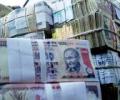
The world economic downturn, a slowing economy and stimulus packages by way tax cuts have all brought the government's indirect tax collections in the first four months of this fiscal down by 28 per cent as compared to last year's revenue during the same period.
