
India's traditional companies are now moving full scale into the renewable and alternative energy space that had been dominated by smaller players over the past decade. Companies such as government-owned NTPC and the Adani and the Tata groups restructured their businesses well in time to become major players in the green space. At the same time, other conventional companies, such as Larsen & Toubro and Reliance Industries Ltd (RIL), which have a presence both in the energy sector as well as myriad other activities - construction, technology and retailing - are tying up with new-age companies to hitch a ride to a greener path.

India's biggest firm, Reliance Industries, has decided to cut salaries by 10 per cent in its oil and refining divisions. Several smaller companies like Kajaria Ceramics have followed suit with cuts as high as 40 per cent for those earning more than Rs 50 lakh.

While companies have not launched too many products in rural areas of late, easy financing has helped push up demand.
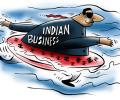
Across the country, companies have stepped up their act to contain the crisis. IT and other new economy firms seem to have taken a lead.


From auto, refrigerator, and mobile handset makers to real estate firms, companies are tying up with banks to dole out attractive finance schemes and discounts to make buying more affordable.

The Tatas, L&T and Bharat Forge expressed interest in building pressure swing adsorption oxygen plants at hospital sites, while IOC and RIL are pitching in with both oxygen and cryogenic tankers needed for its transportation.

'If the government was serious about co-opting the corporate sector meaningfully in the fight against COVID-19, it could have specified activities beyond cheque-writing,' notes Kanika Datta.

India has historically not had a strong compliance mechanism around insider trading. This is in stark contrast to developed countries.

To mitigate the impact of the economic slowdown on their businesses, a majority of Indian firms have implemented significant cost reductions and are reviewing their operational effectiveness, a PwC survey says.

Sitharaman said the Bill has proposed giving a legal framework for fixed-term employment through which contract workers serving a fixed-tenure will get equal statutory social security benefits as regular workers in the same unit.

Companies are looking to combine risk management with strategy.

Technology, which was responsible for creating the new-age digital consumer issue for enterprises, also acts as a solution to the problem, says Karthick Viswanathan.

An appraisal of performance of the board and practice of values and their synergy with the organisational strategy are all crucial for an organisation to evolve into an institution, say Ramachandran Kavil & Sougata Ray.


There is a case for more stringent evaluation of CSR plans based on voluntary allocations, but a rule-based approach might be more effective.

A new book may help companies in getting corporate social responsibility right, notes Ajit Balakrishnan.
The onus rests on the government to help industry take advantage of depreciation.
Corporate leaders are making large philanthropic investments in the area of primary education.
Companies are developing a surrogate education system to create a skilled labour pool.
As expected, there have been no major announcements in the Interim Budget.

Being conservative is good, but not quite in a crisis.
 © 2026 Rediff.com - Advertise with us - Disclaimer - Privacy Policy - Sitemap - Feedback - About us - Terms of use - Grievances