
There is much gloom about macroeconomic fundamentals. Yet consumer sentiment seems to contradict any sense that the India story is stuttering.

Hindustan Unilever on Tuesday reported 15.59 per cent jump in net profit at Rs 871.36 crore (Rs 8.71 billion) for the third quarter ended December 31, 2012, on account of robust sales across various business verticals.

With the appointment of Mahendra Kumar Sharma, former vice-chairman of Hindustan Unilever Ltd, as an independent director of Wipro, it is clear that the tech giant wants to strengthen its corporate governance practices.

Move comes at a time when the $50-billion Unilever is looking to double its turnover in 10 years.

India's largest FMCG company expects a rent of Rs 200-250 a sq ft or a capital value of Rs 300 crore (Rs 3 billion) from the prime Mumbai property.

On its radar are Alberto-Culver and the personal care and laundry portfolios of Sara Lee, both recent acquisitions of Unilever.

It takes 6 to 8 months after the approval for a product to hit stores.

TCS, HDFC Bank, Infosys and Kotak Mahindra Bank were the other firms in the top-10 list which witnessed a rise in their market capitalisation. On the other hand, HUL, HDFC, Bharti Airtel, ITC and ICICI Bank finished with losses.

Investors booked profits in recent gainers dragging the indices into losses

The breadth, indicating the overall health of the market, turned negative. On the BSE, 1,581 shares declined and 1,246 shares fell. A total of 165 shares were unchanged.
The government is in the process of finalising guidelines which have been drafted to deter the advertising industry from making unsubstantiated and misleading claims about their products.The guidelines are based on the recommendations of the committee set up by the Food Safety and Standards Authority of India to investigate claims made by Hindustan Unilever Ltd about 'Kissan Amaze'.

Firm regains volume growth via focus on market share, market development, margins and consumers' mood

Markets ended lower for the fifth consecutive session and were down 2.4% for the week.

Cigarettes to hotel major ITC entered the consumer products business in 2007. In three years, it has managed to corner a two per cent market share.

"From time to time, we do India-specific innovations through products and benefits. Our studies showed that Indian women want a blemish-free skin," says Richa Singh, marketing manager, Garnier India.

HUL global CEO, Paul Polman, on his third visit to India in little over a year, said his company's 170,000 employees across the globe and he were fast learning "how to climb mountains, as the market place was no longer a smooth surface".

But, Madras HC not happy with P&G disclaimer for Tide Naturals' ad.

In May, Satpal Singh, who runs a dairy business with three buffaloes in Jewar, near Noida, was worried about the steep spike in input costs. Singh said dry fodder rates, which cost Rs 1,500-2000 per tractor trolley last year, were quoting at Rs 4,500-5,000. The price of other cattle feed ingredients (that include mustard meal and similar mixes) had also gone up from Rs 2,000 per quintal to Rs 3,100-3,200 per quintal.
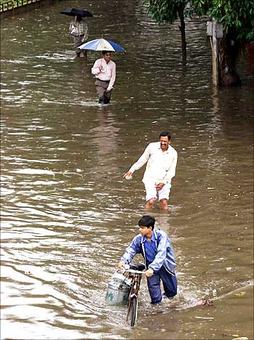
Two days ahead of the high tide warning, corporate houses here are busy drawing plans to meet any possible recurrence of the 26/7, 2005 deluge in the metropolis.

Despite near-term headwinds of rising input costs and the possibility of lower demand for products as Covid dented rural & urban India, and impacts both production & consumption, analysts remain bullish on stocks of fast moving consumer goods (FMCG) companies and expect the index to relatively outperform its peers in the second half of fiscal 2021-22 (FY22). In the past one year, prices of key commodities such as groundnut oil, mustard oil, Vanaspati, soya oil, sunflower oil and palm oil have shot up in the range of 20 per cent to 60 per cent, data show. The FMCG sector macros in this backdrop, according to analysts, have further deteriorated because of weakness in consumer demand and likely margin pressure due to elevated crude oil, palm oil and global food prices.
Hindustan Unilever, GlaxoSmithkline Consumer Healthcare, Godrej Consumer Products, Dabur, Nestle and other FMCG companies are lining up initiatives to maximise returns from modern trade channels including hypermarkets and supermarkets.

Forty-four per cent management students graduating in 2010 have voted the FMCG sector as the most preferred industry to work in, terming giants like Hindustan Unilever Ltd and Proctor & Gamble as "dream companies", a survey said.
Even as large fast moving consumer goods companies like Hindustan Unilever and ITC struggle with their volume growth, mid-tier FMCG companies like Godrej Consumer Products, Marico, Dabur and Nestle have reported strong spurts in volumes as they focus on inorganic growth and rural markets, according to industry experts.

Hindustan Unilever Chairman Harish Manwani, MD & CEO Nitin Paranjpe and CFO R Sridhar speaks to Business Standard after the announcement of the financial results of the company in Mumbai on Tuesday.

The telecom majors should focus on improving service quality with a strong partner, and not on one-shot stake sales.

Among major gainers, ITC, Reliance Industries, Dr Reddy's and HDFC rose up to 3 per cent.
Kishore Biyani, who owns the Future Group and its associated retail chains, is seeking support from rival retailers to challenge the might of Hindustan Unilever, Cadbury, Britannia and other confectionary, food and fast moving consumer goods companies (FMCG) to bargain for higher margins.

More than a hundred years ago, Hindustan Unilever launched a soap called Lifebuoy in India.

We have not suffered such huge price shocks across so many basic commodities, at the same time, in decades. Has the inflationary impact of all this been factored into stock prices as yet, asks Debashis Basu.

While a merger means HUL taking over GSK Consumer's assets, including its employees, any mention of retention of employees beyond the merger is missing in the deal.
HUL is all set to cut down on its managerial positions, with as many as 50 surplus managers losing their jobs.
CavinKare, which has successfully competed with multinationals, including Hindustan Unilever, in the sachet segment to retain leadership in key southern markets, will now have to prove its acumen in the bottled shampoo segment, which is increasingly getting competitive after new marketing strategies were adopted by ITC and other players.

Companies like Dabur India, Colgate-Palmolive and Jyothy Labs, however, spent less than profits on these counts.

'There will always be a challenge to maintain a fine balance to ensure that the growth keeps happening and inflation is contained.'
After achieving high levels of market penetration, the Rs 8,800 crore (Rs 88 billion) detergents industry is now banking on growth through high-value products and innovation. Innovation in the laundry care industry is possible through four ways, according to Sudhanshu Vats, category head, home care, Hindustan Unilever (HUL).
Higher prices are burdening household budgets and threatening the margins of leading manufacturers.

Over the past few months, FMCG companies redefined their "fairness" offerings to make them more inclusive in the backdrop of the global movement "BlackLivesMatter".

The company has made public announcement that it is selling five residential property in Mumbai's prime locations of Cuff Parade and Vile Parle, which includes four two-bedroom and one three-bedroom flats.
Ashok Gupta, executive director, and D Sundaram, vice-chairman, will be directors at Lakme Lever along with Anil Chopra, who returns to the newly formed subsidiary.
Kishore Biyani, the retail baron, seems ready to smoke the peace pipe with suppliers with whom he has been at loggerheads for the past few months. The move comes at a time when some of his recently launched private-label product categories are outselling those of multinational rivals such as Nestle.The founder of Future Group of retail chains including Food Bazaar and Pantaloon recently launched a series of in-house value-for-money consumer products.
 © 2026 Rediff.com - Investor Information - Advertise with us - Disclaimer - Privacy Policy - Sitemap - Feedback - About us - Terms of use - Grievances