
The government also plans to build MPs' chambers that will come up on the land where the Transport Bhawan and Shram Shakti Bhawan are located.

The Shram Shakti Bhavan and Transport Bhavan in Lutyens' Delhi will be the first two buildings to be razed to pave the way for the construction of chambers of members of Parliament there as part of Central Vista redevelopment project.

'I cannot afford to go to court. I cannot afford to lose a case. I will fight the Gandhi way -- peacefully, non-violently, and with determination,' Purshottam Chauhan, a resident of the Sabarmati Ashram, tells Rosamma Thomas. Around him, the homes of former neighbours are rubble. About 300 Dalit families resided within the premises of the Sabarmati Ashram till 2021. Only about 40 now remain.

The new Parliament building will be constructed close to the existing one under the Central Vista redevelopment project, and it is expected to be completed in 21 months.

The apex court made it clear that the fate of the project, which includes several new government buildings and a new Parliament House, will depend on its decision.

A bench, comprising Chief Justice S A Bobde and Justice Aniruddha Bose, did not agree to the submission that the project in Lutyens' Delhi needed to be stayed as the government bodies were to approach the authorities concerned for clearance and other formalities. 'Nobody is going to do anything' during the COVID-19 pandemic, said the bench.

The Central Vista revamp, announced in September, 2019 envisages a new triangular Parliament building, with seating capacity for 900 to 1,200 MPs, that is to be constructed by August, 2022 when the country will be celebrating its 75th Independence Day.
The revamp, which was announced in September last year, envisages a new triangular Parliament building, with seating capacity for 900 to 1,200 MPs, that is targeted to be constructed by August, 2022 when the country will be celebrating its 75th Independence Day.
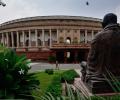
Officials also said that sufficient steps have been taken to control air and noise pollution during the construction work for the new parliament building, which will have separate offices for all MPs and those will be equipped with the latest digital interfaces as a step towards creating 'paperless offices'.
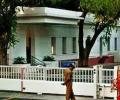
Used since 1984 when late Rajiv Gandhi became the PM, the current residence was built over 12 acres of land, based on designs by New Delhi's chief architect Edwin Lutyens. However, with a new redevelopment blueprint on the table, the PM's residence is now expected to move to the South-West corner, behind South Block on Raisina Hill. Arnab Dutta reports.
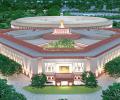
Indian Parliament's new building will have a triangular shape to reflect the importance of triangles being a sacred geometry in various religions, while its interiors will have three national symbols as their main themes -- Lotus, Peacock and Banyan Tree.

Resettlement of 12,000 families living on banks of Sabarmati Riverfront cost Ahmedabad Municipal Corporation about Rs 1,200 crore
 © 2026 Rediff.com - Investor Information - Advertise with us - Disclaimer - Privacy Policy - Sitemap - Feedback - About us - Terms of use - Grievances