
Since February 2025, the RBI has reduced the policy rate by 100 basis points. In its previous policy review in June, it had trimmed the repo rate by 50 basis points to 5.5 per cent.

President Droupadi Murmu addressed the nation on the eve of Independence Day, praising the response to terrorism, highlighting achievements in defense self-reliance, and emphasizing unity and progress.

The Reserve Bank of India on Friday raised the GDP growth projection for the current fiscal to 7 per cent from 6.5 per cent earlier on buoyant domestic demand and higher capacity utilisation in the manufacturing sector. Announcing the bi-monthly monetary policy, RBI Governor Shaktikanta Das, however, flagged protracted geopolitical turmoil and global economic fragmentation as risks to the growth outlook. The RBI kept interest rates unchanged at 6.5 per cent in Friday's monetary policy statement.

Global home decor and furniture retailer IKEA has ambitions to increase sourcing from India to 50 per cent, Swedish trade minister Benjamin Dousa said on Wednesday. IKEA's sourcing basket includes textiles, plastics, and metals, among others, and the company plans to add more items.

The point to note for India is that we must not panic. The United States may be our largest export destination, but high tariffs will not exactly mean gloom and doom. Sure, we can throw some morsels as we continue negotiating, but we must be firm that some red lines cannot be crossed, no matter what, asserts Shreekant Sambrani.

Domestic rating agency Icra on Monday revised its FY24 GDP growth forecast to 6.5 per cent from 6.2 per cent earlier. However, the revised forecast is still much lower than the Reserve Bank of India's (RBI's) 7 per cent real Gross Domestic Product (GDP) growth estimate for the ongoing fiscal. Earlier this month, the RBI had revised upwards its GDP estimate to 7 per cent from 6.5 per cent, calling the revised number a "conservative" one.

GST, net of refunds, now yields close to 20 trillion to both the Centre's and states' exchequer.

Stock markets are in for an event-heavy week ahead with a raft of Q1 earnings from blue-chips, the US Fed interest rate decision and foreign investors trading activity driving investors' sentiment, analysts said. Macroeconomic data announcements, monthly auto sales numbers and global market trends would also guide movement in the domestic equities, they said.

'One Chinese interlocutor said India should realise that "China can do without India, but India could not do without China", pointing to its inability to do without Chinese intermediates and components,' former foreign secretary Shyam Saran discovers on a visit to China.
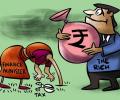
India's 18 largest states, accounting for over 90 per cent of the country's gross state domestic product (GSDP), are likely to record a marginal uptick in revenue growth to 7-9 per cent this year, from 6.6 per cent clocked in 2024-25 (FY25), rating agency Crisil said in a report on Tuesday. This growth, slower than the decadal average of about 10 per cent, would lift these states' cumulative revenue to around Rs 40 trillion in FY26 from Rs 37.26 trillion in FY25.

From the 30-share blue-chip pack, Adani Ports, UltraTech Cement, Larsen & Toubro, Sun Pharma, HDFC Bank, ICICI Bank, NTPC and State Bank of India were the major laggards. Tata Consultancy Services, Reliance Industries, ITC, Asian Paints, HCL Tech and Maruti were among the gainers.

The Indian services sector growth touched an 11 month high in July, supported by a pickup in new exports orders and sharp rise in overall sales, a monthly survey said on Tuesday. The seasonally adjusted HSBC India Services PMI Business Activity Index was at 60.5 in July, little-changed from 60.4 in June, and the rate of expansion was the best seen since August 2024.

India's economic growth accelerated to 8.4 per cent in the third quarter of 2023-24, mainly due to good performance by the manufacturing, mining & quarrying and construction sectors. The Indian economy recorded a growth of 8.4 per cent in the third quarter of this fiscal (October-December 2023), according to data released by the National Statistical Office (NSO) on Thursday.

Continuing on the fiscally prudent path, the Modi government in the interim Budget refrained from announcing populist measures, which will help it trim the fiscal deficit to 5.1 per cent of the GDP next fiscal and 4.5 per cent in FY26.
The Asian Development Bank (ADB) on Wednesday lowered India's growth forecast for FY26 to 6.5 per cent from 6.7 per cent on account of trade uncertainty and higher US tariffs that are expected to impact exports and investment. Despite the downward revision from the April 2025 Asian Development Outlook (ADO), India remains one of the fastest-growing major economies in the world.

Gold prices are expected to witness further consolidation in the coming week as investors brace for a slew of events, ranging from central bank meetings, including the US Federal Open Market Committee (FOMC) meeting's outcome, to global trade negotiations, analysts said.

India has decided to submit a dossier at the upcoming Financial Action Task Force (FATF) meeting, calling for Pakistan to be placed back on the grey list of the global money laundering and terrorist financing watchdog.

In an event-heavy week, stock investors will track quarterly earnings of several bluechip firms, the likely outcome of ongoing India-US trade talks, and inflation data for market cues, analysts said on Sunday. Moreover, global market trends and trading activity of foreign investors would also guide movement in equities, they said.

Generative AI is transforming workplaces but at a cost -- there are fewer jobs for young workers just entering the workforce, reveals a Goldman Sachs report.

Discrepancies in computation of advance estimates of the country's Gross Domestic Product for 2023-24 stood at Rs 2.59 lakh crore as against (-) Rs 3.80 lakh crore in 2022-23 and (-) Rs 4.47 lakh crore in 2021-22, according to National Statistical Office (NSO). On Friday, the NSO released its first advance estimates of national accounts which showed that the Gross Domestic Product (GDP) or Indian economy will grow at 7.3 per cent in 2023-24, slightly higher than 7.2 per cent in 2022-23.

The change in stance to neutral from accommodative in the June monetary policy meeting does not necessarily signal that the Reserve Bank of India's (RBI's) rate setting body - monetary policy committee (MPC) - will go on a prolonged pause on rate cuts going forward, believe experts.

Uddhav Thackeray criticized BJP MP Nishikant Dubey for his controversial remarks amid the Marathi-Hindi language row, accusing him of trying to divide people and disturb harmony.

Mixed views were expressed by top economists on the Reserve Bank of India's (RBI) Monetary Policy Committee's (MPC) decision to hold the repo rate at 5.5% and maintain a neutral stance. While some say the decision was as expected and one more rate reduction is expected this fiscal, there is also a view that rate cut by MPC was warranted given the evolving global situation.
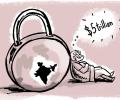
India will become the world's third largest economy by 2026 as its GDP in current dollar terms will reach $5 trillion in that year and further rise to $5.5 trillion in 2027, former Niti Aayog vice chairman Arvind Panagariya said on Friday. Delivering the 18th C D Deshmukh Memorial Lecture titled 'India at 125: Reclaiming the Lost Glory and Returning the Global Economy to the Old Normal', he said it is unlikely that GDP in current dollar terms of either Germany or Japan will cross $5 trillion-mark in the coming three years. Japan will have to sustain a growth rate of 3.5 per cent in current dollar terms to reach $5.03 trillion in 2027 from its 2022 level of $4.2 trillion, he said.

The central government's fiscal deficit fell to 0.8 per cent of the full-year target at the end of May, mainly due to a whopping Rs 2.69 lakh crore dividend received from the Reserve Bank of India. The fiscal deficit, or gap between the government's expenditure and revenue, had touched 11.9 per cent of the Budget Estimates (BE) for 2025-26 or Rs 1.86 lakh crore in April.

President Droupadi Murmu's address to the nation on the eve of the 79th Independence Day.

India's current account deficit declined sharply to 1 per cent of the GDP or $8.3 billion in the second quarter of this financial year, mainly due to lower merchandise trade deficit and growth in services exports, according to a RBI data released on Tuesday. The current account deficit (CAD), which represents the difference between the total amount of money sent abroad and money received from overseas across the economy, was 3.8 per cent of GDP or $30.9 billion in the July-September quarter in 2022-23. CAD was $9.2 billion or 1.1 per cent of GDP in the first quarter (April-June) of the current financial year 2023-24.

The country's biggest carmaker, Maruti Suzuki India, has raised concerns about the continuing slide in small car sales.

Fitch Ratings on Thursday cut India's GDP growth estimate by 10 basis points to 6.4 per cent for the current fiscal, but retained the projections for the next financial year, on concerns over a 'severe' escalation in global trade war. "It is hard to predict US trade policy with any confidence. Massive policy uncertainty is hurting business investment prospects, equity price falls are reducing household wealth, and US exporters will be hit by retaliation," Fitch said in its special update to quarterly Global Economic Outlook (GEO).

Economies of Punjab, Andhra Pradesh, Madhya Pradesh, Uttarakhand and Haryana may have grown at a slower pace than the national economy during 2022-2023.

Foreign brokerages remain cautious on the road ahead for the Indian equity markets. Though analysts at Nomura have revised their March 2026 Nifty target to 26,140 levels from the earlier 24,970, but the upside from the current levels is a modest 6 per cent. BofA Securities, on the other hand, has not made any change to its year-end Nifty target.

India's military expenditure in 2024 was nearly nine times that of Pakistan's, according to a study released by the Stockholm International Peace Research Institute (SIPRI). India's spending reached USD 86.1 billion, while Pakistan spent USD 10.2 billion. China's military spending continued to rise, reaching USD 314 billion, accounting for 50% of all spending in Asia and Oceania.

'We need to be very vigilant as we are passing through some fraught times.'

The Indian services sector growth touched a ten-month high in June aided by robust expansion in international sales and job creation, amid positive demand trends and ongoing improvement in sales, a monthly survey said on Thursday. The seasonally adjusted HSBC India Services PMI Business Activity Index rose from 58.8 in May to 60.4 in June, driven by sharp upturn in new business orders.

Movement in the equity market this week will be guided by a host of macroeconomic data announcements, global trends and trading activity of foreign investors, analysts said. Stocks markets concluded the last week on a subdued note, as investors grappled with global uncertainties.
The economy may grow by around 7 per cent this financial year as estimated by the Monetary Policy Committee (MPC) of the Reserve Bank of India (RBI), say economists with various organisations. The first advance estimates for 2023-24 will be released on Friday by the National Statistical Organisation (NSO), an exercise done for calculating ratios such as the fiscal deficit. The interim Budget will be presented on February 1.

The domestic stock market will continue to monitor the Israel-Iran conflict and its impact on global supplies besides prices of crude oil this week, analysts said. Global trends and trading activity of foreign investors would also drive investors' sentiment during the week.

Office space owners are looking at good times ahead as rentals are expected to rise due to demand for Grade A office spaces outpacing supply that has been sluggish due to construction delays, long gestation periods and developers' interests shifting to residential.

Amazon will invest more than Rs 2,000 crore (about $233 million) in India in 2025 as it strengthens its logistics and safety standards, said the ecommerce company on Thursday.
The World Bank on Wednesday lowered India's growth forecast for the current fiscal by 4 percentage points to 6.3 per cent amid global economic weakness and policy uncertainty. In its previous estimate, the World Bank had projected India's growth at 6.7 per cent for the fiscal year 2025-26.
