
The forthcoming Budget could think of maintaining public capital expenditure at 3 per cent so that domestic resources are available for private investments, points out N R Bhanumurthy.

Using the debt-to-GDP ratio as a fiscal anchor aligns with efforts to promote fiscal transparency through proper disclosure of off-budget borrowings.

India's economy is likely to grow by 6.5 per cent in the current and the next financial year, an EY report said, attributing lower than anticipated expansion in the September quarter to fall in private consumption expenditure and gross fixed capital formation. Real GDP growth eased to a seven-quarter low of 5.4 per cent in July-September -- the second quarter of the current 2024-25 fiscal year.

'The finance minister missed yet another opportunity to simplify the income tax structure in the Budget.' 'This was an opportune moment to get rid of the old tax system entirely and move fully to the new system,' asserts M Govinda Rao, member of the 14th Finance Commission.

A parliamentary committee has pulled up the finance ministry for not adhering to Fiscal Responsibility and Budget Management Act in cutting revenue deficit by 0.5 per cent of GDP for 2005-06 saying there should not be deviations every now and then.
As the duration of the FRBM Act, enacted in 2003, has come to an end, the government would be required to replace it with another law on fiscal consolidation.

The road ahead will require navigating complex financial challenges while fostering job creation and sustainable development in the region.

If the government cuts wasteful expenditure as it is trying now, the deficit would at most fall to 8 per cent, not less than that.

Union Finance Minister Nirmala Sitharaman, along with her team of bureaucrats, delved into the fine print of the 2024-25 Budget documents in a press conference, detailing the government's road map on bringing down the debt-to-GDP ratio and bold tax measures.

The central government's fiscal deficit during 2023-24 at 5.6 per cent of the GDP was better than previous estimates of 5.8 per cent on account of higher revenue realisation and lower expenditure, according to official data released on Friday. In actual terms, the fiscal deficit -- or gap between expenditure and revenue -- was Rs 16.53 lakh crore, or 5.63 per cent of the GDP, which grew 8.2 per cent in 2023-24.

Continuing on the fiscally prudent path, the Modi government in the interim Budget refrained from announcing populist measures, which will help it trim the fiscal deficit to 5.1 per cent of the GDP next fiscal and 4.5 per cent in FY26.

'I found it unbelievable that L&T said 45,000 jobs were waiting to be filled because of unavailability of suitable skillsets.' 'So, when the Opposition sweepingly says there are no jobs, I'm sorry... I'm not saying it's raining jobs, but there are jobs. The (skill) gap has to be bridged.'

'The prime minister's comment on 'revdi culture' was welcome. But I am disappointed he did not follow up on that.' 'All political parties, including the BJP, have been guilty of this.' 'Now, Modi's guarantees, the Congress's 'nyay' path and both ruling and Opposition parties are vying with each other for freebies in my home state Andhra Pradesh.'

However, finding the funds to fulfill them will be a herculean task.
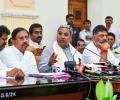
'Karnataka's finances are much healthier than the Union government's, which is indebted to nearly twice the extent of the state.'
Two important features are Effective Revenue Deficit and Medium Term Expenditure Framework.

'They have started becoming an important player, but not at the same level as they were in the earlier part of the decade.'

The government has utilised 'escape clause' under the FRBM Act which provides it leeway for relaxation of fiscal deficit roadmap during time of stress.
The tug of war between the finance ministry and the Planning Commission over more resources for plan projects worsened, with Planning Commission Deputy Chairman Montek Singh Ahluwalia saying he was keen on getting more money for the 11th Plan.
'But can it afford to present a scenario within the existing legal framework of fiscal consolidation?', asks A K Bhattacharya.

To enable widen the fiscal deficit beyond the permissible limit under the present legislation, the government may have to propose amendment to the FRBM Act in the Finance Bill.
The panel may include or seek inputs from former RBI Governor Urjit Patel, former chief economic advisor Arvind Subramanian, Sajjid Chinoy of the PM-EAC, Rathin Roy, among others.

'The finance ministry's decision to accept the deficit target of 4.5 per cent in 2025-2026 appears to have emanated from its endorsement of the Finance Commission's view that the Indian economy will continue to remain impacted by the pandemic, adversely undermining its growth potential,' notes A K Bhattacharya.
The government should have mentioned clearly the specific structural reforms that were responsible for the deviation from the fiscal deficit target by half a percentage point, says A K Bhattacharya.

The panel's report also provides a range for fiscal deficit and debt path of both the Union and states and also recommended additional borrowing room to states based on performance in power sector reforms. Finance Commission is a constitutional body that gives suggestions on Centre-state financial relations. The report of the 15th Finance Commission was tabled in the Lok Sabha by Finance Minister Nirmala Sitharaman.

Amid a debate on the freebies, the Election Commission on Tuesday proposed amending the model code to ask political parties to provide authentic information to voters on the financial viability of their poll promises.
This move will enable it to incur higher-than-mandated borrowing, and possibly spending, till the 2024 Lok Sabha election cycle.

Even with the possible expenditure roll-overs and off-budget financing, the fiscal deficit target will not be met. The FRBM Act, after its amendment in 2018, allows a fiscal deficit slippage of not more than 0.5 per cent for any given year, provided there are justifications. These justifications include war, national security, severe collapse in the agriculture sector, a major natural calamity, big structural economic reforms, or the decline in real output growth of a quarter by at least 3 percentage points below its average of the previous four quarters.

Government looking at cushioning slowdown due to demonetisation with sops and higher outlay for micro, small and medium enterprises, agriculture, and affordable housing.
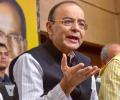
However, independent economists are not as gung-ho as the finance ministry over the likelihood of deficit target being met this time around, says Indivjal Dhasmana.

At a time when major economies have increased spending, India will have to do the same.
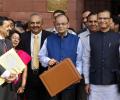
The FRBM report, to be submitted on Tuesday, is likely to have 'excuse clauses', absolving the government of meeting its fiscal commitments under certain conditions such as war or conflict, global economic meltdowns or natural disasters.

The finance ministry on Wednesday said the government will borrow Rs 4.34 lakh crore in the second half of the current fiscal to meet its expenditure requirement amid COVID-19 crisis afflicting the country's economy.
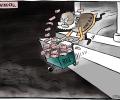
The government has already crossed the fiscal deficit at 132 per cent of the estimate as of December end.

The government on May 17 formed a five-member committee.
The Prime Minister's economic panel on Wednesday said the government needs to draw a programme to rein in the fiscal deficit of over six per cent which is not sustainable.

'The CEA suggested that could be as high as 19 per cent.'
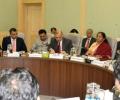
At a pre-Budget meeting, the FM was asked to ensure that NBFCs come out of the liquidity crisis they are facing with the help of RBI. They also spoke about the futility of trying to achieve a 3 per cent fiscal deficit target over the medium term.
 © 2026 Rediff.com - Advertise with us - Disclaimer - Privacy Policy - Sitemap - Feedback - About us - Terms of use - Grievances