
The US Federal Reserve has announced to maintain its bond purchase tapering programme.

'Higher than expected inflation in the US or the European Union, faster than expected tightening by the major central banks, break out of a war in Europe, and withdrawal of portfolio equities from the emerging markets are factors which can result in equity market corrections.'

There are overvaluation and excesses in many pockets of the market. This is most obvious in the IPO market, where loss-making companies have inflicted large losses on investors, observes Debashis Basu.
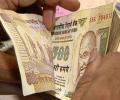
A weak dollar in overseas market in view of the Federal Reserve's cautious stance on interest rate strengthened the rupee value.

The deluge of offerings in the primary market, a muted results season and increasing talks of a Fed taper may quicken the pace of overseas investors selling Indian equities in the near term. The next few weeks may see a dozen companies tap the market for initial public offerings and raise about Rs 30,000 crore. These include the likes of Zomato, Glenmark Life Sciences, Utkarsh Small Finance Bank and Seven Islands Shipping.

IndusInd Bank was the top gainer in the Sensex pack, rallying around 8 per cent, followed by Kotak Bank, Reliance Industries, HDFC, Axis Bank and SBI. On the other hand, Hero MotoCorp, Tata Steel, Bajaj Auto and ONGC were among the laggards.

HDFC was the top loser in the Sensex pack, shedding over 2 per cent, followed by Axis Bank, Bharti Airtel, M&M, Reliance Industries, ICICI Bank, IndusInd Bank and Titan.
Traders broadly expect the rupee to stay in a 61.50 to 63.50 range over the next three months.

'In 2022, active management, long-short strategies, multi-asset strategies, and asset allocation strategies need to be considered to meet long-term investment goals.'

Select the exact category by matching your investment horizon to the portfolio duration, suggests Sanjay Kumar Singh.

We have not suffered such huge price shocks across so many basic commodities, at the same time, in decades. Has the inflationary impact of all this been factored into stock prices as yet, asks Debashis Basu.

Health officials in United States on Friday confirmed that a resident of Oregon has tested positive for coronavirus with no known history of travel to countries severely affected by the outbreak and no known contact with infected individuals.
Fears that FIIs would curtail their investments in emerging markets following the Fed's tapering plan hurt sentiment.
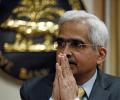
Uncertainty is emerging as the only certainty, said RBI Governor Shaktikanta Das as he emphasised on continued policy support at the December MPC meet during which members expressed concerns over spread of the Omicron variant of coronavirus, as per the minutes of the rate-setting panel released on Wednesday. After three days of deliberations, the six members of the Monetary Policy Committee (MPC) on December 8 unanimously voted for status quo on policy rates for the ninth consecutive time. At the meeting, the RBI Governor said risks stalking the global economy have amplified with rapid spread of the virus mutations, including the Omicron variant, leading to countries scrambling for restrictions.

ONGC was the top gainer in the Sensex pack, rallying around 6 per cent, followed by IndusInd Bank, L&T, UltraTech Cement, Titan, SBI and NTPC. NSE Nifty settled 32.10 points up at 14,707.80.
The 30-share Sensex ended 684 points higher at 20,647 and the 50-share Nifty added 216 points at 6,116 levels.

Even if the bull run may continue, most experts say some profit booking is called for, points out Sanjay Kumar Singh.

HDFC was the top gainer in the Sensex pack, rallying over 7 per cent, followed by HCL Tech, M&M, HDFC Bank, Tata Steel, SBI, Bajaj Finance and Infosys. On the other hand, Axis Bank, Asian Paints, HUL, Titan and IndusInd Bank were among the laggards.

Announcing her appointment, IMF Managing Director Christine Lagarde hailed the Mysore-born Gopinath as "one of the world's outstanding economists with impeccable academic credentials, a proven track record of intellectual leadership and extensive international experience".

Indian rupee is likely to test 76-76.50 levels as a relatively strong greenback, boiling crude prices and COVID headwinds deepen the depreciation bias for the domestic currency, according to experts. One of the significantly-hit Asian currency in recent months amid uncertain economic times, rupee is expected to see a consolidation in the vicinity of the current level before being pulled towards the depreciation bias. While the equity market has been surging with occasional blips, the rupee has mostly been weak against the US dollar in recent months.

The market's sensitivity to the US Fed's balance sheet changes makes it vulnerable to the possible tapering of the bond buying programme and the resulting stagnation or even shrinkage in the balance sheet.

'There will always be a challenge to maintain a fine balance to ensure that the growth keeps happening and inflation is contained.'

The rate hike in the future is set to be 'calibrated and cautious'.

After opening higher, the markets continued to trade in the positive zone in the afternoon session as traders were encouraged by RBI governor Shaktikanta Das's statement that the new resolution framework is expected to give durable relief to borrowers amid the Covid-19 crisis, said Narendra Solanki, head-equity research (fundamental), Anand Rathi.

In signs that the country's growth is on track, the economic activity across the country improved in recent months, according to the US Federal Reserve.

'Indian macro conditions have never been better, and many businesses will safely compound earnings over the next five years.'

Many believe that the surge in the markets defy economic reality and is being fuelled by aggressive monetary easing by central banks across the world.

The market breadth was firm. Out of 2,933 stocks traded , 1,685 stocks advanced compared to 1,136 declined on BSE.

In August, the Fed announced that it would develop a "new interbank 24x7x365 RTGS with integrated clearing functionality to support faster payments in the United States". The Fed Board asked for comments on FedNow by November. In reply to this, Google mentioned its experience of launching Google Pay -- Google's payments app which uses the UPI -- in India.

The Federal Reserve, whose policy-setting Federal Open Market Committee concludes a two-day meeting on Wednesday, has said it expects to keep short-term interest rates exceptionally low to help support the economy.

UltraTech Cement was the top gainer in the Sensex pack, rising 3.06 per cent, followed by IndusInd Bank, ICICI Bank, HDFC Bank, Titan, Axis Bank, SBI and Reliance Industries. NSE Nifty advanced 78.35 pointsto close at 14,814.75.

The announcement of the Federal Reserve sent markets to a tizzy

Sentiments were also bearish largely in tandem with a sell-off in global markets as US Treasury yields surged to multi-year highs on robust economic data and comments from the Federal Reserve, sparking fears of accelerating inflation, brokers said.
The broader NSE Nifty jumped 57.25 points or 0.49 per cent to close at 11,844.10.

'Avoid going overweight on gold. But maintain a 10 per cent allocation via sovereign gold bonds,' Bajaj Capital MD Sanjiv Bajaj tells Sarbajeet K Sen.

The broader NSE Nifty too ended 98.30 points, or 0.89 per cent, down at 10,918.70.

'In the overall global portfolio, India's weighting has come down in the past seven months.'

'When I came here in 2002, I said you can grow at 8%.' 'And I was told that was crazy, and (now) here we are.'

The comment was in response to a June 19 Reuters story citing sources with knowledge of the matter as saying that India planned to clear some oil payments to Iran through the United Arab Emirates central bank.

Kotak Bank was the top loser in the Sensex pack, falling around 3 per cent, followed by Axis Bank, Sun Pharma, HDFC Bank, Bajaj Finance and Asian Paints. On the other hand, ONGC, PowerGrid and IndusInd Bank were the gainers.
