
India and China are emerging as significant sources of foreign direct investment in Africa even as the overall percentage of FDI from Asian countries targeted towards the continent remains low, the United Nations has said.

The BJP lost 15 of the 80 Lok Sabha seats in 2019. Union ministers have been deployed in all 15, tasked with turning the result around.
.jpg)
The report comes at a time when the government is trying to clear pending FDI proposals, which include various planned investments in this sector.

The report -- World Investment and Political Risk -- which was launched by the World Bank's Multilateral Investment Guarantee Agency said the net FDI inflows into the developing countries is projected to touch $416 billion in 2010, up from its 2009 level of $354 billion.

As Prime Minister Manmohan Singh and Congress chief Sonia Gandhi launched an attack on parties opposing FDI in retail and other measures, CPI(M) general secretary Prakash Karat said FDI will be the central issue in the coming session.

After supermarket giant Walmart, it is online retail major Amazon which has begun lobbying with the US lawmakers to seek their support for facilitating its "foreign direct investment in India".
Enthused by 174 per cent growth in services trade this year, India is readying to make an aggressive offer in the WTO negotiations on services.
Prime Minister Manmohan Singh on Monday reached out to Jayalalithaa-led All India Anna Dravida Munnetra Kazhagam to seek its support on the issue of foreign direct investment in multi-brand retail.
Voting will be held in the Rajya Sabha on Friday on the Bharatiya Janata Party's motion opposing the Congress-led United Progressive Alliance Government's move to allow Foreign Direct Investment in multi-brand retail.

The meeting came against the backdrop of members of DMK and Trinamool Congress joining opposition in demanding rollback and a discussion in Parliament under an adjournment motion.
Foreign direct investment (FDI) in India declined sharply for the second month in a row in Maywith inflows slipping to $1.32 billion from $4.66 billion in the year-ago period, reflecting the impact of slowing global economy.

The decision to allow 51 per cent foreign direct investments in multi-brand retail has been put on hold by the government following strong objections from the Opposition and key United Progressive Alliance allies Trinamool Congress and Dravida Munnetra Kazhagam.
The move to delink the FDI provisions from investments by foreign institutional investors in real estate under the portfolio investment scheme was expected to lead to greater stock market play in real estate scrips. Government sources said the clarification was not mentioned in the minutes of the Cabinet meeting sent to the Department of Industrial Policy and Promotion recently. As a consequence, a press note could not be issued.

Another roadblock to be removed from FDI path; Load on insurance chest.

Jaitley evaded vital questions on this issue.

The private sector's new project announcements in the quarter ending March were among the highest on record. The value of new private sector project announcements for the three months ending March 2024 was Rs 9.8 trillion, shows data from tracker Centre for Monitoring Indian Economy (CMIE). This is the second-highest on record in data going back to 2009.
Foreign Direct Investment inflows into India increased 47 per cent to $1.7 billion in April-June quarter this fiscal, compared to $1.1 billion in the same period last fiscal.

Contrary to Modi's claim of the state being the largest beneficiary of Foreign Direct Investment, Gujarat has received only $8 billion of foreign investment during the 13-year period beginning 2000, according to the Union Minister.

Accusing the United Progressive Alliance government of "heaping hardships on people," Tamil Nadu Chief Minister J Jayalalithaa flayed its "knee-jerk" reaction of increasing Foreign Direct Investment cap in different sectors and warned that its "insensitivity" towards people will take its toll soon.
Why is the Bharatiya Janata Party opposed to FDI in retail? A day after promising to scrap FDI in retail, the BJP set about fine-tuning its line to ensure it did not fall foul of the middle-class.
The $20.13 billion inflow 'is the highest FDI into equity in the country during any year', an official release said on Friday. FDI inflows in February 2008 grew a whopping 712 per cent over the year-ago period to $5.67 billion, surpassing the inflows received in any single year since 1991 barring 2006-07, it said.
Seeking to dismiss reports of differences in NDA over FDI in multi-brand retail, the Bharatiya Janata Party on Wednesday said it was opposed to the decision in toto and indicated that it will scrap the policy if it comes to power.

In July 2011, the country had received foreign investment worth $1.10 billion.

In a major policy reversal, the AAP government wrote to the Centre to withdraw approval given by previous Congress government for FDI in multi-brand retailing in Delhi, saying the entry of global chains such as Walmart and Tesco in India would result in large-scale job losses.
With Trinamool's 72-hour deadline to the Centre to rollback diesel price hike, LPG subsidy cap and FDI in multi-brand retail coming to an end, opposition JD-U on Monday sought to reach out to Mamata Banerjee saying that she "sticks" to her stand.
Talks are underway to allow banks from both the countries to open branches in each other's territory.

China's FDI during the first quarter was $43.8 billion, while FDI in the US fell by 60 per cent from a year earlier to $46.1 billion during the same period, leaving a gap of $2.3 billion.

The retail sector seeks industry status, which can reduce the cost of capital and to allow FDI in retail that can increase investments and global competitiveness

India is one of the largest defence importers.
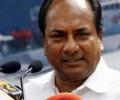
Defence Minister A K Antony has shot down Commerce Ministry's proposal to raise Foreign Direct Investment in defence from 26 per cent to 49 per cent, saying it will be a "retrograde" step and "stymie" the growth of the domestic industry while increasing dependence on foreign manufacturers.

At present, FDI in multi-brand retail is prohibited in India. However, the government allows 51 per cent FDI in single brand retailing and 100 per cent in wholesale trade.
The retail companies are hoping that the Finance Minister Pranab Mukherjee would accord industry status to the sector and allow unrestricted foreign direct investment inflow.
Foreign direct investment (FDI) into India saw a whopping 310 per cent increase in June to $5.65 billion, the highest monthly inflow in the last 11 financial years, indicating the revival of investor confidence in the Indian economy.

Currently, 100 per cent FDI in is permitted if the companies manufacture cigars or cigarettes or allied products.
India's foreign exchange reserves increased to $604 billion as on December 1, surpassing the $600 billion mark after a gap of about four months. The forex reserves were last above the $600 billion mark on August 11 this year. "India's foreign exchange reserves stood at $604 billion as on December 1, 2023.
In 1998 and 1999, the Indian government announced a number of reforms designed to encourage and promote a favourable business environment for investors.
The deadlock over foreign direct investment in the retail sector continues as government officials on Tuesday informed parties opposing FDI that they will discuss their demands with the Prime Minister Manmohan Singh.

Floats discussion paper for stakeholders' feedback with a deadline of January 28.
