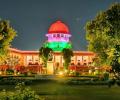
The Supreme Court has agreed to list for final hearing the pleas challenging the validity of certain provisions of the Places of Worship (Special Provisions) Act, 1991.

The Supreme Court on Tuesday granted time till October 31 to the Centre to file its response to a batch of pleas challenging certain provisions of a 1991 law that prohibits filing of a lawsuit to reclaim a place of worship or seek a change in its character from what prevailed on August 15, 1947.
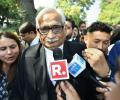
Dhavan took to Facebook to disclose that he has been removed from further participation in the Ayodhya case on the 'nonsensical' ground that he is unwell.

The Supreme Court will hear on April 5 a batch of PILs challenging the validity of certain provisions of a 1991 law that prohibits filing of a lawsuit to reclaim a place of worship or seek a change in its character from what prevailed on August 15, 1947.
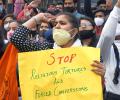
The Supreme Court on Monday said it would hear on February 3 a batch of pleas challenging controversial state laws regulating religious conversions due to interfaith marriages.
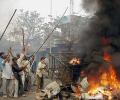
Terming as "infructuous", the Supreme Court on Tuesday closed as many as 11 petitions, including the one filed by the National Human Rights Commission (NHRC), almost 20 years ago seeking an independent probe into the 2002 Gujarat riots cases.

The 1991 provision is an Act to prohibit conversion of any place of worship and to provide for the maintenance of the religious character of any place of worship as it existed on August 15, 1947, and for matters connected therewith or incidental thereto.
The Supreme Court of India on Wednesday asked the Centre to furnish by October 31 its affidavit in response to petitions challenging the validity of certain provisions of a 1991 law, which prohibit filing of a lawsuit to reclaim a place of worship or seek a change in its character from what prevailed on August 15, 1947.
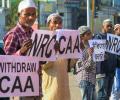
The plea filed by NGO Association for Protection of Civil Rights and others also sought a direction to the Centre to refrain from preparing the National Register of Citizens.

While five pleas have been filed by Maulana Mufti Hasbullah, Moulana Mahfoozur Rehman, Mishbahuddin, Mohd Umar and Haji Nahboob, who are all supported by the All India Muslim Personal Law Board, the sixth one has been filed by Mohammad Ayub.

If the 'shebaitship' of Nirmohi Akhara was accepted, then their evidence will also be accepted, the bench said on the 20th day of the hearing in the politically-sensitive case.

During the hearing, Solicitor General Tushar Mehta, appearing for the Centre, said that meaning of Sanskrit 'shlokas' is a universal truth and merely because it is written in Sanskrit, it does not make it communal.
The litigant, in review plea filed through lawyer Ejaz Maqbool, has also sought an interim stay on operation of the verdict in which it had directed the Centre that a trust be formed within three months for construction of the temple at the site.
 © 2026 Rediff.com - Advertise with us - Disclaimer - Privacy Policy - Sitemap - Feedback - About us - Terms of use - Grievances