
India's gross GST collection increased by 8.1 per cent to over Rs 1.83 lakh crore in February, driven by higher import revenues and improved domestic sales. Despite some states reporting negative or below-average growth, experts see the overall trend as a sign of a maturing tax ecosystem and a confident domestic market.

Base revisions are technical exercises, but history shows they can significantly reshape the narrative around India's growth performance.

The deal shifts the US posture towards India from hostile to neutral, and that matters for growth, points out T T Ram Mohan.

Rising automobile exports are reflective of the increasing acceptance of India-manufactured vehicles across global markets, according to Economic Survey 2025-26.
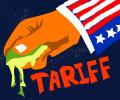
India must focus on building enduring national capabilities and economic sovereignty in the face of shrinking space for rules-based trading, anti-immigrant stance, weaponization of energy sources and growing use of export controls in critical sectors, the Economic Survey said on Thursday.

"The policy of Macaulay, which sowed the seeds of mental slavery in India, will complete 200 years in 2035. This means there are 10 years left. Therefore, in these very 10 years, we all must come together to free our country from the slave mentality," he said.

President Droupadi Murmu addressed the nation on the eve of Independence Day, praising the response to terrorism, highlighting achievements in defense self-reliance, and emphasizing unity and progress.

President Droupadi Murmu's address to the nation on the eve of the 79th Independence Day.

'Pakistan will also try to turn Bangladesh into a base for terrorist attacks on India.'

...the DMK chief minister's campaign -- which includes criticism of the BJP's 'pro-Hindutva, anti-Tamil, anti-federal' policies and building on his own government's social welfare programmes targeting especially women and youth -- appeals to Tamil Nadu's voters in next year's assembly election, explains N Sathiya Moorthy.

The CII Business Summit 2025's inaugural session witnessed a rousing standing ovation and a felicitation ceremony for the defence top brass sending a strong message about India's rising military industrial complex and hghlghting that security is a top-of-the-mind issue for India Inc.
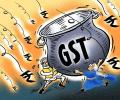
Goods and Services Tax (GST) collection rose 12.6 per cent Y-o-Y to an all-time high of about Rs 2.37 lakh crore in April, which the government said shows resilience of the Indian economy and the effectiveness of cooperative federalism. The gross GST mop-up was Rs 2.10 lakh crore in April 2024 -- the second highest collection ever since GST was rolled out on July 1, 2017. The net mop-up was Rs 1.92 lakh crore.

Credit card spending in September recorded strong growth of 25 per cent year-on-year (Y-o-Y), marking the highest increase in six months. Even as many banks saw higher slippages during the July-September quarter of 2024-25, spending growth exceeded 20 per cent for the first time since February. According to the latest data released by the Reserve Bank of India (RBI), September spending reached Rs 1.76 trillion, compared to Rs 1.42 trillion in the same period a year ago. In August 2024, credit card spending was Rs 1.68 trillion.

India's GDP is likely to grow at 6.5 to 7 per cent in the current fiscal year amid global challenges which may impact exports, said Economic Survey 2023-24 tabled in Parliament on Monday. The growth projected for 2024-25 is lower than the economic growth rate of 8.2 per cent estimated for the previous financial year. The Reserve Bank has projected the GDP growth for the fiscal year ending March 2025 at 7.2 per cent.

The Survey is authored by Chief Economic Advisor V Anantha Nageswaran and his team.

Capital markets are becoming more prominent in India's growth story, with an expanding share in capital formation and investment landscape on the back of technology, innovation and digitisation, according to the Economic Survey 2023-24 tabled in Parliament on Monday. Further, Indian markets are resilient to global geo-political and economic shocks, it added. "Despite heightened geo-political risks, rising interest rates and volatile commodity prices, Indian capital markets have been one of the best performing among emerging markets in FY24," the Economic Survey said.

Looking under the hood, I see India on the terrible, but commonplace, road to prosperity failure, warns Rathin Roy.

With the prediction of an above normal monsoon in 2024, the government is expecting food prices to come down, the finance ministry's monthly economic report for March has said. The report, released on Thursday, said robust foreign inflows and comfortable trade deficits were expected to keep the rupee within a comfortable range. "Further easing of food prices is on the anvil as IMD (India Meteorological Department) has predicted above-normal rainfall during the monsoon season, which is likely to lead to higher production, assuming good spatial and temporal distribution of the rainfall," the monthly report, released by the Department of Economic Affairs, said.

The finance ministry expects a broad-based moderation in inflationary pressures on the back of an anticipated reduction in food prices as a result of the uptick in summer sowing. The retail inflation rate remained stubbornly clung to the 5 per cent mark in seven of the past eight months. "Core inflation is trending downwards, indicating a broad-based moderation in price pressures... Driven by strong domestic growth and benign global commodity prices, core inflation is declining continuously.

Gujarat's so-called superior performance, relative to its own history, and its present peer group, is being used to assiduously promote a personality cult around Modi together with a fascist ideology, say Sonali Ranade and Shaelja Sharma

Have the markets already played out their dynamics before the economy has even properly taken off? Are we now destined for a period of mediocre returns despite a strong economy? asks Akash Prakash.

Taking both direct and indirect taxes, the gross collection is expected to grow 10.45 per cent to Rs 33.61 trillion in 2023-2024.
On a scale of 1 to 10, how would you rate the economic achievements of the government?

'Historically, equities have consistently outperformed debt, gold, property, and other assets over a reasonable period.'
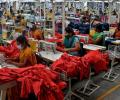
Enthused by higher than expected GDP numbers in the fourth quarter of 2022-23, Chief Economic Adviser (CEA) V Anantha Nageswaran on Wednesday said India's economic growth may exceed the initial estimate of 6.5 per cent in the current fiscal and the country can look for another year of solid economic performance.

The Indian economy will grow at around 6.5 per cent in the current fiscal, notwithstanding high crude oil prices and increased uncertainty due climate changes, NITI Aayog member Arvind Virmani said on Thursday. Virmani also asserted that the gross household savings ratio in India has consistently gone up. In an interview with PTI, he said: "My growth projection (of India's GDP growth) is 6.5 per cent plus minus 0.5 per cent... because my experience is that the fluctuations in global GDP more or less has balanced out for us, assuming normal changes."
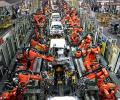
India's economy grew 6.1 per cent in the fourth quarter of 2022-23, pushing up the annual growth rate to 7.2 per cent, official data showed on Wednesday.
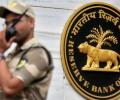
A day after the RBI raised the benchmark lending rate by 35 basis points, Kotak Mahindra Bank Managing Director Uday Kotak on Thursday said the central bank may go for one more rate hike to bring inflation below its upper tolerance level of 6 per cent. Yesterday, the RBI indicated that it wants inflation to be within the band first and then move towards the target of 4 per cent, Kotak said at the CII Global Economic Policy Summit 2022. "My sense is that there could be one more rate hike and that may be the time for thinking about a pivot, but we got to watch very closely the data, and maybe around 6.5 per cent as it looks today, subject to what happens to the world, subject to what happens to oil, subject to what happens to many other things," he said.

India's growth in the last three financial years has averaged just 1.9%. It is natural to project rapid growth from this low base. Crucial to that would be the assumption that the economy has suffered no lasting damage from the pandemic, observes T N Ninan.

Seeking to address international concerns, foreign ministry spokesman Zhao Lijian said China has been adjusting the zero-COVID policy based on the changing circumstances.

The International Monetary Fund (IMF) on Tuesday slashed India's growth forecast for 2022-23 (FY23) by 80 basis points to 7.4 per cent, citing less favourable external conditions and rapid policy tightening by the central bank. In its update to the April World Economic Outlook, the IMF said that though a global recession in 2022 was ruled out with a growth estimate of 3.2 per cent, the balance of risks was squarely to the downside, driven by a wide range of factors that could adversely affect the global economic performance. "The risk of recession is particularly prominent in 2023, when in several economies growth is expected to bottom out, household savings accumulated during the pandemic will have declined, and even small shocks could cause economies to stall.

India's services sector activity expanded at the second-fastest pace in more than a decade during November, driven by sustained rise in new work and improvement in market conditions, a monthly survey said on Friday. The seasonally adjusted India Services Business Activity Index was at 58.1 in November, fractionally down from 58.4 in October. The November figure points to the second-fastest rise in output since July 2011. For the fourth straight month, the services sector witnessed an expansion in output.

Indians' belief in the country's economic future has diminished in the recent years, with the COVID-19 pandemic taking a further toll on sentiment while pushing many middle-class citizens into poverty, former RBI governor Raghuram Rajan has said. Virtually addressing an event organised by the NALSAR University of Law, Rajan further said the domestic stock market is booming but that does not reflect the reality that many Indians are in deep distress.

Economic performance is affected if large numbers of people are out of work, or at such low levels of income as to force under-consumption, observes T N Ninan.

Ajit Balakrishnan on how to arrest a worldwide decline.

The robust revenue collection reinforces hope of a good economic performance in the third quarter of financial year 2020-21 after the surprising pickup seen in Q2.

A new Congress leader may make an electoral impact by his very presence. Congress voters who had moved away from the party, after being influenced by the BJP's 'family rule' campaign, can now return with a certain moral satisfaction, observes N Sathiya Moorthy.

The employment situation remains dire. Whatever can be done to promote greater low-skill employment should be pursued aggressively, advises former chief economic adviser Shankar Acharya.

Issues such as the economy's health and the government's ability to produce an environment where jobs are available are not of particular concern to us as voters, asserts Aakar Patel.

India maintained 43rd rank on an annual World Competitiveness Index compiled by the Institute for Management Development (IMD) that examined the impact of COVID-19 on economies around the world this year. The 64-nation list was led by Switzerland, while Sweden has moved up to the second position (from sixth last year), Denmark has lost one place to rank third, the Netherlands has retained its fourth place and Singapore has slipped to the fifth place (from first in 2020). At eighth, Taiwan reached the top-10 for the first time since the ranking began 33 years ago (moving up from 11th last year).
 © 2026 Rediff.com - Advertise with us - Disclaimer - Privacy Policy - Sitemap - Feedback - About us - Terms of use - Grievances