
Retail inflation eased to 7.04 per cent in May, mainly on account of softening food and fuel prices as the government as well as the RBI stepped in to control spiralling price rise by way of duty cuts and repo rate hike. However, the inflation print stayed above the Reserve Bank's upper tolerance level of 6 per cent for the fifth month in a row. The Consumer Price Index (CPI) based retail inflation was 7.79 per cent in April.

In a double delight, retail inflation eased to a one-year low of 5.72 per cent - staying below the upper tolerance limit for two months in a row, while factory output rose sharply to 7.2 per cent on the back of healthy growth in manufacturing. The retail inflation numbers based on Consumer Price Index (CPI) will provide some room for the Reserve Bank to further moderate the quantum of hike in key interest rate or even press a pause button. The RBI has been on a rate hiking spree since May 2022 in its bid to tame inflation, having raised the repo rate by a cumulative 225 basis points (bps).

The wholesale price-based inflation declined to over two-year low of 3.85 per cent in January on easing prices of manufactured items, fuel and power, even though food articles remained expensive. This is the ninth straight month of decline in the rate of wholesale price-index (WPI) based inflation. The WPI inflation was 4.73 per cent in January and 13.43 per cent in February, last year.

Renewed inflationary pressures, led by a spike in prices of vegetables and cereals, have cast a spell on the equity markets in the past month. The BSE Sensex and Nifty50 have declined up to 2 per cent each during the period, clipping the 13 per cent rally from the March lows, shows data from ACE Equity. Investors typically consider shares of fast-moving consumer goods (FMCG) companies as defensive bets, putting their weight behind them in a falling market.

Days after the US Fed raised the interest rate, the RBI may go in for its third consecutive policy rate hike by at least 35 basis points to check high retail inflation, experts said. The central bank has already announced to gradually withdraw its accommodative monetary policy stance. The Reserve Bank of India's rate-setting panel -- the Monetary Policy Committee -- will meet for three days from August 3 to deliberate on the prevailing economic situation and announce its bi-monthly review on Friday.
The rise in consumer price index (CPI) inflation could see the Reserve Bank of India (RBI) in an extended pause mode as regards interest rates, and in turn, keep the market rally in check, believe analysts. Signs of inflation cooling off in the US, however, is likely to provide some cushion as the expectations of a change in stance by the US Fed as regards interest rates is likely to aid sentiment. Back home, CPI inflation surged for the first time in five months to 4.81 per cent in June 2023, and was higher than the street's expectations of 4.58 per cent.

Ahead of Diwali festival, the Union Cabinet on Wednesday increased the dearness allowance (DA) and dearness relief by 4 per cent effective July 1, 2022, benefiting 41.85 lakh central government employees and 69.76 lakh pensioners. The additional instalment of DA and dearness relief (DR) is an increase of 4 per cent over the existing rate of 34 per cent of basic pay/pension. The combined impact on the exchequer on account of both DA and DR would be Rs 12,852.5 crore per annum, said Information and Broadcasting Minister Anurag Thakur while briefing reporters about the decisions of the Union Cabinet.
Retail inflation rose marginally to 4.91 per cent in November, mainly due to an uptick in food prices, government data showed on Monday. The Consumer Price Index (CPI) based retail inflation was 4.48 per cent in October 2021 and 6.93 per cent in November 2020. As per the data released by the National Statistical Office (NSO), food inflation was at 1.87 per cent in November this year compared to 0.85 per cent in the preceding month.

Bond markets, global as well as domestic, are likely headed towards hard times over the next three to six months, as higher vegetable prices, rising fuel costs, and improved wages may keep inflation hot, believe analysts, who expect the yields to hit 7.5 per cent in the near-term from the current 7.234 per cent. In this backdrop, they suggest investors can put in money in funds/instruments with residual maturity of 4 to 6 years, while longer-term investors can allocate cautiously to the longer end in the range beyond 7 years.

The wholesale price-based inflation declined to a 21-month low of 5.85 per cent in November on easing prices of food, fuel and manufactured items. After remaining in double digits for 19 months, the wholesale price index (WPI) based inflation declined to 8.39 per cent in October. The inflation was 14.87 per cent in November 2021. "Decline in the rate of inflation in November 2022, is primarily contributed by fall in prices of food articles, basic metals, textiles, chemicals & chemical products and paper & paper products as compared to the corresponding month of the previous year," the commerce and industry ministry said on Wednesday.

While India won't be immune to global spillovers, we need to create the macro preconditions for sustained growth. Policy agility, prudence, and resilience will be key, suggests Sonal Varma.

Rising crude oil prices, traction in China equities and inflation concerns back home are casting a shadow on the Indian equity markets in the short term, believe analysts at Jefferies. They said this could see the markets remaining range-bound in the near term before the next leg up.

Retail inflation dipped marginally to 6.44 per cent in February, mainly on account of a slight easing in prices of food and fuel items though it remained above the Reserve Bank's comfort level of 6 per cent for the second month in a row. As per the government data released on Monday, the Consumer Price Index (CPI)-based inflation was at 6.52 per cent in January and 6.07 per cent in February 2022. The retail inflation rate for the food basket worked out to be 5.95 per cent in February, marginally lower than 6 per cent in January.

How is it that tomatoes recorded a price fall in official statistics when it remained unaffordable for the common person in June?
Retail inflation declined to a one-year low of 5.72 per cent in December 2022, mainly due to softening prices of food items, according to official data released on Thursday. The Consumer Price Index (CPI) based retail inflation was at 5.88 per cent in November 2022 and 5.66 per cent in December 2021.

Manufacturing activities in India touched a three-month high in March boosted by faster expansions in new orders and output amid demand resilience and easing of cost pressures, according to a monthly survey. The seasonally adjusted S&P Global India Manufacturing Purchasing Managers' Index (PMI) rose from 55.3 in February to 56.4 in March, signalling the strongest improvement in operating conditions in 2023 so far. The March PMI data pointed to an improvement in overall operating conditions for the 21st straight month.

Benchmark BSE Sensex gained 130 points on Friday after gains in index majors Reliance Industries, ICICI Bank and Tata Steel ahead of the release of inflation and factory output data. Recovering from its early losses, the 30-share BSE index ended 130.18 points or 0.22 per cent higher at 59,462.78 in a range-bound trade. The broader NSE Nifty advanced 39.15 points or 0.22 per cent to close at 17,698.15.

Finance Minister Nirmala Sitharaman on Wednesday said the country's economic growth remains a priority for the government, as inflation has come down to a manageable level. Job creation and equitable distribution of wealth remain the other focus areas, she said at India Ideas Summit. "Some of course are red-lettered (priorities), some may not be. Red-lettered ones would of course be jobs, equitable wealth distribution and making sure India is moving on the path of growth.

S&P Global Ratings on Monday kept its forecast for India's economic growth unchanged at 6 per cent in the fiscal year starting April 1, before rising to 6.9 per cent in the following year. In the quarterly economic update for Asia-Pacific, S&P saw inflation rate easing to 5 per cent in 2023-24 fiscal, from 6.8 per cent in the current financial year. It saw India's gross domestic product (GDP) likely growing by 7 per cent in the current financial year ending March 31 (2022-23), before slowing to 6 per cent in the next 2023-24 fiscal.

The Reserve Bank is likely to maintain status-quo on the key interest rates for the third time in a row in its upcoming bi-monthly policy review despite the US Federal Reserve and the European Central Bank hiking benchmark rates, as domestic inflation is within the RBI's comfort zone, say experts. The borrowing cost which started rising in May last year has stabilised with RBI keeping the repo rate unchanged at 6.5 per cent since February when it was raised from 6.25 per cent. In the previous two bi-monthly policy reviews in April and June the benchmark rate was retained.
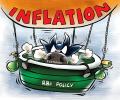
The Reserve Bank on Wednesday projected inflation to come down below the upper threshold level of 6 per cent by March quarter of the current fiscal. RBI Governor Shaktikanta Das said the central bank will keep 'Arjuna's eye' (focus) on the evolving inflation dynamics and will remain 'nimble and flexible' to deal with the price situation. Global commodity prices, including crude oil, have undergone some downward correction, but uncertainty continues to surround the near-term outlook in view of the prolonging geo-political hostilities. Moreover, the resurgence in domestic services sector activity could also lead to price increases, especially as firms pass on input costs.

Investors' wealth eroded by more than Rs 2.21 lakh crore in early trade on Wednesday, with the market witnessing a selling-off amid prospects of aggressive rate hikes by the US Federal Reserve to tackle high inflation, and sluggish global trends. In less than an hour of the start of trading on Wednesday, the key indices -- Sensex and Nifty -- were deep in the red and witnessed significant volatility, reflecting jittery investor sentiments. The market capitalisation of BSE-listed companies, which is also an indicator of wealth of investors, tumbled more than Rs 2.21 lakh crore to Rs 2,84,49,727.56 crore amid the 30-share Sensex falling 564.76 points to 60,006.32 points.
Retail inflation declined to an 18-month low of 4.7 per cent in April mainly due to falling prices of vegetables, oils and fats, and came closer to Reserve Bank's target of 4 per cent, showed government data released Friday. It was for the second month in a row that Consumer Price Index (CPI) based inflation remained within the RBI's comfort zone of below 6 per cent. The government has tasked the central bank to ensure retail inflation remains at 4 per cent with a margin of 2 per cent on either side.

Equity benchmarks Sensex and Nifty on Friday spurted by nearly 2 per cent, propelled by heavy buying in IT, metal and financial stocks amid a rally in global markets after lower-than-expected US inflation data. A strong rupee against the US dollar and unabated foreign capital inflows further bolstered sentiment, traders said. Easing US inflation triggered speculation that the US Federal Reserve might slow down the pace of interest rate hikes.

Retail inflation eased to 4.06 per cent in January, mainly on account of a decline in vegetable prices, as per government data released on Friday. The inflation based on Consumer Price Index (CPI) was 4.59 per cent in December 2020.

A careful reading of the national income accounts suggests that after a strong recovery from the pandemic, there has been a significant ebbing of dynamism over the last three quarters to more modest levels recently, note Arvind Subramanian and Josh Felman.

Finance Minister Nirmala Sitharaman on Thursday said India has ramped up the import of crude oil from Russia at discounted prices amid sanctions on Moscow as part of the country's inflation management. "In a situation where global prices were going beyond anyone's affordability, at that stage to take a very strong political decision, I respect the prime minister for his courage on this to get it from Russia because they are ready to give it to you at discount. And how speedily did we manage to do it," she said. India ramped up its import from Russia from about 2 per cent of the total shipment of petroleum products to 12-13 per cent in a couple of months as part of inflation management, she said at a seminar organised by economic think-tank Icrier.

In twin blows to Indian economic revival, higher food prices drove retail inflation to a five-month high of 7.4 per cent while factory output fell for the first time in 18 months. The second consecutive month of rise in consumer price index (CPI)-based inflation will add to the pressure on the Reserve Bank of India (RBI) to again raise interest rates to tame high prices. Inflation has been above the targeted zone for the ninth month in a row and as per statute, the RBI will now have to explain to the government in writing why it failed to keep prices below 6 per cent.

The rupee depreciated by 37 paise to close at 79.62 against the US dollar on Thursday despite sustained foreign capital inflows and a positive trend in equities. At the interbank foreign exchange market, the local currency opened at 79.22 and saw an intra-day high of 79.22 and a low of 79.94 against the American currency. It finally ended at 79.62, down 37 paise over its previous close of 79.25.

The wholesale price-based inflation eased to a 29-month low of 1.34 per cent in March on easing prices of manufactured products and fuel items, even though food articles turned expensive.

'There are occasions when the prices of individual items like food raise inflation; then supply-side measures must be taken.' 'But if there is continued inflation, it means liquidity is aggravating the situation.'

Enthused by higher than expected GDP numbers in the fourth quarter of 2022-23, Chief Economic Adviser (CEA) V Anantha Nageswaran on Wednesday said India's economic growth may exceed the initial estimate of 6.5 per cent in the current fiscal and the country can look for another year of solid economic performance.

Elevated food price-led inflation could become a sore point for markets, which they seem to be ignoring at current levels, observe analysts. Retail inflation in India - as measured by the Consumer Price Index (CPI) - came in at a three-month high of 6.52 per cent in January 2023, compared with 5.72 per cent in December and 5.88 per cent in November 2022. The inflation print for February, according to Madan Sabnavis, chief economist at Bank of Baroda, will be critical for the Reserve Bank of India's monetary policy committee.

Inflation has reappeared as a global issue in both advanced and emerging economies and India needs to be wary of "imported inflation", especially due to high oil prices, according to the Economic Survey 2021-22 released on Monday. "Inflation has reappeared as a global issue in both advanced and emerging economies. "India's Consumer Price Index inflation stood at 5.6 per cent YoY in December 2021 which is within the targeted tolerance band," the survey report presented in the Parliament by Finance Minister Nirmala Sitharaman noted.
The wholesale price-based inflation bucked the 4-month rising trend in December 2021, and eased to 13.56 per cent, mainly on account of softening in fuel, power and manufacturing items even though food prices hardened. WPI inflation has remained in double digits for the ninth consecutive month beginning April. Inflation in November was 14.23 per cent, while in December 2020 it was 1.95 per cent.

Retail inflation hit an eight-month high of 6.07 per cent in February, remaining above the RBI's comfort level for the second month in a row, while wholesale price-based inflation soared to 13.11 per cent on account of hardening of crude oil and non-food item prices, government data showed on Monday. The previous high for retail inflation was 6.26 per cent in June 2021. The consumer price index (CPI) based retail inflation, which is taken into account by the Reserve Bank of India (RBI) while deciding its monetary policy, rose mainly because of costlier food items, as per the data released by the National Statistical Office (NSO).

The government's step could push investors to choose riskier equity, or to fall back on bank deposits, thereby negatively impacting the debt market which actually needs to grow, points out T N Ninan.
The Reserve Bank's rate setting panel on Thursday met to finalise a report for the government on why it failed to keep retail inflation below the target of 6 per cent for three consecutive quarters since January this year, said sources. The report will be presented to the government as per the Reserve Bank of India Act, they added. The six-member Monetary Policy Committee (MPC) is headed by Governor Shaktikanta Das.
The wholesale price-based inflation rose to a four-month high of 14.55 per cent in March, mainly due to hardening of crude oil and commodity prices, even though vegetables witnessed easing of price pressures. As per the government data released on Monday, WPI inflation has remained in double digits for the 12th consecutive month beginning April 2021. The last time such a level of WPI was recorded was in November 2021, when inflation was 14.87 per cent.

'Revision of the base year for both CPI and GDP are long overdue.' 'The basic data that went into the 2011-2012 series were mainly from surveys done in 2011 or earlier.' 'We have since seen the emergence of new sectors like platform-based work and online marketing.' 'The employment surveys and the consumption surveys need to reflect these adequately.'
 © 2026 Rediff.com - Investor Information - Advertise with us - Disclaimer - Privacy Policy - Sitemap - Feedback - About us - Terms of use - Grievances