
Fitch Ratings on Thursday raised its forecast for India's economic growth to 7 per cent for the next fiscal year starting April 1 on the back of strong domestic demand and sustained level of business and consumer confidence. With a stronger-than-expected 8.4 per cent growth in gross domestic product (GDP) during the third quarter (October-December) of the current fiscal year, Fitch saw the Indian economy expanding 7.8 per cent in 2023-24 financial year (April 2023 to March 2024), marginally higher than the government's estimate of 7.6 per cent.

The Interim Budget for 2024-25 (FY25) to be presented on February 1 is likely to assume 10-10.5 per cent nominal gross domestic product (GDP) growth against 8.9 per cent estimated for FY24 by the National Statistical Office (NSO). "We were waiting for the First Advance Estimates GDP numbers for FY24. "We will finalise the nominal GDP growth assumption for FY25 Interim Budget in a couple of days.

The Reserve Bank on Friday retained the inflation forecast for 2023-24 at 5.4 per cent, and vowed to take timely measures to prevent any spillovers of global food and fuel price shocks. Stressing that the Reserve Bank has identified high inflation as a major risk to macroeconomic stability and sustainable growth, Governor Shaktikanta Das said the September retail inflation number may be lower than August and July prints. The headline inflation based on Consumer Price Index (CPI) moderated to 4.6 per cent in first quarter of 2023-24 as compared to 7.3 per cent in the same period a year ago.

The ongoing second quarter earnings, movement of oil benchmark Brent crude and the uncertainty in the Middle East would dictate terms in the domestic markets this week, analysts said. Furthermore, the activities of Foreign Institutional Investors (FIIs) will also influence trading in the markets. "A slew of earnings reports from heavyweights expected this week will significantly impact market direction.

Snapping its declining trend, retail inflation rose to a three-month high of 5.55 per cent in November on firming food prices, including vegetables and cereals, though it remains within the RBI's comfort zone of less than 6 per cent. Inflation based on the Consumer Price Index (CPI) was 4.87 per cent in October and 5.88 per cent in November 2022, the government data released on Tuesday showed. The previous high was 6.83 per cent in August and inflation had been on a decline since then.

India spends significantly less on defence than could be expected from a country that faces simultaneous armed threats from two hostile neighbours -- China and Pakistan.

After falling 10 per cent against the greenback in 2022, the rupee staged a comeback in 2023 as it appreciated, albeit marginally, on the back of strong portfolio inflows, in addition to timely intervention by the Reserve Bank of India. The Indian unit appreciated by 0.16 percent in six months until June 28. The rupee stood in third place in terms of appreciation against the US dollar among the 12 Asian currencies and in 12th place of the 23 emerging-market currencies.

'Your decisions should not be driven by your view on the market, but by your objectives, risk appetite, and time horizon.'
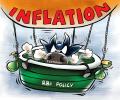
The Reserve Bank of India on Thursday marginally lowered its inflation projection for the current financial year to 5.1 per cent, as Governor Shaktikanta Das said the central bank's monetary policy actions are yielding the desired results. In April, the Reserve Bank had estimated the consumer price index (CPI) based retail inflation at 5.2 per cent during the fiscal 2023-24. CPI inflation fell sharply to 4.7 per cent in April 2023, from 6.4 per cent in February, on the back of favourable base effects, with softening observed across all the three major groups.

The wholesale price-based inflation eased for the eighth consecutive month to 4.73 per cent in January on easing prices of manufactured items, fuel and power. The wholesale price-index (WPI) based inflation rate was 4.95 per cent in December 2022 and 13.68 per cent in January 2022. Inflation in food articles, however, rose to 2.38 per cent in January, from (-) 1.25 per cent in December, 2022.

Retail inflation declined to 6.83 per cent in August after touching a 15-month high of 7.44 per cent in July, mainly due to softening prices of vegetables, but still remains above the Reserve Bank's comfort zone. The overall inflation in the food basket stood at 9.94 per cent in August as against 11.51 per cent in July, according to data released by the National Statistical Office (NSO) on Tuesday. Retail inflation based on the Consumer Price Index (CPI) was at 7 per cent in August 2022.

Indian economy is gathering momentum in the second quarter, though inflation would continue to average above the central bank's comfort zone of 6 per cent, said an article in the RBI's monthly bulletin released on Thursday. The consumer price index (CPI) based retail inflation shot up significantly to 7.44 per cent in July, from 4.87 per cent in the preceding month, mainly due to soaring prices of tomato, vegetables and other food items. In his address to the nation on the Independence Day, Prime Minister Narendra Modi vowed to take more steps to contain price rise.

Reserve Bank Governor Shaktikanta Das on Wednesday said the decision to tweak policy rates was not in his hand as he himself is driven by the situation on the ground. In April, the Reserve Bank in a surprise move hit the pause button and decided to keep the key benchmark policy rate at 6.5 per cent. Prior to it, the Reserve Bank of India (RBI) was on a rate hiking spree, raising the repo rate by 250 basis points since May 2022.

Power Grid, HCL Technologies, Asian Paints, Hindustan Unilever, Maruti and Nestle were among the laggards. Shares of HCL Technologies were trading over 1 per cent lower even after the company reported a 7.6 per cent year-on-year rise in June quarter net profit on the back of new order wins.
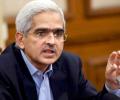
Reserve Bank of India (RBI) Governor Shaktikanta Das had stumped the market in the previous two policies - in August and in October - first with action and then with words. In August, it was the introduction of an incremental cash reserve ratio (I-CRR) to take out excess liquidity, which took the markets by surprise. In October, there was no action. Rather, what is known as "open mouth operation", Das' comment that the central bank might conduct open market operations (OMOs) by selling bonds tempered the euphoria in the bond markets after JP Morgan's inclusion of India in its Emerging Market Bond Index.

From the Sensex pack, ITC, Titan, Asian Paints, Reliance, Tata Steel, Bajaj Finserv, Axis Bank, Hindustan Unilever, Infosys, Bajaj Finance, Nestle and ICICI Bank were the major gainers. Kotak Mahindra Bank, Mahindra & Mahindra, HCL Technologies, State Bank of India, Bharti Airtel and Tata Motors were among the laggards.

'If rate cuts happen, bond yields will come down and investors will make mark-to-market capital gains on them.'

Wholesale price inflation remained in the negative territory for the fourth month in a row in July at (-)1.36 per cent, even though prices of food items, especially vegetables, skyrocketed. The inflation, however, has inched up from (-)4.12 per cent recorded in June fuelled by 62.12 per cent rise in vegetable prices. In July last year, wholesale price index (WPI) was 14.07 per cent.
India's headline retail inflation is expected to moderate further in the months to come, as low wholesale inflation will transmit to consumer prices, the Ministry of Finance said in its latest monthly economic review (MER) on Monday. "Inflationary pressures eased in February, with slight moderation in Consumer Price Index (CPI) inflation and Wholesale Price Index (WPI) inflation softening to a 25-month low. "With WPI inflation easing, its transmission to CPI inflation is soon expected," the MER for February said.
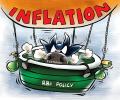
"We have to stand in readiness to go beyond keeping Arjuna's eye to deploying policy instruments, if necessary" to contain inflation, said Reserve Bank Governor Shaktikanta Das on Thursday. Headline consumer price index-based inflation projection for the second quarter of 2023-24 has been revised up substantially, primarily due to the price shock from vegetables, at 6.2 per cent by the RBI form 5.2 per cent estimated in June. Unveiling the bi-monthly monetary policy, Governor Das said the moderation in headline inflation to 4.6 per cent in the first quarter of 2023-24 was in line with the projections set out in the June MPC meeting.
Equity markets rallied after softer-than-expected inflation data in the US and UK rekindled hopes of the end of the rate-hiking cycle by major central banks. The soft inflation reading drove down bond yields and the US dollar, whetting the appetite for risky assets. The 10-year US bond yield fell below 4.5 per cent after topping 5 per cent less than a month ago.

Consumer price-based inflation jumped to 6.95 per cent in March, mainly on account of costlier food items, according to government data released on Tuesday. The Consumer Price Index (CPI) based inflation was 6.07 per cent in February.
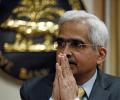
The Reserve Bank of India's rate-setting panel on Wednesday began its three-day deliberations on the next bi-monthly monetary policy amid expectations of at least a 35-basis-point hike in the interest rate to check high inflation. If raised, it will be the third consecutive hike in the repo rate -- the short-term rate at which the RBI lends money to banks. The central bank has already announced to gradually withdraw its accommodative monetary policy stance.

Fitch Ratings on Thursday retained India's growth forecast for the current fiscal at 6.3 per cent citing economic resilience despite tighter monetary policy and exports weakness, but upped year-end inflation projection on El Nino threat. The Indian economy grew 7.8 per cent in the April-June quarter of current fiscal on strong services sector activity and robust demand. "The Indian economy continues to show resilience despite tighter monetary policy and weakness in exports, with growth outpacing other countries in the region," Fitch said, while projecting 6.3 per cent growth for current fiscal (April-March), and 6.5 per cent for next fiscal.
Retail inflation fell to an 11-month low of 5.88 per cent in November, mainly due to softening prices of food items, official data showed on Monday. This is the first time in 11 months that the retail inflation print has come within RBI's tolerance band of 4 (+/- 2) per cent. The consumer price index (CPI) based retail inflation was 6.77 per cent in October 2022, and 4.91 per cent in November last year.
Retail inflation dropped to 6.77 per cent in October from 7.41 per cent in the preceding month, mainly due to easing prices in the food basket, though it remained above Reserve Bank's comfort level for the 10th month in a row, according to the government data released on Monday. The Consumer Price Index (CPI) based retail inflation has remained above the 6 per cent target since January this year.

The wholesale price-based inflation surged to more than a decade high of 14.23 per cent in November, mainly due to hardening of prices of mineral oils, basic metals, crude petroleum and natural gas. WPI inflation has remained in double digits for eight consecutive months beginning April. Inflation in October this year was at 12.54 per cent, while in November 2020 it was at 2.29 per cent. "The high rate of inflation in November 2021, is primarily due to rise in prices of mineral oils, basic metals, crude petroleum & natural gas, chemicals and chemical products, food products etc as compared to the corresponding month of the previous year," the commerce and industry ministry said in a statement on Tuesday.

The Reserve Bank on Wednesday projected retail inflation to ease to 5.3 per cent in next fiscal from 6.5 per cent this year on assumptions of lower imported inflation, even though core inflation remains sticky. The RBI's inflation outlook for current fiscal has improved from 6.8 per cent projected earlier, to 6.5 per cent, on the back of steeper than expected decline in vegetable prices and Indian basket of crude at $95 a barrel. "Looking ahead, while inflation is expected to moderate in 2023-24, it is likely to rule above the 4 per cent target.

Foreign flows into Indian equities are expected to pause in the short to medium term, say analysts. The outlook is influenced by multiple factors, including rising oil prices, actions from global central banks, climbing bond yields, and the dollar index gaining prominence. "Valuations appear rich with the markets at record highs.

Finance Minister Nirmala Sitharaman on Wednesday said the government is keeping an eye on inflation which is purely "extraneous" nowadays because of fuel and fertiliser prices. Replying to the debat on the Supplementary Demands for Grants in the Rajya Sabha, the minister said wholesale inflation has fallen to a 21-month low. Later, the Rajya Sabha returned the Supplementary Demands for Grants to the Lok Sabha, thus completing the process of authorising the government to spend an additional Rs 3.25 lakh crore in FY2022-23.

Retail inflation jumped to a 15-month high of 7.44 per cent in July as prices of vegetables and other food items spiked, according to official data released on Monday. The Consumer Price Index (CPI) based inflation was at 4.87 in June and 6.71 per cent in July 2022. Previously, high inflation was recorded at 7.79 per cent in April 2022.
Retail inflation breached the RBI's comfort zone and rose to a three-month high of 6.52 per cent in January, mainly on account of a spike in food prices, as per government data released on Monday. The inflation rate based on the Consumer Price Index (CPI) stood at 5.72 per cent December and 6.01 per cent in January 2022.

The Monetary Policy Committee (MPC) is expected to maintain the status quo on policy rates for the fourth consecutive time in its October 4-6 review meeting. The incremental information available since its last meeting in August suggests that growth and inflation prints for the second quarter (Q2) of financial year 2023-24 (FY24) will exceed the committee's projections. However, the Consumer Price Index (CPI)-based inflation is expected to moderate in the second half (H2) of FY24.
Retail inflation cut short its three-month declining trend and inched up to 7 per cent in August mainly due to higher food prices, according to official data released on Monday. The consumer price index (CPI) based inflation was 6.71 per cent in July and 5.3 per cent in August 2021. The CPI inflation has remained above the RBI's comfort level of 6 per cent for the eighth month in a row.
The RBI's rate-setting panel MPC on Monday began its three-day deliberation amid expectations of another round of hike in benchmark interest rates to contain inflation that continues to remain above the central bank's upper tolerance level. RBI Governor Shaktikanta Das will announce the decision of the Monetary Policy Committee after deliberations on Wednesday. Das has already indicated that there may another hike in the repo rate, though he refrained from quantifying it.
Wholesale price-based inflation rate fell to a 3-year low of (-) 3.48 per cent in May on easing prices of food, fuel and manufactured items, strengthening the case for continuing with the pause in rate hike in the coming months of the current fiscal. This is the second straight month when WPI has been in the negative zone mainly on account of a higher base and falling prices of fuel and manufactured goods. Food prices also eased during May. In May, 2022 WPI inflation was at 16.63 per cent. Last month, it was (-) 0.92 per cent.
Retail inflation declined to a 25-month low of 4.25 per cent in May mainly on account of softening prices of food and fuel items, with experts saying that RBI is expected to hold interest rates steady in the current fiscal. This is the fourth straight month when retail inflation has declined and the third straight month of Consumer Price Index (CPI) based inflation remaining within the RBI's comfort zone of below 6 per cent. CPI-based inflation stood at 4.7 per cent in April and 7.04 per cent in May 2022.
The spike in food prices at the onset of the monsoon season has corroborated the Reserve Bank of India's (RBI's) view that the fight against inflation is far from over, the State of the Economy report of the central bank said. At the same time, the report said that the country is poised to become the fastest-growing major economy in the world, notwithstanding some sequential moderation in economic activity in June. Consumer Price Index (CPI)-based inflation rate increased to 4.8 per cent in June 2023, from 4.3 per cent in May, primarily on account of an increase in food inflation.
The inflation figures are based on data collected from limited markets in view of the restrictions imposed on account of coronavirus pandemic.

Retail inflation rose to three-month high of 4.81 per cent in June, mainly on account of hardening prices of food, according to the government data. Inflation based on the Consumer Price Index (CPI) stood at 4.31 per per (revised upward from 4.25 per cent) in May and 7 per cent in June 2022. The inflation, however, remains within the RBI's comfort level of below 6 per cent.
 © 2026 Rediff.com - Investor Information - Advertise with us - Disclaimer - Privacy Policy - Sitemap - Feedback - About us - Terms of use - Grievances