
Foreign investors faced flak for pulling down the domestic stock market deep into the red over the past one month. However, a little bit of data crunching shows that Foreign Institutional Investors are not guilty as charged.

'The difficult part is that there is no script and you have to be impromptu. So by the end of the day, I am very tired.'

The South China Morning Post has iconic status in the region.
After making its entry into the Bombay Stock Exchange's benchmark 30-share index Sensex in May

Major losers include Lupin 1.96 per cent, along with Tata Motors, Coal India and Sun Pharma.
The Indian economy is set to cross 7 per cent growth mark owing to robust industrial growth and continuous resurgence in the services sector, an industry survey said.
Investors lost as much as 20 per cent of their money put into equity focused mutual funds over the past one month as the benchmark stock index Sensex dropped about 11 per cent during the same period.
The Sensex stood at 13,786.91 points at the end of 2006 and closed the year 2007 at 20,286.99 points on Monday. It crossed seven thousand-point milestones -- from 14,000 to 20,000 marks -- during the year, which is the maximum for a year.
With the prices touching a two-year high, CEOs of leading companies expect a cut in corporate tax and measures to boost the capital markets in the Budget 2007-08 to be presented on February 28.

The NSE Nifty ended 89.40 points, or 0.83 per cent, lower at 10,710.45.
The Indian stock markets' buoyant reaction to US Fed's decision to halt the interest rate hikes seems to reflect the growing clout of FIIs on the domestic bourses, which were falling like ninepins not long time back.\n
Stock market listings in the ongoing turbulent phase have not only become a dreaded dream for corporates planning to raise money from public, but are turning out to be inauspicious for the benchmark Sensex too -- the trends on the bourses show.
The NSE index, Nifty, on Thursday surged over the 5,000-points mark in early trade, on aggressive buying by foreign and domestic funds. It gained 75.05 points at 5015.55 in the first five minutes of trade and hovered around the 5000 mark.
IIP down due to poor show by manufacturing, mining and power sectors

Talking corporate heads are a barometer of the business community's engagement with the economy. If they have nothing to say now there should be cause for concern.

India's annual industrial output growth slowed to 4.2 per cent in July compared with an upwardly revised 4.4 per cent growth a month ago, government data showed on Friday.

In line with Sensex, the broader indices also saw hefty losses. Large cap index tumbled 0.79 per cent, midcap 0.87 per cent and smallcap 0.57 per cent.

The CSO estimate is, however, a bit lower than 7.4 per cent growth projected by the Reserve Bank for the current fiscal.
Investors went looking for bargain in banking, oil and gas and auto stocks.

Manufacturing sector, which constitutes over 75 per cent of the index, grew at 5.5 per cent in November compared to a decline in output by 4.6 per cent earlier

Recent data from market analytics firm Nielsen shows that the rural market in the country's 630,000-odd villages is pulling down the overall FMCG business.

Infosys was the top gainer in the Sensex pack, rising 2.36 per cent, followed by HDFC Bank up 1.39 per cent.
India Inc has given the United Progressive Alliance government a 65 per cent score, a shade better than Prime Minister Manmohan Singh's

Slowdown in industrial production notwithstanding, a marginal increase in inflation raised the clamour for another round of rate cut by the Reserve Bank on April 4 to boost economic activity.
The Indian industry on Tuesday expressed overwhelming concern at the way the stock market had negated all negatives and scaled an all-time high and felt that the Sensex needed a healthy correction.
For the second straight week, the Sensex rose, notching up a significant gain of 528.34 points, or 1.59 per cent. The Nifty was up 129.45 points, or 1.25 per cent, during the week.
As many as 85 per cent of the country's chief executive officers and managing directors favour the strength of independent directors in listed companies to be not more than one-fourth of the board's strength, a study by Assocham has said.

Analysts polled by Reuters had expected an annual output growth of 3.5 per cent for the month.

Reliance Industries raced to 52-week high on better than estimated earnings and announcement of bonus share.
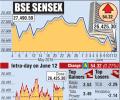
Oil, banks eneded the day in green while few in auto sector lost heavily.
Deficiency in rainfall and the resultant decline in food grains and oilseeds output would exert inflationary pressures and need to be cushioned against the possible delay in monsoon, an Assocham study said.

Economists surveyed by Reuters had forecast a 0.5 per cent growth in output

'The choice of chief minister after the win is a pointer to what issues really mattered at the polls.' 'Perhaps, demonetisation was an electoral side issue -- a reflection of the disconnect between commentators in the cities and the realities on the ground,' says Somasekhar Sundaresan.
 © 2026 Rediff.com - Advertise with us - Disclaimer - Privacy Policy - Sitemap - Feedback - About us - Terms of use - Grievances