
Tata Motors, India's largest electric passenger vehicle manufacturer, has signed an agreement with ride-hailing company Uber to supply 25,000 electric vehicles (EVs), the company said. The agreement is the largest EV commitment between an automotive manufacturer and a ride-sharing platform in India. Under the agreement, Uber will deploy Tata Motors' XPRES-T EVs by partnering fleet operators in Delhi National Capital Region, Mumbai, Kolkata, Chennai, Hyderabad, Bengaluru, and Ahmedabad.
Tata Motors, India's largest electric passenger vehicle manufacturer, has signed an agreement with ride-hailing company Uber to supply 25,000 electric vehicles (EVs), the company said. The agreement is the largest EV commitment between an automotive manufacturer and a ride-sharing platform in India. Under the agreement, Uber will deploy Tata Motors' XPRES-T EVs by partnering fleet operators in Delhi National Capital Region, Mumbai, Kolkata, Chennai, Hyderabad, Bengaluru, and Ahmedabad.

The government is considering the option of inviting fresh applications to bid for the fourth slot which fell vacant after one of the initial candidates who qualified, Hyundai Global Motors, exited from the production-linked incentive (PLI) scheme for advanced chemistry cell battery storage with a capacity of 20 GwH. Earlier, stakeholders had expected that the vacant slot would be offered to waitlisted players ranked on their technical and financial offer. A final decision will be taken soon.

Equity mutual funds (MFs) deployed maximum in shares of Reliance Industries (RIL) in June at Rs 2,177 crore, followed by Maruti Suzuki (Rs 2,045 crore) and Bharti Airtel (Rs 1,310 crore). Shares of both RIL and Bharti Airtel have been turbulent this month. On July 1, shares of RIL crashed over 7 per cent, following the government imposing windfall taxes on domestic crude oil production and fuel exports.

Engineers based in India are estimated to be writing roughly 35 per cent of the 100 million lines of codes required to develop one fully driverless car for global vehicle makers.

The early bird results for the January-March quarter of 2022-23 (Q4FY23) show a pick-up in earnings growth, despite a slowdown in revenue growth, thanks to a decline in input costs and lower provisioning for bad loans by banks. The combined net profit of 66 companies that have, so far, declared their quarterly results was up 15.2 per cent year-on-year (YoY) in Q4FY23, an improvement from 4.3 per cent YoY growth in Q3. Net sales growth of these companies, however, slowed down to 11.5 per cent YoY in January-March 2023, the slowest rate in eight quarters.

Unemployment rate in the country has zoomed to a high of 8.3 per cent in December, the highest in 2022, according to data from Centre for Monitoring Indian Economy (CMIE). The unemployment rate during November was at 8 per cent, while in September it was the lowest at 6.43 per cent and was at the second highest level during the year at 8.28 per cent in August, the CMIE data stated. While the urban unemployment rate was at 10 per cent during the last month of 2022, rural joblessness stood at 7.5 per cent during December.

For Mahindra & Mahindra (M&M), which has just started executing a comeback strategy for wresting back ground it lost to rivals, this could not have come at a worse time. The maker of the Bolero Neo and the Thar models on Thursday said it would have to halt production at its automotive plant for a week due to the worsening supply situation of semiconductors.
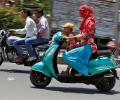
After lagging behind other segments in the automotive (auto) space over the past few years, two-wheelers are expected to reverse their volume underperformance. After witnessing a 36.3 per cent volume decline over the 2018-19 (FY19) through 2021-22 (FY22) periods, the sector staged a recovery in 2022-23 (FY23), with volumes rising 17 per cent. While volumes are still a quarter lower than the FY19 peak of 21 million units, a double-digit growth trajectory is expected to prolong.

With the Big Four information technology services players having disappointed the Street, the focus is on mid-cap IT players who seem to have met expectations, according to analyst reports and management commentary on the demand environment.

The 2022-23 (FY23) January-March quarter performance of the country's largest listed paint companies was better than Street expectations. Asian Paints, Berger Paints, and Kansai Nerolac Paints (Kansai Nerolac) registered double-digit revenue growth, compared with the year-ago quarter, reinforced by strong volume/value growth. Falling raw material prices also helped the paint majors hoist their gross margins.

The EV industry is at an inflection point and batteries will play a critical role ahead -- batteries and related components typically constitute 35-45 per cent of an EV's costs.
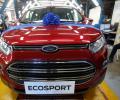
Ford, which had announced to quit the Indian market last year, said it was exploring the possibility of using one of its plants in India to produce electric cars for exports.
Two-wheeler exports from India fell by 17.8 per cent to 3.65 million units in 2022-23 (FY23), according to data released by the Society of Indian Automobile Manufacturers (Siam) on Thursday. This decline is due to a rise in global inflation and the weakening of economies and currencies in key export markets of Africa, Latin America (LatAm), and South Asia. In contrast to FY23, two-wheeler exports from India jumped 35.4 per cent to 4.44 million units in 2021-22 (FY22).
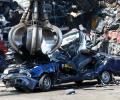
One of the challenges for those car graves is that Indian owners often find markets for their old cars rather than send them to scrapyards.

Health premiums have picked up again after a slight moderation in growth, taking the non-life insurance industry's growth to 22 per cent in November, and to almost 17 per cent so far this financial year. Health premiums grew by 22.54 per cent in the April-November period, driven largely by group health plans, which have seen good growth due to rationalisation of discounts in premiums caused by adverse claim ratios in prior periods, medical inflation, and enhanced coverage. Health premiums grew by 29 per cent in the same period last year.
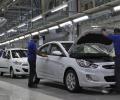
Automakers Maruti Suzuki, Tata Motors, Mahindra & Mahindra and Kia reported robust growth in their vehicle dispatches in the domestic market for August buoyed by festive demand and easing of semiconductor shortage woes. Other manufacturers like Hyundai, Toyota and Skoda also reported growth in wholesales in August as compared with the same month last year. The country's largest automaker Maruti Suzuki India said its domestic passenger vehicle dispatches increased by 30 per cent to 134,166 units in August as compared with 103,187 units in the year-ago month.

There will be two variants on sale -- namely the F77 and the F77 Recon, priced at Rs 3.8 lakh and Rs 4.55 lakh (ex-showroom) respectively.

'As the Indian economy continues to expand over the next three years, mid- and small-caps should do well as they have higher exposure to the domestic economy than large-caps.'

The institutional portion was subscribed 143 times, the wealthy investor portion by 360 times and the retail investor portion by 24.5 times.

Both are finding it difficult to sell one each of their plants -- Chennai Maraimalai Nagar (Ford) and Talegaon near Pune (GM) -- and are finding the road blocked by employee severance snarl-ups, report Sohini Das and Shine Jacob.

The automotive business includes vehicle manufacturing plants of Ford India in Chennai and Sanand.

Leading automakers Maruti Suzuki India, Hyundai and Tata Motors reported a double-digit increase in dispatches to dealers in April as the demand remained robust especially for the sports utility vehicles. The country's largest car maker Maruti Suzuki India (MSI) said its domestic passenger vehicle wholesales rose 13 per cent to 137,320 units last month as against 121,995 units in April 2022. Sales of mini cars, comprising Alto and S-Presso, fell 18 per cent to 14,110 units as compared with 17,137 units a year ago.

Even as India's passenger-vehicle sales touched a record high of 3.9 million units in 2022-23, growing 27 per cent over the previous financial year, the country's largest carmaker, Maruti Suzuki India (MSIL), said on Monday uncertainties in the electronic-component supplies might affect production in FY24. MSIL said the shortage of electronic components had some impact on production in FY23. "The company took all possible measures to minimise the impact.

'The reason being we cannot let premiums go beyond a certain point.'

According to reports, by last year, the company has helped its customers save 15 per cent on costs -- around 5-6 per cent on fuel and 15 per cent on fleet utilisation through digital measures.

The S&P BSE Auto Index has been one of the biggest outperformers among sectoral indices over the past year with returns of 26 per cent. By comparison, the benchmarks - the National Stock Exchange Nifty50 and the S&P BSE Sensex - managed about 6-8 per cent during this period. Improving demand, falling raw material costs, and rising product realisations, led by the premiumisation of portfolios, have led to a revision of growth estimates and upgrades by domestic brokerages.

Infosys on Tuesday said it has formed a long-term partnership with Daimler AG for a technology-driven IT infrastructure transformation. After the receipt of all regulatory approvals, Daimler AG will transform its IT operating model and infrastructure landscape across workplace services, service desk, data centre, networks and SAP Basis together with Infosys, a statement said. "As a part of this partnership, automotive IT infrastructure experts based out of Germany, wider Europe, the US and the APAC region will transition from Daimler AG to Infosys," it added. The companies, however, did not disclose the number of people who will transition as part of the deal.

'Markets could face uncertainty in the short to medium term.' 'It would be prudent to invest in alternative asset classes, especially debt, for about a year.' 'Bank fixed deposits are offering rates as high as 9 per cent per annum and these can be used as a great hedging tool until equity markets stabilise.'

Driven by strong demand, the overall passenger vehicle dispatches crossed 3.35 lakh units in February as automakers, including Maruti Suzuki India, Hyundai, Tata Motors and Mahindra & Mahindra, reported robust sales during the month. The dispatches of more than 3.35 lakh units last month marked an 11 per cent over February 2022. It was also the highest ever overall wholesales in the month of February. The country's largest carmaker Maruti Suzuki India on Wednesday said its domestic wholesales rose 11 per cent to 155,114 units in February as compared with 140,035 units in the same month last year.

'The Fed rate will peak in the range of 5.1-5.3 per cent during the second quarter of CY23 and will most likely stay there for a while before rate cuts start in CY24.'

Open order books in February breach 700,000; wait period for some models exceed a year.

The advantage of leasing is that you can get a new car every few years. You can also get to drive a high-end car without paying its entire price.

'The Indian govt's initiatives on EVs are very strong and customers want to buy EVs. This will make the country's conversion to EVs faster than other markets, and I hope even faster than the US'

With just a month left in this financial year, electric two-wheeler sales, so far, are at just 62 per cent of the ambitious target of 1 million units set for 2022-23 by the NITI Aayog. According to VAHAN data, compiled by the Society of Manufacturers of Electric Vehicles (SMEV), 620,006 units of electric two-wheelers were sold across the country in FY23 until February 21. Though the industry may miss the 1-million target, sales in FY23 are already up 146 per cent from 249,621 units sold in FY22.

'While we have done a few thousand kilometres in India, most of the testing and data collection and analysis has been done in the US, Japan and Europe.'

White is easy to maintain, looks brighter than other colours over a longer period, is the least commonly rejected colour among family members, has high resale value, provides better safety at night, absorbs less heat in the summer season, makes small cars look bigger, and is not considered inauspicious.

The three bikes -- presented by Classic Legends Private Limited, the automotive company owned by the Mahindra Group -- are a welcome addition to the two-wheeler options already present on Indian roads, says Rajesh Karkera.

The prime minister took a ride in the metro train between Zero Mile Freedom Park and Khapri stations with some students. Before boarding the train, he visited an exhibition on the project at the Zero Mile station.

Bhavish Aggarwal, the founder of ride-hailing firm Ola who disrupted the electric scooters market in the country, is planning to launch an electric sports car in 2024. The plan will put it in competition with Indian players, such as the Tata group and Mahindra & Mahindra, and global giants like Tesla and Hyundai. Aggarwal, recently, took a group of reporters to the firm's design studio at the Ola campus in Bengaluru where his teams are working on several EVs, including scooters, motorcycles, sedans, and SUVs - and even robotaxis.
 © 2026 Rediff.com - Investor Information - Advertise with us - Disclaimer - Privacy Policy - Sitemap - Feedback - About us - Terms of use - Grievances