
The government is finalising a major GST overhaul with automated refunds, pre-filled returns, and analytics-based scrutiny to simplify compliance and boost liquidity for MSMEs.

From filing 37 returns a year when the Goods and Sales Tax was first introduced in July last year, the process has undergone major changes as the GST Council considered and implemented various models to ease the pain for assessees. Here's a recap of how the process has changed in 10 months.

Businesses that have not filed GSTR-3B returns in the preceding two months will not be able to file details of outward supplies in GSTR-1 from September 1, GSTN has said. While businesses file GSTR-1 of a particular month by the 11th day of the subsequent month, GSTR-3B, through which businesses pay taxes, is filed in a staggered manner between 20th-24th day of the succeeding month. In an advisory to taxpayers, GSTN, which manages the technology backbone for Goods and Services Tax, said that Rule-59(6) of Central GST Rules which provides for restriction in filing of GSTR-1, will come into effect from September 1, 2021.

'Significant reductions in the compliance obligations mean businesses earlier struggling to comply will now have enough time to prepare and comply within the extended timelines.'

Tax experts are nudging the authorities to figure out why so many assessees are not filing their returns.
Come January and the government is empowered to send its recovery officials to your premises to collect GST without notice, if your tax liability shown in the requisite form is less than what invoices, mentioned in the outward supply form, should draw. The relevant provision in the Finance Act, 2021, will come into effect from January 1, 2022, according to a gazette notification issued on Tuesday. Under the GST system, there are two kinds of returns that a company is required to file monthly if its turnover is over Rs 5 crore annually. These are form GSTR-1 and GSTR-3B.

Total number of GSTR-3B returns filed up to January 30, 2022 is 1.05 crore that includes 36 lakh quarterly returns, the finance ministry said. January is the fourth straight month when Goods and Services Tax collection has crossed Rs 1.30 lakh crore.

The buoyancy in the tax revenue of GST reflects the upswing in the economy and better compliance

Deadline ends, after two extensions and only 70% file detailed return for July

'We revolutionised the system in a manner so that the chances of leakage will be much lower than it was in the beginning.'

1.03 crore taxpayers have been registered under GST till February 25, of which 17.65 lakh are composition dealers who are required to file returns every quarter.

After the 2019 election, one thing is sure: GST will see a number of changes, explains Indivjal Dhasmana.
Only 69 per cent of the assessees filed returns
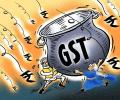
'We have already given Rs 1.59 trillion to states.' 'So, there is no question of giving them more.'

'There are unscrupulous traders who create fake invoices by showing bogus e-way bills, movement of goods.' 'Since the entities registered across different states, and kept on changing their numbers, tracing them was difficult.'

The Council also discussed process to make return filing simpler with just one return to be filed every month.

GST collections in March slipped below the psychological Rs 1 lakh crore-mark for the first time in four months to Rs 97,597 crore as the Covid-19 lockdown that shut most businesses compounded tax collection woes in an already sluggish economy. Goods and Services Tax (GST) mop-up in March recorded a 8.4 per cent decline over March 2019 collection of Rs 1.06 lakh crore. The collections were lower on account of dip in revenues from domestic transactions as well as imports.
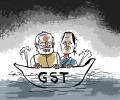
The Centre managed to collect only Rs 990 crore as compensation cess in April 2020-21, almost one-ninth of the figure of Rs 8,874 crore mopped up a year ago. The subdued collection would further increase states' problems unless the GST Council, which meets next week, decides to borrow from the market.
 © 2026 Rediff.com - Advertise with us - Disclaimer - Privacy Policy - Sitemap - Feedback - About us - Terms of use - Grievances