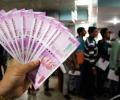
Future Gaming and Hotel Services whose director is the lottery magnate Santiago Martin is the top purchaser of electoral bonds having purchased bonds worth Rs 1,368, according to data uploaded by the Election Commission of India on its website on Thursday.

The slowdown in corporate revenue growth over the last one year has begun to reflect in India Inc's capital expenditure, or capex. The country's top listed companies are going slow on fresh investment in capacity expansion, in line with a deceleration in their top line growth. The combined fixed assets of the listed companies, excluding banking, finance services and insurance (BFSI) and the government-owned oil & gas firms, were up 10.1 per cent year-on-year (Y-o-Y) during April-September 2023 (H1FY24) - the slowest in 18 months - as against 21.1 per cent Y-o-Y growth in H2FY23 (October 2022-March 2023) and 11.6 per cent growth in the April-September 2022 period (H1FY23).

The Indian economy is likely to post better than anticipated growth in the second quarter (July-September) owing to robust urban consumption and expansion in services, a Business Standard analysis of high-frequency indicators showed. While gross domestic product growth in the September quarter is expected to come below the 7.8 per cent print in the June quarter due to a favourable base fading, analysts say the print will be much closer to 7 per cent than the 6.5 per cent anticipated earlier. While the Reserve Bank of India (RBI) had estimated 6.5 per cent growth for July-September, last month Governor Shaktikanta Das said the growth figure would surprise on the upside.

'This is the victory of the people of Gujarat who want real development, not the hype of development.'

From the Sensex pack, Infosys, Tata Motors, UltraTech Cement, HDFC Bank, NTPC, IndusInd Bank, Larsen & Toubro, HCL Technologies, Power Grid, Maruti, HDFC and Tata Steel were the major laggards. Kotak Mahindra Bank, Asian Paints, Nestle, Titan, State Bank of India and Reliance Industries were the gainers.

Equity markets began the new financial year with smart gains on Friday, with the Sensex rallying over 708 points to recapture the crucial 59,000-mark following gains in index majors HDFC twins and Reliance Industries, along with foreign fund inflows. On the first day of trading in the new financial year, the BSE barometer rallied 708.18 points or 1.21 per cent to settle at 59,276.69. During the day, it jumped 828.11 points or 1.41 per cent to 59,396.62. The broader NSE Nifty advanced 205.70 points or 1.18 per cent to settle at 17,670.45.

The headline for corporate profit growth has been very encouraging in the July-September quarter (Q2) of 2023-24 (FY24), with the combined net profit of listed companies up by 38 per cent year-on-year. However, the earnings distribution has been very lopsided, with most of the growth coming from public-sector oil-marketing companies (OMCs), banks, non-bank lenders, automobile (auto) companies, and cement producers. By comparison, companies from information technology services, fast-moving consumer goods (FMCG), retail, and consumer durables were disappointed, experiencing a sharp slowdown in net sales growth and a relatively muted increase in reported net profit.
From steel tycoon Lakshmi Mittal to billionaire Sunil Bharti Mittal's Airtel, Anil Agarwal's Vedanta, ITC, Mahindra and Mahindra, and a lesser-known Future Gaming and Hotel Services were among the prominent buyers of the now-scrapped electoral bonds for making political donations.

Even as the slowdown in the information technology (IT) services sector deepens, banking, financial services and insurance (BFSI), as well as oil and gas companies, emerge as the primary drivers of corporate earnings in the country. The IT services sector's share in corporate earnings declined to a five-year low of 17.4 per cent in the second quarter (Q2) of 2023-24 (FY24), whereas banks and finance companies accounted for 46.5 per cent, and oil and gas firms contributed 16.8 per cent. At their peak, IT services firms like Tata Consultancy Services (TCS), Infosys, HCLTech, and Wipro represented just over a third of the combined net profit of all listed companies in the Business Standard sample.

For someone who is such an indefatigable litigant, what is stopping Mr Saxena from using the law to depose Mr Kejriwal? Maybe we will get the answer after May 25, notes Aditi Phadnis.

George Acland from Great Britain ran a coffee plantation in Sri Lanka and set up India's first jute mill in 1855. He raised capital and imported the machinery for the mill on the banks of the Hooghly in West Bengal. His company wasn't a great success, but his pioneering work paved the way for India to dominate the jute industry.

Tata Motors, India's largest electric passenger vehicle manufacturer, has signed an agreement with ride-hailing company Uber to supply 25,000 electric vehicles (EVs), the company said. The agreement is the largest EV commitment between an automotive manufacturer and a ride-sharing platform in India. Under the agreement, Uber will deploy Tata Motors' XPRES-T EVs by partnering fleet operators in Delhi National Capital Region, Mumbai, Kolkata, Chennai, Hyderabad, Bengaluru, and Ahmedabad.

'Investors should focus on largecap funds, flexicap funds, business cycle funds, or hybrid-category funds.'

From the Sensex pack, HDFC, HDFC Bank, Mahindra & Mahindra, UltraTech Cement, Tata Steel, Bajaj Finance, State Bank of India, Reliance Industries, Bajaj Finserv and ICICI Bank were the major gainers. Power Grid, Maruti, Tech Mahindra, IndusInd Bank, HCL Technologies and Axis Bank were among the laggards.

From the Sensex pack, Infosys jumped the most by 3.67 per cent. Asian Paints, HCL Technologies, Reliance Industries, ICICI Bank, Wipro, NTPC, Tech Mahindra, Bajaj Finserv and Larsen & Toubro were among the other major gainers. State Bank of India, Bajaj Finance, Titan, Tata Steel, Tata Motors and UltraTech Cement were among the laggards.
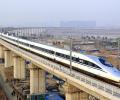
The first consortium includes Afcons Infrastructure, IRCON International and JMC Projects, while the second group of companies include NCC, Tata Projects and J. Kumar Infra Projects.

ITC was the biggest gainer in the Sensex pack, rising nearly 3 per cent, followed by Kotak Mahindra Bank, ICICI Bank, Maruti, Bharti Airtel, State Bank of India, Sun Pharmaceutical Industries, Axis Bank, Reliance Industries, Hindustan Unilever and JSW Steel. On the other hand, Infosys, UltraTech Cement, HCL Technologies, Bajaj Finserv, Larsen & Toubro, Titan, Tata Consultancy Services and Wipro were the laggards.

Industry players said they were indeed seeing a serious fall in capacity usage, though some sectors were seeming to prevent further fall in the overall capacity utilisation.

The market capitalisation of BSE-listed firms jumped to an all-time high of Rs 304.53 lakh crore on Wednesday, buoyed by an unprecedented rally in equities where the BSE benchmark Sensex ended over the 67,000-mark for the first time ever. Rallying for the fifth day running, the 30-share BSE Sensex climbed 302.30 points, or 0.45 per cent, to end at its lifetime closing high of 67,097.44 points. During the day, it jumped 376.24 points, or 0.56 per cent, to reach its all-time intra-day peak of 67,171.38 points.

"Lady candidates need not apply." So read the postscript in a job notice from Telco (now Tata Motors) on a notice board in the corridors of the Indian Institute of Science, Bangalore (now Bengaluru), in 1974. Irked, Sudha Murty, who was then pursuing her masters in computer science at the institute, wrote a postcard to JRD Tata, expressing her surprise at this gender discrimination, especially since the Tata Group were pioneers on many fronts. Shortly, Murty became the first woman on the firm's shop floor.

Brokerages expect revenue growth at a 7-quarter high but profitability may disappoint.

The Q1FY24 earnings season has started on a dismal note for corporate India. The early-bird companies' revenue growth has been at a 10-quarter low, while the combined earnings of non-BFSI (banking, financial services, and insurance) companies seem to have hit the ceiling. The numbers suggest corporate India is entirely dependent on BFSI companies and the IT services sector to drive growth in revenue and profit while other sectors are showing signs of stagnation.

April-June 2023 (Q1FY24) was a mixed quarter for India's top family-owned business groups. Three of the big five in terms of revenue reported a year-on-year (Y-o-Y) decline in combined net sales and two saw a Y-o-Y fall in net profits. Combined net sales of all listed companies in the five groups were up just 2.2 per cent Y-o-Y at Rs 6.6 trillion in the quarter, down sharply from the 10.3 per cent in the March 2023 quarter (Q4FY23) and 42.8 per cent in Q1FY23.

From the Sensex pack, Larsen & Toubro jumped 4.26 per cent to emerge as the biggest gainer, followed by IndusInd Bank, Tech Mahindra, State Bank of India, HCL Technologies, Power Grid, NTPC, Axis Bank, Kotak Mahindra Bank, HDFC Bank and Wipro. Mahindra & Mahindra, Infosys, UltraTech Cement and Hindustan Unilever were the major laggards.

Top companies across sectors -- automobile maker Maruti Suzuki, consumer electronics giant Samsung to IT giant Infosys -- have reopened factories and offices as India took its first steps towards resuming economic activity after weeks under a near-total coronavirus lockdown.

White House Press Secretary Karine Jean-Pierre said the upcoming visit will affirm the deep and close partnership between the United States and India.

After a turnaround in performance by Indian equity markets since July that has seen the S&P BSE Sensex and the Nifty50 wipe out the year-to-date losses, analysts suggest investors start nibbling into stocks that are focused on the domestic economy. While they say intermittent corrections, led by policies of global central banks and other economic data, cannot be ruled out, analysts expect India's relative outperformance among global equity markets to continue as it looks better placed with a healthy economic recovery, and remains one of the fastest growing major economies. In this backdrop, Neeraj Chadawar, head of quantitative equity strategy at Axis Securities, believes that amid global slowdown, aggressive tightening by the central banks, and preference for domestic interests first (by the local government), export-oriented themes are likely to be muted or will deliver conservative returns in the near-term.

'When I was toying with 10 different ideas, my father was diagnosed with lung fibrosis and his condition deteriorated so badly that we lost him in six months. He was very unsatisfied with the lack of proper diagnosis.' 'It made me think will anyone do a biopsy if there is no symptom? Why is it that we do not have any non-invasive diagnostic method?' 'This idea was the strongest out of the ten, and with Snahlata Singh with her cancer biology background joining me, the idea got a real boost.'

Ajit Mishra, vice president, Research, Religare Broking, answers your queries.

The National Stock Exchange (NSE) Nifty Next 50 Index could undergo large-scale changes if the proposed tweaks to its computation methodology get implemented. In a discussion paper floated recently, NSE Indices, which owns and manages a portfolio of over 350 indices under the Nifty brand, proposed that only stocks that are traded in the futures and options (F&O) segment can be part of the index. Currently, as many as 11 non-F&O stocks are part of the Nifty Next 50 Index, which, as the name suggests, represents the next rung of large and liquid securities after the Nifty50.
Tata Motors, India's largest electric passenger vehicle manufacturer, has signed an agreement with ride-hailing company Uber to supply 25,000 electric vehicles (EVs), the company said. The agreement is the largest EV commitment between an automotive manufacturer and a ride-sharing platform in India. Under the agreement, Uber will deploy Tata Motors' XPRES-T EVs by partnering fleet operators in Delhi National Capital Region, Mumbai, Kolkata, Chennai, Hyderabad, Bengaluru, and Ahmedabad.

India scripted history as the ambitious third Moon mission of the Indian Space Research Organisation (ISRO) touched down on the Moon's south pole, propelling the country to an exclusive club of four and making it the first nation to land on the uncharted surface.

Business conglomerate Adani Group's chairman Gautam Adani is now the world's second-richest person after overtaking Louis Vuitton's Bernard Arnault, according to Forbes' Real-Time Billionaires List. At the time of writing this report, Gautam Adani's net worth was $153.9 billion, compared to Arnault's net worth of $153.7 billion. Adani is now just behind business magnate Elon Musk, according to Forbes' data.

After the hit of the pandemic, India Inc is now worried about the adverse impact of inflation and higher commodity prices on their revenues and margins. The inflation scare is the strongest among manufacturers of consumer goods such as automobiles, consumer durables, and fast-moving capital goods (FMCG). Companies across sectors fear they will not be able to pass on the hike in input costs to their consumers due to weak demand, which, in turn, would lead to a hit on margins and profitability in the forthcoming quarters.

With the Nifty50 just about 3 per cent away from its all-time closing high of 18,812 points, analysts at BofA Securities suggest investors book profit. Their reasons for the advice include risks like the possibility of a cut in corporate earnings growth forecasts, high valuation (one-year forward P/E of 19.5x), interest rates staying elevated for longer-than-expected and credit tightening. Going ahead, they expect the Nifty50 index to drop to 16,000 levels - down nearly 12 per cent from the current level of 18,255 points, which they believe would be a good time to buy.

PowerGrid was the top loser in the Sensex pack, shedding over 4 per cent, followed by Reliance Industries, Asian Paints, Kotak Bank, Tech Mahindra and Bharti Airtel. NSE Nifty tanked 204.95 points to 17,196.70.

Before resigning as an auditor of an Adani Group firm, Deloitte had sought an independent external examination of allegations made by a US short-seller but the company said the allegations had no effect on financial statements and the reasons cited for quitting were not convincing to warrant such a move. In a 163-page filing with stock exchanges relating to Deloitte Haskins & Sells LLP's resignation, Adani Ports and Special Economic Zone (APSEZ) said that in meetings with its leadership, Deloitte indicated concern over a lack of a wider audit role as auditors of other listed Adani companies. However, the firm conveyed to the auditor that it was not within its remit to recommend such appointments as other entities are "completely independent".

The words 'industry', 'industrial development', 'jobs', and 'employment' have been ringing with higher frequency since Mamata Banerjee stepped into her third term with landslide victory after a high-octane election last year. "Our government's next target is industrial development," the chief minister (CM) had been heard stating at different public meetings in the past few months - perhaps setting the tone for the sixth edition of the Bengal Global Business Summit (BGBS) slated for later this month. Investor summits by any state are about intent, big numbers, and tall claims. Yet in competitive federalism, its importance as a marketing tool is undeniable.

To cement India's position as a preferred global outsourcing destination, the government on Wednesday liberalised guidelines for voice-based BPOs removing the distinction between domestic and international units as well as permitting interconnectivity between all types of OSP centres. Broadly, the rules would allow global companies, say an airline, with a voice-based centre in India to now serve global and domestic customers with common telecom resources, something that required dedicated, separate infrastructure previously. Moreover, the restrictions on data interconnectivity between any BPO (business process outsourcing) centre of the same company, a group company or any unrelated company has been done away with, allowing for massive flexibility in resource management for BPO operations.

India always faces a Hobson's choice as far as feeding coal-fired generators goes - even if the government is reluctant to admit it. The country cannot do without shipping in the world's most polluting fuel from overseas. And it will continue to do so unless it decides to reduce demand by forcing citizens, farmers and businesses to live without electricity for part of the day, or use diesel generators to fire facilities.
 © 2026 Rediff.com - Investor Information - Advertise with us - Disclaimer - Privacy Policy - Sitemap - Feedback - About us - Terms of use - Grievances