
Indian benchmark indices Sensex and Nifty surged in early trade, with the Sensex jumping nearly 700 points, primarily driven by strong buying in IT stocks following TCS's positive June-quarter results and optimistic demand outlook. Track Sensex, Nifty on July 10, 2026.

Indian stock markets witnessed a significant rally, with the Sensex climbing 964.58 points and the Nifty reaching 24,330, driven by strong buying in blue-chip stocks, particularly in the IT and banking sectors, amidst optimism over Q1 earnings and a shift towards large-cap investments.

Indian benchmark indices, Sensex and Nifty, closed lower due to profit-taking after a four-day rally, influenced by weakness in Asian markets, with Trent shares tumbling over 12 per cent.

Drone technology company ideaForge Technology has successfully raised Rs 500 crore through a Qualified Institutional Placement (QIP). The funding, which saw strong interest from domestic and international institutional investors, will be used to accelerate innovation, expand its product portfolio into combat drones and autonomous systems, and strengthen its working capital to meet growing demand in defence, homeland security, and civil sectors.
Drone technology company ideaForge Technology has successfully raised Rs 500 crore through a Qualified Institutional Placement (QIP). The funding, which saw strong interest from domestic and international institutional investors, will be used to accelerate innovation, expand its product portfolio into combat drones and autonomous systems, and strengthen its working capital to meet growing demand in defence, homeland security, and civil sectors.

HCL Technologies reported a significant 20 per cent year-on-year increase in its consolidated net profit for the June quarter of FY27, reaching Rs 4,624 crore, while maintaining its revenue growth guidance of 1-4 per cent for the fiscal year.

L&T Finance reported a robust Q1FY27 with net profit growing 29% year-on-year to 900 crore, driven by strong asset growth and strategic initiatives including accelerating cross-selling, improving productivity, and fostering a technology-first, AI-led culture, alongside significant expansion in gold loans.

Indian stock markets extended their gains for a third consecutive day, with the Sensex climbing 753 points and the Nifty closing above 24,550, driven by a drop in crude oil prices and optimism surrounding potential peace talks between Iran and the US.

Foreign investors have aggressively sold off Indian equities, withdrawing over 48,213 crore in the first 10 days of April, following a record 1.17 lakh crore outflow in March, driven by escalating geopolitical tensions in West Asia, rising crude oil prices, and global inflation concerns.

India's net direct tax collections have surged by 16.4 per cent year-on-year to 6.51 trillion as of July 13, primarily driven by robust growth in corporate tax receipts, according to provisional data from the Central Board of Direct Taxes (CBDT).

Net inflows into equity mutual fund schemes moderated in FY26, falling by 27 per cent to about 3 trillion till February, as choppy markets and global uncertainties prompted investors to shift towards safer options like hybrid funds and gold ETFs.
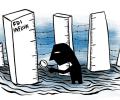
India has significantly improved its position as a global foreign direct investment (FDI) destination, climbing two places to 11th in 2025, with inflows surging by nearly 44 per cent to $38.89 billion, according to the United Nations Conference on Trade and Development (Unctad) World Investment Report 2026.

Indian benchmark equity indices, Sensex and Nifty, extended their winning streak for a third consecutive day, driven by a rally in IT stocks and global cues suggesting a more accommodative monetary policy after softer-than-expected US jobs data.

Smallcap funds give investors access to businesses that can grow much faster than the broader economy.
Indian benchmark indices, Sensex and Nifty, bounced back significantly after two days of losses, with the Sensex climbing 443.97 points to settle at 76,922.64, driven by positive global market trends and a drop in crude oil prices.
Indian benchmark indices Sensex and Nifty extended their winning streak to a fourth consecutive day, driven by strong buying in blue-chip bank stocks and a decline in global crude oil prices. Fresh foreign fund inflows also contributed to the optimistic sentiment in the domestic equity market.

Indian stock exchanges are actively preparing to implement a new closing auction mechanism (CAS) from August 3, aimed at enhancing transparency in determining closing prices for securities with derivative contracts.

'Buy on dips, buy on dips and sell on rise.'

The International Cycling Union (UCI) has praised India's "outstanding success" in its nationwide World Bicycle Day celebrations, which involved approximately 200 cities and towns across 28 States and Union Territories. UCI President David Lappartient commended the Cycling Federation of India (CFI) for its remarkable organisational efforts and also lauded the launch of the Asmita Women's League, a grassroots programme aimed at promoting gender equity in cycling.
'Midcaps and smallcaps are the 'go-to segments' for retail investors.'
Indian equity benchmark indices Sensex and Nifty rallied in early trade, driven by reports of a second round of talks between the US and Iran, which are fostering hopes for a resolution to the West Asia conflict, coupled with Brent crude oil prices trading below the USD 100 per barrel mark.

The change comes at a time when online MF distributors are increasingly moving investors from the SoA mode to demat holdings.

SBI Funds Management, India's largest asset management company, has set its IPO price band between 545 and Rs 574 per share, valuing the company at 1.2 trillion. The management explained the 'moderate' valuation aims to instil investor confidence amidst market uncertainty, while also highlighting plans for AI integration, expansion into GIFT City, and new alternative investment funds.

Indian benchmark indices Sensex and Nifty advanced in early trade, driven by renewed foreign fund inflows and a significant drop in crude oil prices to pre-war levels, signalling an uptrend in the market. Track Sensex, Nifty on July 7, 2026.

The National Stock Exchange (NSE) is reportedly planning to launch its much-anticipated initial public offering (IPO), estimated at around Rs 30,000 crore, in September, potentially valuing the exchange at over Rs 5 lakh crore.

Life cycle funds may suit people who are starting their investing journey. They may suit those who do not want to monitor their investments frequently. Busy professionals, beginners and delegators, who lack the time, information or interest to manage asset allocation actively, may find these funds useful.

Indian benchmark indices, Sensex and Nifty, experienced a decline in early trade due to uncertainty surrounding the upcoming US-Iran negotiations in Doha. Foreign fund outflows and a dip in major IT stocks further contributed to the market's cautious sentiment, despite mixed performance in global markets.

India has emerged as the most impacted market within emerging economies, experiencing $3.7 billion in outflows over the past three weeks, matching the total outflows from the entire emerging market basket, as global equity funds turn negative for the first time since January 2026 due to escalating geopolitical tensions.

Taxpayers must provide more details to support deduction and exemption claims.

Indian insurance companies are bracing for reduced profitability in Q4FY26, primarily due to the rationalisation of GST on retail life and health policies, leading to a loss of input tax credit, coupled with volatility in equity markets impacting investment income.
Indian benchmark stock indices Sensex and Nifty rebounded nearly 1 per cent, snapping a three-day decline, driven by rallies in Reliance Industries and Sun Pharma, alongside positive global market trends and easing geopolitical tensions.

IT major Wipro reported a nearly flat consolidated net profit of Rs 3,352 crore in the April-June quarter of FY27, a marginal increase from Rs 3,330.4 crore in the year-ago period, while revenue from operations grew 10.6 per cent to Rs 24,478.6 crore.

Indian benchmark indices Sensex and Nifty rallied in early trade, driven by a significant decline in Brent crude oil prices, which fell below the USD 73 per barrel level, and positive trends observed across most Asian equities.

Investor interest in precious metal exchange-traded funds (ETFs) rebounded sharply in June, with silver ETFs attracting an estimated 4,900 crore and gold ETFs around 2,900 crore in net inflows, following a significant correction in gold and silver prices.

Trent reported a 20 per cent revenue rebound in Q4FY26, driven by a recovery in like-for-like growth and significant store additions. The company's board has approved raising up to 2,500 crore in equity to fund investments in store network upgrades, new brands, supply chain automation, and Star Bazaar expansion, alongside a 1:2 bonus issue and a 6 dividend.

IT stocks had their worst first half fall in decades, with the Nifty IT index declining 31% in the January-June 2026 period, its biggest decline in the first six months of a calendar year since 2003.
Indian benchmark equity indices, Sensex and Nifty, rebounded nearly 1 per cent, with the Sensex jumping 790.54 points to 76,991.22, driven by softening crude oil prices and strong buying in banking, financial, and IT shares.

In essence, Tata Sons will continue to be a CIC, whether registered or unregistered. It will have to follow the 90:60 principle.
If it qualifies as belonging to the upper layer, public listing will be one of the regulatory requirements. However, if it qualifies as 'unregistered CIC', it will escape from prudential regulation, explains Tamal Bandyopadhyay.
India's net foreign direct investment (FDI) surged more than fourfold to $6.58 billion in April 2026, driven by a significant increase in equity inflows and reduced repatriation by foreign investors, according to the Reserve Bank of India (RBI).

The report notes that equities had faced pressure from elevated valuation premiums, subdued nominal gross domestic product (GDP) and earnings growth, sustained foreign portfolio investor (FPI) selling, artificial intelligence (AI) infrastructure euphoria, and external shocks including US tariffs and a spike in crude oil prices due to geopolitical tensions in West Asia. However, several of these factors are now reversing.
