
Equity benchmark indices Sensex and Nifty bounced back on Thursday to close higher by nearly 1 per cent on gains in banking, IT and auto shares amid mixed global trends. The 30-share BSE Sensex rose by 443.19 points or 0.86 per cent to settle at 52,265.72. During the day, it rallied 694.26 points or 1.33 per cent to 52,516.79. The NSE Nifty advanced 143.35 points or 0.93 per cent to 15,556.65.

M&M led the gainers' pack, spurting 2.76 per cent, followed by ITC, Kotak Bank, L&T, SBI, Bajaj Auto and Nestle India.

This year's tally is the second best ever after 2022 when 16 firms raised Rs 40,311 crore, led by LIC's biggest-ever IPO.

The 30-share Sensex gained 271 points to end at 28,805 and the 50-share Nifty ended up 84 points at 8,712.

Smaller stocks have emerged as Dalal Street's favourites in 2023 that has turned out to be a "great year" for equities, rewarding investors with big gains, driven by optimism over the country's macroeconomic fundamentals and heavy retail investors participation. Experts said equity markets are experiencing a prolonged bull run and it is during this time that the midcap and smallcap segments tend to outshine their larger counterparts. Till December 22 this year, the BSE smallcap gauge has jumped 13,074.96 points or 45.20 per cent while the midcap index has surged 10,568.18 points or 41.74 per cent.

This correction has given a good entry for long-term investors. One should buy quality stocks and those with growth potential.

Equity benchmarks Sensex and Nifty ended over 1 per cent higher on Friday, helped by heavy buying in Infosys and banking stocks amid a rally in global stock markets. The 30-share BSE Sensex jumped 684.64 points or 1.20 per cent to settle at 57,919.97. During the day, it rallied 1,199.79 points or 2.09 per cent to 58,435.12.

Market benchmarks gave up intra-day gains to close in the red for the sixth session on the trot on Friday, capping a bruising week which saw a massive dash for safety amid rate hikes by global central banks and fears of slowing growth.

BSE, the oldest stock exchange in Asia, aims to raise up to Rs 1,243 crore from the IPO, which has a price band of Rs 805-806 per share.

The National Stock Exchange (NSE) on Tuesday said it has halved the lot size for trading derivatives contracts for the Nifty 50 index to 25 and also reduced the lot sizes of the Nifty Financial Services and Nifty Midcap indices as part of its periodic revision. "All contracts, i.e. weekly, monthly, quarterly, and half-yearly expires available for trading from the trade date of April 26, 2024, onwards will be with the revised market lot size," the NSE said, referring to applicability of the change for Nifty 50. The lot size in the derivatives segment refers to the fixed number of shares in a unit or group for which contracts are traded.

In a bid to enhance its equity exposure and earn higher returns for its nearly 65 million subscribers, the Employees' Provident Fund Organisation (EPFO) is considering reinvesting 50 per cent of its exchange-traded funds (ETFs) redemption proceeds back into equity. Sources close to the development said a proposal regarding this was discussed in the investment committee (IC) meeting in October last year, and the recommendation has been sent to the Central Board of Trustees (CBT), the apex decision-making body of the EPFO for its approval. The next CBT meeting is scheduled to be held on Saturday.

In a memorable year for the equity market, Dalal Street investors added a whopping Rs 81.90 lakh crore to their wealth in 2023 as a raft of positive factors powered a stellar rally in stocks. Experts said India's strong macroeconomic fundamentals, political stability owing to the BJP's success in recent elections in three significant states, optimistic corporate earnings outlook, signals from the US Federal Reserve about three prospective rate cuts next year and heavy retail investors participation played a major role in fuelling the stock market rally in 2023. In the year 2023, the 30-share BSE Sensex jumped 11,399.52 points or 18.73 per cent.

Debt-saddled telecom operator Vodafone Idea Ltd's Rs 18,000 crore follow-on offering (FPO) opened to a modest response on Thursday with just 26 per cent of shares on offer being sought by investors. Of the 1,260 crore shares on offer, 331.24 crore was subscribed on Thursday, according to information on the BSE. Qualified institutional buyers picked up 61 per cent of their 360 crore shares reserved for them while non-institutional investors sought 28 per cent out of 270 crore shares earmarked for them.

The ongoing weakness in the broader equity market is likely to weigh on primary market investor participation ahead, which has already begun showing signs of fatigue, analysts said. The spillover effect, they say, will continue as long as the midcap and smallcap segments remain volatile. "The effect will be felt in the IPO market. The subscription levels have come down in the last few days and recent 4-5 IPOs have not done well.

Benchmark stock indices Sensex and Nifty tumbled nearly 1 per cent on Wednesday due to profit booking in banking, financial and IT stocks after a recent rally. The 30-share BSE Sensex plunged 537.22 points or 0.94 per cent to end at 56,819.39 as 24 of its stocks declined. During the day, it tanked 772.57 points or 1.34 per cent to touch a low of 56,584.04. The broader NSE Nifty declined by 162.40 points or 0.94 per cent to 17,038.40 with 39 of its constituents ending in the red. Bajaj Finance was the biggest loser among Sensex stocks, dropping by 7.24 per cent.

Equity benchmark Sensex gained 37 points on Thursday, tracking gains in index majors Kotak Bank, L&T and Bharti Airtel amid a largely negative trend in global markets. After a largely choppy session, the 30-share BSE index ended 37.87 points or 0.06 per cent higher at 60,298 after starting the trade on a weak note. During the day, it hit a high of 60,341.41 and a low of 59,946.44.

Rating agency Fitch on Tuesday downgraded the US government's top credit rating to AA+ from AAA, citing fiscal deterioration over the next three years and repeated debt ceiling negotiations. The development caused a flutter across equity markets, with most leading frontline global equity indices trading weak. Back home, the S&P BSE Sensex and the Nifty50 lost over 1 per cent each in intra-day deals to hit a low of 65,751.53 and 19,517.55 levels, respectively.

IndiGo share price today: IndiGo share price fell as much as 4.8 per cent to a low of Rs 4,275 per share on the BSE in Monday's intraday trade as investors booked profit in the stock post a its April-June quarter (Q1) results for financial year 2024-25 (FY25). The stock ended 1.36 per cent lower at Rs 4,430 as against a 23-points gain in the benchmark BSE Sensex. The selling also got exacerbated as the management commentary, post Q1FY25 results, highlighted that inflationary pressure could likely dent July-September (Q2FY25) performance.

Larsen & Toubro, Axis Bank, Reliance Industries, UltraTech Cement, Mahindra & Mahindra, IndusInd Bank, ICICI Bank and Tata Steel were the other big gainers. Sun Pharma, HCL Technologies, Asian Paints, Nestle and Infosys were the laggards.

The market capitalisation of BSE-listed companies jumped to a record high of Rs 2,40,04,664.28 crore on Tuesday, driven by a rally in stocks that also saw the benchmark Sensex touching its lifetime peak of 53,887.98 points. Rallying for the second consecutive day on Tuesday, the 30-share BSE index closed at a fresh closing peak of 53,823.36 points, a jump of 872.73 points or 1.65 per cent. During the day, it zoomed 937.35 points to 53,887.98 points.

The markets may be entering a consolidation phase and are expected to trade sideways for now after a good run in the last few weeks, suggest analysts. In this backdrop, they suggest investors can book profits at the current levels and enter the market again on a decline from a medium-to-long term perspective. Thus far in fiscal 2023-24 (FY24), the S&P BSE Sensex has moved up around 5 per cent to nearly 62,000 levels.

From the Sensex basket, Larsen & Toubro, Maruti, Reliance Industries, Nestle, Bharti Airtel, UltraTech Cement, Kotak Mahindra Bank and JSW Steel were among the major laggards. Bajaj Finance climbed nearly 1 per cent higher.

Equity benchmarks ended modestly higher on Friday after the Reserve Bank raised the key interest rate in an effort to cool stubbornly high inflation and defend the rupee. Continuous foreign fund inflows into the capital markets and softening crude oil prices also helped the bourses regain momentum, traders said. The 30-share BSE Sensex ended 89.13 points or 0.15 per cent higher at 58,387.93 after facing volatility during the fag-end of trade. During the day, it climbed 350.39 points or 0.60 per cent to 58,649.19. The broader NSE Nifty went up by 15.50 points or 0.09 per cent to finish at 17,397.50.

Finance Minister Arun Jaitley said Sebi would develop new products in the commodity derivatives space apart from taking steps to deepen the corporate bond market.
Offer size could vary from Rs 1,200 cr to Rs 2,000 cr

'Investors need to be stock specific and should not rush to buy stocks at the current levels.'

Equity benchmarks Sensex and Nifty ended on a mixed note on Wednesday as the euphoria about the Budget fizzled out, with investors going for profit-taking ahead of the Fed interest rate decision. The 30-share BSE benchmark Sensex climbed 158.18 points or 0.27 per cent to settle at 59,708.08 after it trimmed most of the intra-day gains. During the day, it had zoomed 1,223.54 points or 2 per cent to 60,773.44.

'Those satisfied with returns and not expecting further rally could be booking profits and also stopping SIPs.'

Moody's Analytics said that the reduced political stability and the need for consensus building that is inherent with a coalition government, might erode investor confidence in the near term.

Equity indices frittered away a good start to close with modest losses on Monday, pressured by heavy selling in metal stocks after the government imposed export duties on steel-making raw materials to curb soaring prices. The 30-share BSE Sensex opened strong and gained momentum as the session progressed, but came under severe selling pressure in afternoon trade to close 37.78 points or 0.07 per cent lower at 54,288.61. On similar lines, the broader NSE Nifty slipped 51.45 points or 0.32 per cent to end at 16,214.70.

Investors' wealth jumped Rs 2,93,054.25 crore on Thursday as markets returned to winning ways after falling for three straight sessions. The 30-share BSE benchmark Sensex zoomed 638.70 points or 1.22 per cent to close at 52,837.21. During the day, it gained 668.75 points to 52,867.26. Tracking the bullish trend, the market capitalisation of BSE-listed companies jumped Rs 2,93,054.25 crore to reach Rs 2,33,94,917.25 crore.

Banking and capital goods stocks were out of favour, while oil and auto stocks saw buying interest.

From the enactment of the capital control Act to the recognition of the BSE as a stock exchange and the infamous Harshad Mehta scam, here are the 18 biggest events for stock markets from 1947 to 1993.

Snapping a six-day losing run, equity indices settled in the green after a highly volatile session on Monday, with the Sensex climbing 237 points amid positive cues from European markets. The BSE benchmark gained 237.42 points or 0.46 per cent to settle at 51,597.84. During the day, it hit a high of 51,714.61 and a low of 51,062.93.

Prominent exits by promoters included a Rs 15,300 crore share sale in Indus Tower by Vodafone Plc, a Rs 9,300 crore share sale by the Tata group in Tata Consultancy Services.

ONGC was the top gainer in the Sensex pack, rallying around 6 per cent, followed by IndusInd Bank, L&T, UltraTech Cement, Titan, SBI and NTPC. NSE Nifty settled 32.10 points up at 14,707.80.

'We expect market consolidation and recommend buying during market dips.'
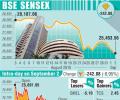

Siemens reported solid results in the July-September quarter (fourth quarter, or Q4) of 2022-23 (FY23), with the top line growing 25 per cent year-on-year (Y-o-Y) to Rs 5,808 crore. The operating profit margin stood at 12.1 per cent, led by lower employee costs and other operating expenses. The company follows the October-September financial year.

Stock exchanges, clearing corporations, depositories, stockbrokers and Sebi-registered participants operating through these institutions have been exempted from the lockdown.
 © 2026 Rediff.com - Investor Information - Advertise with us - Disclaimer - Privacy Policy - Sitemap - Feedback - About us - Terms of use - Grievances