

'Now there is no fight between us (Thackerays); now the fight is with them.'
Jyoti Punwani reports from the Shiv Sena (UBT)-MNS joint rally in Shivaji Park.

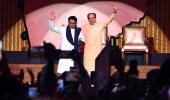
"You'll go from here with your stomachs full," Maharashtra Navnirman Sena Chief Raj Thackeray promised the thousands who had packed Shivaji Park on Sunday evening to witness, after a gap of 20 years, the sight of estranged cousins Uddhav and Raj address a rally together for the upcoming BrihanMumbai Municipal Corporation polls.
The audience laughed, thinking it to be another of his trademark jibes. But nobody could have expected what followed.
Rarely has a political rally been stunned into silence by a presentation. But not a sound could be heard as the screen showed, with mournful music playing in the background, a map of India.
Headlined 'Adani in 2014', it was followed by another map, headlined 'Adani in 2024'. 12 dots marked the Adani projects existing in 2014. In the 2024 map, these had become more than 60.
The same incremental progression was shown in the next presentation: 'Adani in Maharashtra'; and finally, 'Adani in (and around) Mumbai', which showed that acres of land had been handed over to the industrialist for the Dharavi redevelopment project as well as other projects.
His research team had put this together, said Raj, after a journalist first hinted at this to him after the Lok Sabha elections in 2024.
"Show me one country where such favours have been bestowed on one individual," said Raj, after the presentation ended. "Power, cement, ports and airports, everything is being given to him. Today, if he decides to switch off the power plants, all of us would be in darkness."
"Land and language -- once these two things are taken away from a people, they perish," said Raj, asking the audience to wake up.

Raj, who had supported the ruling Mahayuti of the Bharatiya Janata Party, Shiv Sena and Ajit Pawar's Nationalist Congress Party during the 2024 assembly elections in Maharashtra, said their behaviour changed after they won those elections.
The first inkling came when they decided to make Hindi the third language in Maharashtra. That was like a pin prick, he said, to test how much the people of Maharashtra would tolerate.
Unlike previous ruling parties such as the Congress, who were afraid of public opinion, the Mahayuti had stopped fearing the public, he said. "They feel they can throw money and people will be silenced. Sadly, people are willing to be bought."
Presenting a frightening scenario of sons of the soil being deprived of their land in the Konkan, in Palghar and eventually in Mumbai, Raj portrayed the January 15, 2026 BMC election as the last chance for the "Marathi Manoos" to ensure that "Mumbai remains in the hands of Mumbaikars. Fight for Mumbai, that is your strength," he said. "Now there is no fight between us (Thackerays); now the fight is with them."

Interestingly, Raj urged Marathi-speaking leaders of other parties too, to come together to "save" Mumbai from being handed over to Gujarat.
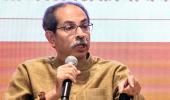
In his speech, Uddhav Thackeray too, reverted to Raj's theme of Gautam Adani's growing influence. "That was the reason they wanted us out," he said. "They knew we would not allow Mumbai to be handed over to Adani."
While both brothers centred their speeches around the spectre of Mumbai being taken away from Maharashtra, Uddhav also spent a considerable amount of time demolishing what he called the BJP's "Hindu-Muslim narrative". This narrative was spun just before every election to divide the people, he alleged.
Recalling the struggle for a Maharashtra state with Mumbai as its capital, Uddhav said that among the founding fathers of the Samyukta Maharashtra Samiti, along with his grandfather Prabodhankar Thackeray and Communist leader S A Dange, were folk poets Annabhau Sathe and Shahir Amar Shaikh. He quoted Shaikh's songs composed during that struggle.
The Jana Sangh was nowhere in that struggle for Maharashtra, stressed Uddhav. And, the man who ordered the firing on protesters then was a Hindu, Morarji Desai, he pointed out.

Those who betrayed the Shiv Sena and broke the party in 2022, he continued, referring to Eknath Shinde's Shiv Sena, were also "Marathi manoos, not Khans," Uddhav said. "They claim to be fighting for Mumbai now, but it is we who allowed them to enter the BMC, we who made them ministers. I'm ashamed to admit that it was I who committed that sin," said Uddhav.
BJP leader K Annamalai's recent statement about 'Bombay' being an international city that didn't belong to Maharashtra, featured in the speeches of both cousins, as well as that of Sena (UBT) MLA Aditya Thackeray, who pointed out that Annamalai, who had come third in the 2024 Lok Sabha election from Coimbatore, had no business dispensing advice on how to run Mumbai.
Annamalai's utterances had revealed what the BJP really wanted, said Uddhav, just as in the Lok Sabha elections, a BJP leader had revealed that the real motive behind the BJP slogan 'Ab ki baar 400 paar' was the party's intention to change the Constitution.
Raj ridiculed Annamalai as 'Rasmalai' and said that the abusive jibe coined by Sena chief Bal Thackeray during the party's anti-South Indian agitation in the 1960s: 'Uthao lungi, bajao pungi' was coined for people like Annamalai.
The BJP's poll tie ups with the AIMIM in Akot and the Congress in Ambarnath were mentioned by both brothers as examples of their arrogance and their hypocrisy. So was the grant of a ticket to Badlapur rape co-accused Tushar Apte.
"I had raised suspicions about the encounter in which Badlapur accused Akshay Shinde was eliminated," recalled Uddhav. "Had he been arrested, and not killed, he would have revealed everything about Tushar Apte."
"Break that 'masti' of power that's gone to their head that encourages them to do such things," Raj urged the audience.

***
Much was made by both leaders about the historic significance of Shivaji Park as the venue where the Shiv Sena was founded in the presence of their grandfather Prabodhankar Thackeray. Both also emphasised the Thackeray lineage, to show that "love for Maharashtra and Marathi" lay in their "blood". "That was why we've come together, to save Marathi and Maharashtra," said Raj.

***
Earlier, Aditya Thackeray recounted the myriad amenities and services provided by the BMC which the undivided Sena had ruled for 20 years, and which he alleged, had deteriorated ever since the BJP took over. He asked the audience how many of them travelled by BEST buses, and reeled out statistics to show how the fleet had reduced under the current government.
An important part of Aditya's speech were the photographs he presented on the screen, where Uddhav Thackeray and he were present at the launch of three important phases of the Coastal road: The geo-technical survey; the inauguration of work, and the bringing of the tunneling machine. "Can you see Devendra Fadnavis anywhere in these?" he asked. "That is why we say, we did the work for which they are claiming credit."
Aditya started his speech by urging the audience to keep in mind that this election was about basic issues: "gutter, (electricity) meter and water." At the end of his speech, he asked the audience if they wanted the best services from the BMC, and who would they vote for to get that. He emphasised that they should vote either for the mashaal (the Sena [UBT] symbol), the engine (the MNS symbol) or the man blowing a trumpet (the NCP Sharad Pawar symbol).
All three symbols were displayed on the podium. Jayant Patil, senior leader of the NCP (SP), also spoke, claiming that when the Shiv Sena was founded at Shivaji Park in 1966, Sharad Pawar had been sitting in one far corner, listening to Bal Thackeray. "They always had a cordial relationship," claimed Patil; "both worked for the welfare of the Mumbai and the Marathi Manoos in different ways."

***
What did the "Marathi manoos" on whom every speaker lavished so much attention, think?
"We are so happy that the two brothers have come together; this should have happened a long time back," was the common sentiment.
Busloads of women had come from Worli Koliwada, Aditya Thackeray's assembly constituency; they claimed nobody had brought them. "We thought it our duty to come out of respect for the two brothers," said MNS member Saburi Koli.
Rejecting the Mahayuti's claims about women being happy with the Laadki Bahin dole (Rs 1,500 per month), Saburi said she would readily give it up if the mehngai (inflation) prevalent today could be reversed. "Today, a Rs 500 note disappears in a day; earlier, it had some value," said the domestic worker who earned Rs 15,000 a month. "From cooking gas to gold, the rice of everything has doubled. (Chief Minister) Fadnavis talks about the metros he has brought, but how can we afford to pay Rs 50 for single journey?"

Many old-timers were present at the rally, some had been with the undivided Shiv Sena since the last 35 years.
53-year-old Pandhari Jamalpur recalled attending Shiv Sena chief Bal Thackeray's rally way back in 1986. "I was just 13 then, but I was very attracted to him. When I turned 18, I joined the party and have been attending every rally since, often traveling ticketless, expecting nothing in return," said the up shakha pramaukh from Nagpada in central Mumbai.
Many expressed confidence that having come together, the Thackerays would win the BMC election. "The bond between Maharashtra and the Thackerays cannot be broken," said 36-year-old Dayanand Farathe, an MNS member since its founding in 2006. "Even the North Indians working under me feel only a Thackeray should rule Mumbai," said the security manager.
"The two brothers have come together for Maharashtra," said MNS member Prashant Mane from Tardeo. "Their unity has made all of us Marathi Manoos also united."
"We will bring the two brothers to power," said Saburi. "Mumbai unki thi, unki hi rahni chahiye."
Photographs curated by Anant Salvi/Rediff
Feature Presentation: Aslam Hunani/Rediff






 © 2026