

Sheena Bora's birthday fell on February 11 and it's been 14 years since she disappeared into thin air.
She would have been 39.
Nearly one-and-a-half decades later are we patiently inching nearer to knowing the truth of what happened?

Key Points
- Among the accused, Sanjeev Khanna is most on the ball, often heading to the front of the court to aid Ranjeet Sangle with information on his iPad.
- Peter Mukerjea is in a meditative frame of mind. It's hard to tell what's going through his head.
- Indrani Mukerjea appears distracted too, maybe busy with her dance performances and social appearances.
The Great Game of Skipping Rope has begun in Courtroom 51, in the Sheena Bora murder trial, at the Mumbai city civil and sessions court, Kala Ghoda, south Mumbai.
The ends of the rope are being held by the defence lawyers, chiefly Ranjeet Vishnupant Sangle, with the accused lending a hand.
The sturdy man in the middle is Prosecution Witness 146, former police officer Dinesh Parshuram Kadam, skipping away, trying not to miss a single step.
Occasionally, Public Prosecutor Chetankumar Jawaharlal Nandode briefly jumps in, so Kadam and he are skipping in the centre together. But a testy Sangle usually stops the rope then and peevishly asks Nandode what is he skipping there for.
Sangle, the lawyer for Accused No. 1 Indrani Mukerjea, as time goes on, rotates the rope faster and faster, gleefully whipping it along, hoping to get Kadam miss his step more often.
Kadam, a decent skipper, does trip a few times briefly yet significantly, but is usually nonchalant about it, not unnerved, getting right back in the game, moving ahead.
Before we get to the important incidents of Witness Tripping, a word about the Sheena Bora murder trial.
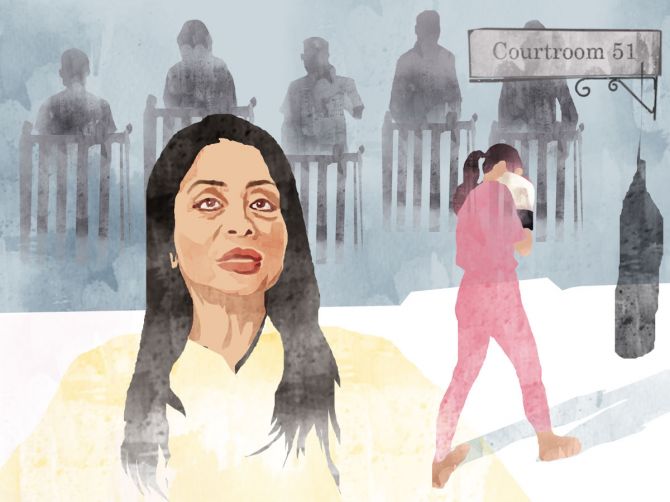
This trial began, with its first witness on February 23, 2017 and I have been covering it off and on since its first day.
Indrani Mukerjea, Accused No. 1, is being tried for the murder of her first-born daughter Sheena Bora, whom she had with her first partner Siddhartha Das. The other three accused in this case are: Her second partner and first husband Sanjeev Khanna, third partner and second husband Peter Mukerjea and the family driver Shyamvar Pinturam Rai, who has turned approver.
She allegedly killed her daughter because Sheena was in a relationship with Rahul Mukerjea, Peter's son from his first marriage. Indrani, as per one (unconfirmed, of course) version, allegedly wanted her favoured second daughter Vidhie, she had with Sanjeev, who Peter adopted, to inherit her and Peter's fortune eventually and not allegedly the less-preferred Sheena.
There are 237 witnesses in this trial. It has taken nine long years, since February 2017, to get to Witness No. 146 Kadam.
Indrani, Peter and Sanjeev were in jail for six years as undertrials and each got bail between five and six years ago and are out of jail.
Why has the trial taken so long?
Unless you step into a courtroom and spend extensive time covering a trial, you will not ever understand why trials have such lengthy timelines.
Each witness takes anywhere from half a day (only very few rather incidental witnesses have taken that little time) to a month to complete.
First the prosecutor takes the witness through his testimony, over 1 to 15 days. Then his cross examination begins by the defence lawyers, for all of the three accused, and goes on over many, many days, depending on the importance of the witness.
In between there can be other delays like a change of judge, court holidays. Earlier adjournments related to bringing the accused from prison too.
As mentioned once earlier, in order for one hearing to proceed smoothly some 20 people play a role, and if one is missing then you don't have a day in court.
Criminal investigations in India are complex, with many arduous twists and turns, and witnesses going into several hundreds. Cross-examinations therefore take a long time too.
But we are now at a hopeful 146. It is likely, in an effort snip off time from the trial, that most of the remaining witnesses will not be examined, except for the crucial last four or five, and we are close to the end of the trial.
The last few witnesses in any trial are critical.
Dinesh Kadam, who is presently in the witness box, was the main investigating officer of this case at the Khar police station, north west Mumbai, back in August-September 2015, and what he says is very vital to the progress of the trial and ultimately -- important to all of us -- whether the long-dead Sheena gets justice or not.
Once the examination of the witnesses is through, there will be closing arguments and then the verdict, likely later this year or in early 2027.

The CBI has chosen not to call a few pretty key witnesses and one of them is former dynamic Mumbai police commissioner Rakesh Maria, who cracked this case with Kadam's help in 2015.
But the defence can choose to call him.
Kadam apparently does no prep work for each hearing. But he travels long distances from Badlapur, a township on the outer rim of Mumbai, to get to the courtroom every day -- his cross will take a month of daily appearances -- and it is three hours each way, door to door.
He is indeed hampered by the long years that have elapsed between his investigation of the crime and his stint, now, in the witness box.
It's hard to remember dates, times and tiny details on how everything went down 10-and- a-half years ago. And those little facts are important to a trial and especially to the judge presiding over it, who has to give a verdict.
In February 3 in court, Sangle recreated the drama that erupted when the Sheena Bora murder case was first uncovered in 2015, asking Kadam if he knew or remembered the high points, reminding him: "The media coverage in all types of news media, electronic and print, did a huge propaganda about the present matter. Many articles and news were published with respect to you. He gave examples like: "Rediff.com: The cop who cracked the Sheena Bora case. You knew Maria and he knew you very well. You were his trusted officer."
Kadam squeaked, attempting shock: "Trusted?", shrewdly playing down his association with Maria.
He denied he had knowledge -- via several firmly-spoken "mahitnahis (don't know, in Marathi)" -- that he was considered the face of the investigation during those long-ago days or that there was "pressure" to stick to the "original theories" the police had given the media.
Sangle verbally sketched a pic of the snug kind of relationship Kadam and Maria he enjoyed, that Kadam kept self-effacingly tearing down, suggesting it was just an average, uninteresting equation of boss and ordinary police officer.
Kadam claimed complete ignorance on why the case was transferred to the CBI in September 2015, and if it had to do with Maria's "association with the accused".
Sangle expressed extravagant astonishment, his forefinger jabbing the air in punctuation: "By what stretch of the imagination (can one believe) that an IO (investigating officer) of this standard will not know why the matter was transferred???"
A bit of a tamasha started up. Kadam made a few faces at the pronouncement, a bit taken aback at Sangle's tone and looked a tad irritated.
Smiling, charming Judge Jyoti P Darekar, keeping the peace, spoke a few conciliatory words to both sides.
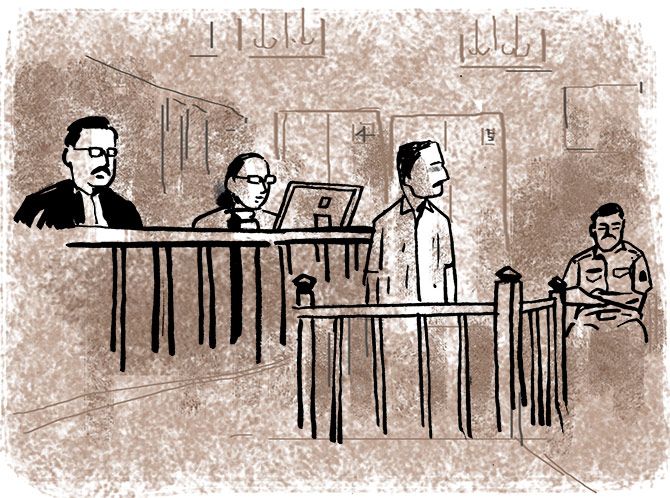
The first of the tripping began...
The cross moved to the night of the Mukerjeas' driver Shyamvar Rai's arrest on August 21, 2015. For some reason, that Kadam attempted to not so logically explain, Kadam's name is not on the initial first information report (FIR) of the investigation.
Further, Sangle's line of questioning addressed the puzzling fact that the home of Rai, who had been arrested first for possession of a country revolver, was not searched immediately after the arrest, in case he had other arms stashed there. It was searched only on the third day, August 23, 72 hours later.
Kadam sort of shrugged his shoulders, confirming that it had not been done, not ascribing a definite reason, just "Nahi dille (didn't happen, in Marathi)," except to say that the arrest had only gone through finally post-midnight on the first day -- 12.40 am of the 21st night, although Rai had been picked up much earlier in the evening.
Sangle had Kadam catalogue the extent of staff at the Khar police station at the time and it exceeded 100 and there was no shortage of staff to send to Rai's Vakola address in north west Mumbai.
Sangle: "She (Rai's wife) had daun divas (two days, in Marathi) to plant something?"
Kadam disbelievingly: "Kai plant? (what could she plant, in Marathi?)."
Sangle: "Sharda Rai had two days to allow anything to be planted!"
Kadam laughs: "Plant? Kaun sa level?"
The second tripping also related to Rai. It is an IPC (now Bharatiya Nyaya Sanhita) formality that the relatives of someone arrested have to be informed immediately. Kadam said that Rai's wife Sharda had been informed, "The phone call was made from the landline of Khar police station by taking the contact number from Rai."
He described meeting her: "She was a good and honest wife and supportive of her husband (signifying therefore perhaps not capable of planting stuff). I had observed her properly when she came to the police station," suggesting that as a policeman he was good at making these character judgements, which might be so.
Sangle: "Sharda Rai made allegations to police that her husband was in custody of the police since 19/08. He had gone for his work and had not returned."
Kadam: "I do not know."
The next day in court, intriguingly, Kadam was shown television footage in which Sharda Rai tells reporters that she does not know what has happened to her husband.
Kadam was apparently po-faced and said he was not sure if the woman in the television reports was the same woman, though it looked like her, feeding doubts on whether he had ever met her.
The police officer, who is always crisply dressed, in neat, well-ironed shirt-pants, is a cool customer in the witness box. He rarely raises his voice. Most of his answers are laconic, not going into much elaboration. He often rubs his hands together pensively. Occasionally the "witness volunteers" the odd explanation in reaction to a query.
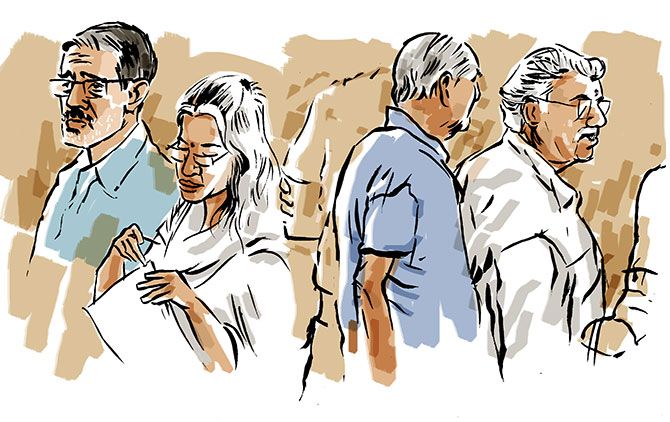
Among the accused, Sanjeev Khanna is most on the ball, often heading to the front of the court to aid Sangle with information on his iPad, acting as Sangle's lieutenant.
Peter is in a meditative frame of mind, usually leaning his head on the accused box railing. It's hard to tell what's going through his head. He just marked six years since his release on bail.
Indrani appears distracted too, maybe busy with her dance performances and social appearances.
Shyamvar Rai was not to be seen.
Sheena's birthday fell on February 11, according to a recent poignant Facebook post by her brother Mekhail Bora, with adorable pics, and it's been 14 years, since she disappeared into thin air. She would have been 39.
Nearly one-and-a-half decades later are we patiently inching nearer to knowing the truth of what happened to the vivacious girl in the pictures?






 © 2026