

Returning to the Brahmaputra for Vijay Diwas was not just a journey across geography, but across memory of war, service, sacrifice, and the enduring bond between the Indian Air Force and the north east, asserts Air Commodore Nitin Sathe (retd).

Flying to the far east was like homecoming. From high up in the sky I peered out from my window.
The mighty Brahmaputra flowed below, with the mightier Himalayas flanking it to the north as if protecting it. At this height, it looked like a maze of small lazy rivulets flowing westwards.
Many years ago, whilst we flew much lower and slower along this river, it appeared endless in its expanse.
We flew sometimes along it, sometimes crossing over into the hills of Arunachal Pradesh carrying out sortie after sortie to the many advanced landing grounds and airstrips.
Our job was to carry out supply drops to sustain our troops, rescue people in distress and most importantly, connecting our soldiers with their homeland.
For those of us who flew in the north east, the Brahmaputra was more than a geographical feature.
In bad weather, when visibility was poor and options few, it became a reassuring beacon, guiding us safely home.
We respected it deeply -- not only for its power, but for the sense of security it provided to us and, by extension, to the nation we served.

It was therefore fitting that I returned to the east once again, this time to participate in the 54th Vijay Diwas celebrations at Air Force Station Mohanbari, near Dibrugarh.
Senior leaders of the Indian Air Force, including Chief of the Air Staff Air Marshal Amar Preet Singh, Commander In Chief Eastern Air Command Air Marshal Surat Singh, along with distinguished guests and veterans, gathered to commemorate one of India's most decisive military victories.
It was the 10th of December and on this day, back in 1971, the most audacious Meghna Heli-lift was taking place.
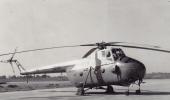
Around 5,000 troops and tons of war fighting material were shipped across the river by Mi-4 helicopters in a daring heli-bridging operation.
This speeded up the operations and helped the army to tighten the noose around Dacca, forcing the Pakistani army to capitulate and surrender.
The quick end to the war resulted in formation of the new nation, Bangladesh.

A seminar had been organised to kickstart the proceedings. Veterans who participated in the war recounted their experiences straight from their heart the tales of their gallantry felt real -- real as can be.
Speaking to us were Air Marshal Harish Masand, Vir Chakra, Air Commodore K C Kuruvilla, Vir Chakra, Wing Commander D J S Kler and Wing Commander Shiv Krishna besides many more in the audience.

Taking us into history, we are fascinated and awed. Our hearts swelled with pride as we paid homage to those who sacrificed so much for so many of us.
I too had my little contribution -- a short talk on the Kilo Force and Kilo Flight as well as the Meghna Heli-bridge. Audacious operations planned by bold commanders and executed by daring pilots.
The CAS, in his closing address, spoke about how the air force has evolved due to the hard work put in by the veterans in the past and also made a mention of how our success in Operation Sindoor was an all out air force effort.

We then moved to the runway shoulder for the next part of the programme.
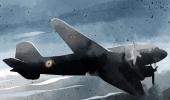
Three Dornier aircraft flew past us in formation followed by the helicopters. A formation of C-130s flew past in perfect formation dropping small parachutes with simulated loads. They demonstrated troop insertion inside enemy lines.
The Tangail paradrop simulation was next. While we waited to see the fifty odd parachutists sail in to land in front of us, the air warrior drill team filled the void carrying out smart movements, depicting our training, discipline, dedication and coordination.

The sky abovefilled with parachutes hanging lazily -- some tri-colour and some grey that blended with the sky above.
What a sight it would have been! A thousand of them falling from the skies -- it definitely did scare the Pakistani forces in 1971, forcing them to withdraw.
The Mi-17 formation depicted the Mi-4s dropping troops across the Meghna -- there were six of them this time, and the troops slithered down from the helicopters and carried out a simulated attack on the enemy.
The air reverberated with controlled explosions and the staccato crackle of gunfire, lending realism to the demonstration.

The grand finale, of course, was by our fighters -- the moment everyone in the crowd had been waiting for. A SU-30 formation flew in at low level along the runway.
Zooming past, they pulled up in a steep climbing turn and fired their flares as they went in for a simulated dive attack on the governor's house in Dacca, a replica of which had been created in one corner of the arena. Amidst sound of explosions it was ablaze, in ruins.
The amazing display of firepower concluded, we moved on to the area which housed an exhibition of photographs and memorabilia of the war.

Few air warriors were given on-site commendation medals and cards by the Chief for their display of dedication and devotion to make this event a success.
The day concluded with a Bara Khana at the hangar. Amidst beautifully laid tables, personnel from different generations -- past and present -- came together to share a meal, conversations, and memories. A fitting end to a day of remembrance and pride.

The entire event was impeccably organised by Air Force Station Mohanbari, under the leadership of Group Captain Deepak Kumar Bishnoi, VM (Vayu Sena Medal) and his committed team of officers and air warriors, whose efforts brought everyone together for this meaningful commemoration.
For me, returning to the East has been deeply nostalgic. It was from this region that my father fought in the 1971 War.
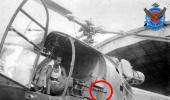
It was here that I learnt to fly helicopters -- pushing their capabilities, understanding their limitations, and forging a bond that only aviators truly understand.
I carry many stories from this land, permanently etched in memory. This one too, has now found its place.


A helicopter pilot who served the Indian Air Force for 35 years, IAF Veteran Air Commodore Nitin Sathe is a frequent contributor to Rediff.
You can read his earlier articles here.
Feature Presentation: Rajesh Alva/Rediff




 © 2026