

Yogi Adityanath champions national unity over caste divisions, asserting that 'casteism' weakens India's social fabric and hinders its progress on the global stage.
Key Points
- Yogi Adityanath asserts that while the caste system should organise society, 'casteism' weakens national unity.
- Adityanath criticises previous governments for dividing people based on caste, region, and language, hindering national progress.
- He highlights the Modi government's efforts to address issues like unrest in Kashmir and Naxalism while ensuring welfare schemes reach all citizens.
- Adityanath contrasts the current government's support for spiritual traditions with the previous UPA regime's perceived disregard.
- He emphasises the importance of unity and faith in achieving national goals, citing the Ram temple construction as an example.
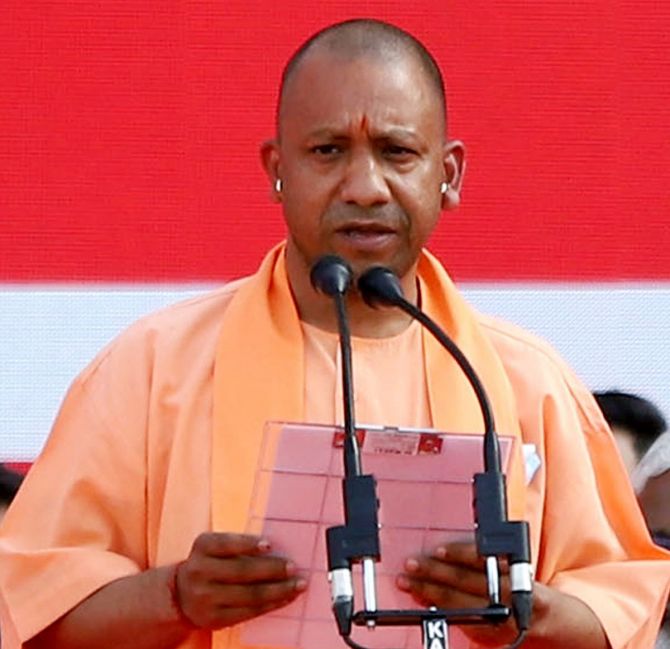
Uttar Pradesh Chief Minister Yogi Adityanath on Monday said while the caste system is meant to organise society, 'casteism' weakens the social structure and divides the nation.
Addressing a programme at the Sire temple in Jalore, Adityanath also said that religion should act as a unifying force in society.
"Caste should be the means of running the society systematically, but casteism weakens that system," Adityanath said.
"The previous governments believed in dividing people in the name of caste, region and language, which weakened the country and led to challenges such as the unrest in Kashmir, Naxalism, linguistic disputes and caste conflicts. The benefits of governance often failed to reach the Dalits, the poor and other marginalised sections," he said.
"But today, India is moving ahead to become a major global force under Prime Minister Narendra Modi. The country has been brought together under his leadership," Adityanath said, adding that steps have been taken to address the issues of Kashmir and Naxalism, while ensuring that welfare schemes reached people without any discrimination.
The chief minister also said that the government is focused on expanding infrastructure and public facilities across the country.
"Good roads have been built in areas where there were none earlier, railway connectivity has been expanded, while airports, Metro, medical institutions and engineering colleges have been built in areas that lacked them," Adityanath said.
Spiritual Traditions and Development
Targeting the previous UPA regime at the Centre, Adityanath claimed it treated India's spiritual traditions as regressive.
"In contrast, the present leadership recognised that our faith is deeply connected to Sanatan Dharma and that society cannot move forward without faith," he said.
Referring to the construction of the Ram temple in Ayodhya, Adityanath said it could have been built decades earlier, but the previous governments did not act on it and even questioned the existence of Lord Ram.
"The Ram temple is now progressing grandly. Whenever people unite with determination, achievements like the Ram temple become possible," he said.
Referring to the development of the Kashi-Vishwanath corridor in Varanasi, he said earlier only a limited number of devotees could visit the temple at a time, but now thousands can have 'darshan' simultaneously.
"Similar arrangements are being created for the devotees at Mathura and Vrindavan," he said.
Vision for a United India
Calling India a unique nation shaped by the spiritual practices of saints, the bravery of the warriors, and the hard work of the farmers, artisans and labourers, Adityanath said, "Every citizen should work towards the vision of 'Ek Bharat, Shreshtha Bharat'. And preserving faith is essential for maintaining the country's unity and strength."
Adityanath also said that India endured centuries of attacks by foreign invaders who looted the country, disrupted social order and disrespected cultural traditions.
"These forces succeeded largely because of internal divisions. Had the country remained united, no invader could have dominated it," Adityanath said.





 © 2026