

By ensuring Myanmar remains dependent on Chinese economic and military assistance, Beijing indirectly exerts pressure on India's North Eastern states, making New Delhi's regional security strategy even more complex.

Amid the din over electoral malpractices, two important events earlier this month went almost unnoticed.
On August 1, the military junta in Myanmar announced it had lifted the emergency imposed in February 2021 as a precursor to elections to be held in December this year; and on August 5, Parliament extended President's Rule in Manipur for another six months till February next year.
The two events, seemingly unrelated, combined with possible general elections in Bangladesh in February 2026, will have a profound impact on politics in the North East.
It is the world's worst-kept secret that Myanmar is in the grip of a ferocious civil war.
The military has little or no control of the border provinces -- especially Shan state, which is on the Myanmar-China border -- and Chin state, which touches Manipur and Mizoram.
China is extremely proactive in politics in Shan state (and indeed in many other parts of Myanmar) as an outstanding study by scholar Amara Thiha in an edited volume about China's overt and opaque role in South Asia, recently published by the Centre for Social and Economic Progress, reveals.
The strategy is simple: By ensuring Myanmar remains dependent on Chinese economic and military assistance, Beijing indirectly exerts pressure on India's North Eastern states, making New Delhi's regional security strategy even more complex.
And in Mizoram, to a lesser degree in Nagaland, but especially in Manipur, there is an inevitable spillover of politics in Myanmar.
Speaking at the conclusion of 100 days of the Narendra Modi government's third term last year, Union Home Minister Amit Shah said publicly that infiltration from Myanmar was the root cause of the ethnic tensions in Manipur.
So, the Free Movement Regime, in place since 1968, had been scrapped, and of the 1,643-km border, 30 km had been fenced to prevent people from crossing the border illegally from Myanmar to India.
It is highly unlikely that the entire border will have been fenced by December 2025, when the polls in Myanmar are due. It is estimated to be a 10-year project.
Separatist groups from the North East continue to have their camps and training facilities in Myanmar's northern Sagaing region and find these fetters inconvenient.
In the southern zone contiguous to Manipur, some outfits have been effectively picked up by the junta against resistance groups.
But most resistance groups have announced that they will boycott the polls because they see the election as a sham.
So a parallel administration in areas abutting the Indian border will likely continue and presents a security threat: Not just to Myanmar but also to India.
Although violent clashes in Manipur have come down dramatically, especially after President's Rule was imposed, tensions between the Hindu Meitei population and the Kuki-Zo tribes persist.
What is more, clashes between the Kuki-Zo and Meitei communities in Manipur mirror the broader ethnic divisions in Myanmar.
The Kuki-Zo have clan and tribal connections with families in Myanmar.
So opposition to fencing is bitter because it prevents movement.
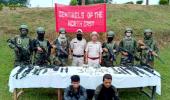
In May this year, a gunfight broke out between rebel groups in Myanmar opposing the fencing and Indian security forces. Ten rebels were killed.
An army statement said seven AK-47 rifles, an RPG launcher, one M4 rifle, and four single-barrel breech-loading rifles, ammunition and others were recovered following the gunfight. This is an arsenal of a pretty serious order.
The more the authority of Naypyidaw is undermined, the more will be the incidence of such standoffs, especially if the Kuki Zo in Manipur feel a deeper kinship with their clan across the border than with India.
Manipur is a state that has seen the maximum spell of President's Rule. Differences between the Meitei and Kuki Zo are not new.
These differences spill out into the open but also find political expression.
In June this year, firing broke out in Imphal when volunteers of the Arambai Tenggol, a Meitei group, were arrested by the National Investigation Agency.
It took no time at all for the population from the area to lay siege to the police station, demanding their release.
The Rajya Sabha MP from the region (who is from the Bharatiya Janata Party) immediately rushed to the Raj Bhavan to protest.
With so much happening in that pocket of the North East, more political engagement that is seen to be bipartisan is essential.
What remains of 2025 and 2026 promises to be an eventful period for the region.
Feature Presentation: Aslam Hunani/Rediff






 © 2026