
Recent explorations in a village in Haryana's Yamunanagar district have uncovered ancient remains and cultural artefacts, indicating the presence of human habitation dating back approximately 3,500 years, archaeologists said on Friday.
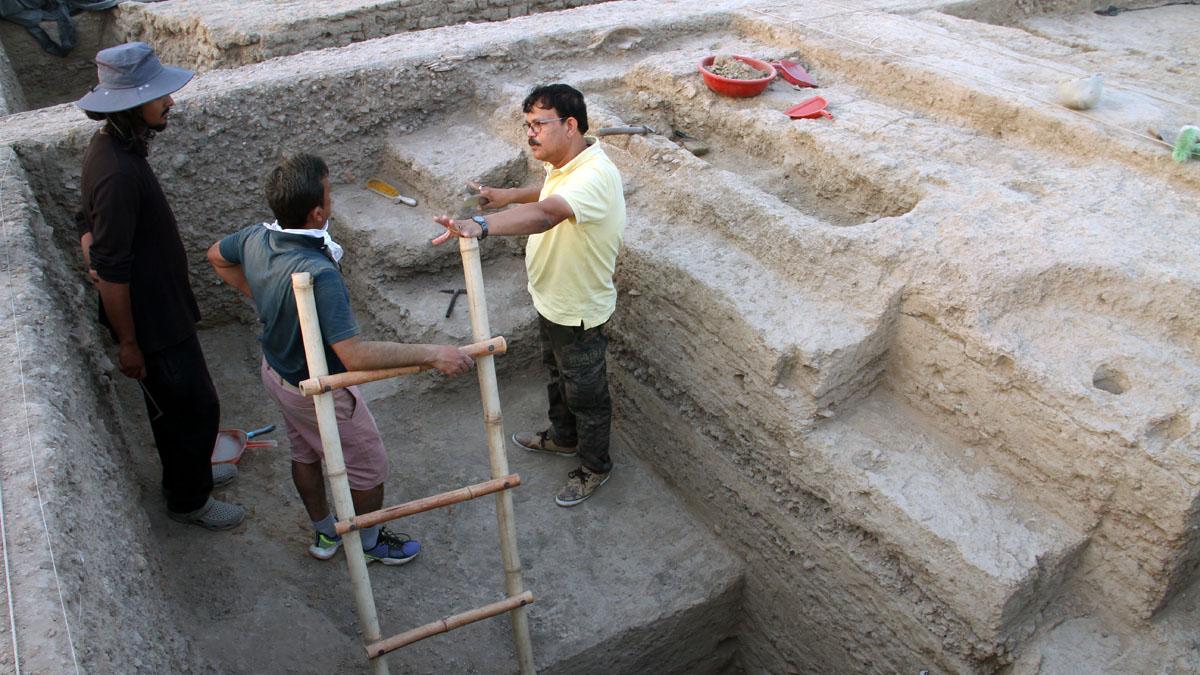
"During exploration in Topra Kalan village, we observed several pieces of Painted Grey Ware and other ancient cultural materials," said a senior official from the department of Archaeology and Museums of Haryana.
These findings suggest that human habitation in the area may date back nearly 3,500 years; however, this is a tentative date range.
"Until we conduct excavations and recover dateable objects through stratified analysis, we cannot provide an exact date," explained Dr Banani Bhattacharyya, deputy director of the department of Archaeology and Museums, Haryana.
During stratification, archaeologists carefully analyse the layers (strata) of an archaeological site to understand its history and the sequence of events that have shaped it.
Due to the dense population in the area, carrying out excavations at this site may pose significant challenges. The department first conducted an on-site exploration, followed by a Ground Penetrating Radar survey, which revealed several remains, including hollow structures, round structures, and walls.
"While we may not be able to give an exact date, these are definitely ancient structures," Bhattacharyya stated.
She emphasised that GPR surveys are essential for determining whether a structure exists beneath the surface, adding that the findings also provide valuable insights into the historical and archaeological significance of the Yamunanagar region.
Talking about the Ashoka pillar edict found at Topra Kalan, now located at the Feroz Shah Kotla Fort in Delhi, the official stated that it is a significant artefact from the Mauryan Empire, and underscores the historical significance of this region.
The Yamunanagar district is known for maximum remarkable Buddhist sites, she said, adding that the state archaeology department has been conducting site exploration around Topra Kalan for about two years, to identify ancient sites and monuments so that these could be preserved.
Topra Kalan, being a centre of Buddhist activity, is supported by historical references, including those from Sir Alexander Cunningham, who was the founding head of the Archaeological Survey of India, Bhattacharyya said.
Notably, Yamunanagar district is a region that holds a treasure trove of Buddhist history. For example, the Chaneti Stupa, located just three km northwest of modern-day Sugh (the ancient city of Srughna), is a well-preserved Buddhist stupa that dates back to the Mauryan period, around the 3rd century BCE.
The stupa stands as one of the oldest monuments under the protection of the department of Archaeology and Museums, Haryana.
Its architectural design is distinctive and remarkable, characterised by concentric layers of baked bricks stacked atop one another. These layers are intentionally spaced, creating a visually rhythmic aesthetic.








 © 2025