

'Who tried engine relight?'
'If the first officer was the one flying at takeoff, the captain may have taken control immediately post-thrust loss.'
'But the AAIB report doesn't clarify any of this.'
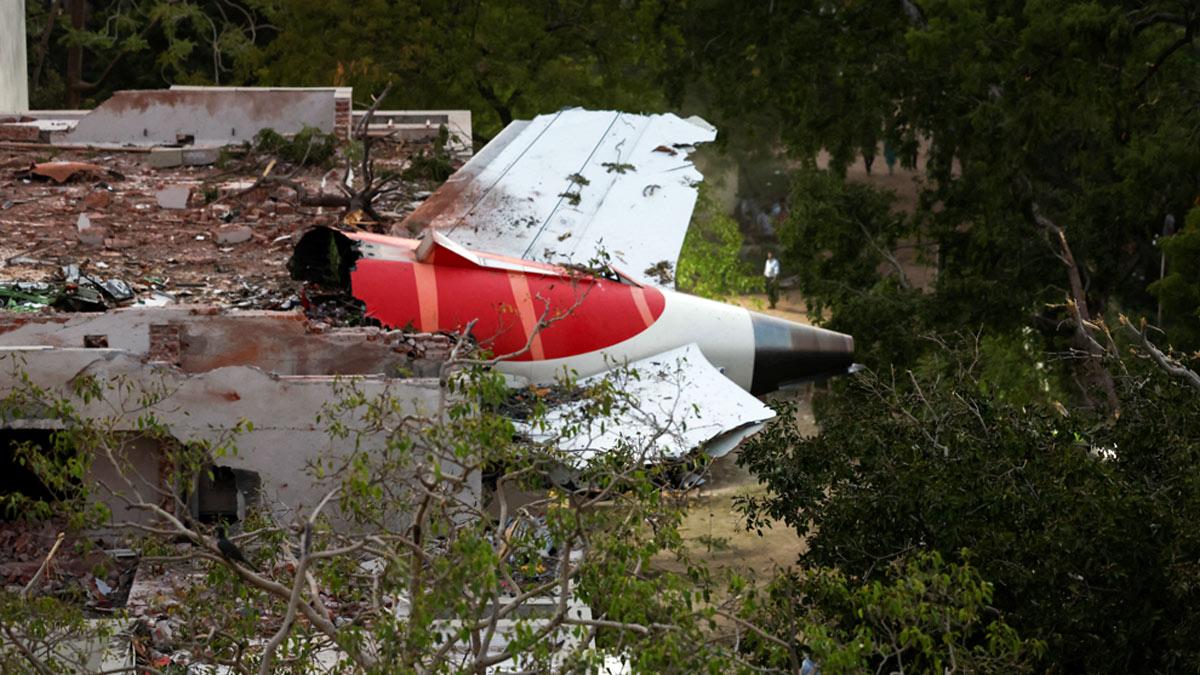
Air India pilots are "deeply disturbed" and "demoralised" by what they claim is an ambiguous preliminary report that hints at pilot error while failing to account for known technical concerns, following last month's fatal crash of flight AI171 near Ahmedabad.
Speaking to Business Standard, pilots criticised the Aircraft Accident Investigation Bureau's (AAIB) preliminary findings -- released on Saturday, July 12, 2025 -- for using vague language and omitting key technical details.
The report stated that both engine fuel control switches on the Boeing 787-8 'transitioned' from 'RUN' to 'CUTOFF' just three seconds after takeoff on June 12, resulting in a sudden dual-engine power loss.
But it does not clarify whether the switches were moved manually, shifted due to mechanical failure, or activated by an electrical fault.
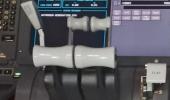
These switches, located on the Boeing 787-8's throttle quadrant, stop fuel supply to the engines when moved to 'CUTOFF'.
"Did someone move them by hand, or did the system interpret some error and act on its own?" asked one senior captain.
The switches are spring-loaded and require a deliberate pull-and-turn motion, making accidental movement highly unlikely.
"The likelihood of both failing together -- within one second -- is minuscule unless something seriously went wrong in the switch mechanism or aircraft electronics," said another pilot.
Some questioned whether the switches "transitioned" physically or whether the aircraft's computers simply behaved as if they had, due to a fault.
"The flight data recorder may be recording what the system did, not necessarily what the switches physically showed," one said, highlighting a key gap in the report.
Another veteran pilot stated bluntly: "If both engines lost thrust simultaneously after takeoff, and the fuel cutoffs weren't commanded by the crew, we're all flying with a wing and a prayer."
"Until they find the actual cause, it must be treated as a dual engine failure."
The AAIB report includes a brief cockpit exchange: One pilot asks why the fuel was cut off; the other replies he did not do it.
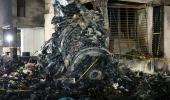
A Mayday call followed seconds later, before the aircraft plunged into a hostel compound belonging to the B J Medical College, killing 241 people on board and 19 on the ground. One passenger survived.
"In 30 seconds, that's all they said? Where are the standard callouts like V1, rotate, gear up, and positive rate? Why has that transcript not been included?" asked an Air India pilot, referring to mandatory verbal cues during takeoff that confirm speed milestones and aircraft configuration.
These standard callouts serve as verbal checkpoints between pilots to ensure both are aligned during the most critical phase of flight.
'V1' marks the speed beyond which takeoff must continue even if there is a problem; 'rotate' is the moment when the aircraft's nose is lifted off the runway; 'positive rate' indicates that the plane is climbing safely; and 'gear up' instructs retraction of the landing gear.
Several cockpit crew members criticised what they saw as "ambiguous language" and key omissions.
There was no reference, they noted, to alerts from the Electronic Centralised Aircraft Monitoring (EICAS) system, which logs warnings in real time.
"If the switches were moved, or fuel flow was interrupted, surely there would've been engine shutdown alerts?" a pilot said.
Also missing is any mention of the Emergency Locator Transmitter (ELT), a crash-survivable device meant to activate automatically.
"Why did it not trigger?" a pilot asked.
"If it didn't activate, either it was damaged, not functioning, or improperly installed," the pilot added.
"We feel deeply disturbed and demoralised by the way this report has been issued, and by the conclusions the general public is drawing from it," one pilot said.
Many Air India pilots pointed to a 2018 safety bulletin issued by the US Federal Aviation Administration (FAA) that had warned of potential malfunctions in the locking mechanism of fuel switches with the same part number (4TL837-3D) used on the Boeing 787.
While the advisory was not mandatory, Air India confirmed it did not conduct the advised inspections.
"It may have been advisory, but not acting on it was a lapse. Especially when the throttle quadrant on this plane was replaced twice -- once in 2019 and again in 2023. Why wasn't this checked?" a pilot asked.
Pilots also raised concerns about the data captured by the Flight Data Recorder.
"Did it log the switch position or the valve status downstream? If it's recording only electrical commands, even a momentary short circuit or power fluctuation could show up as a fuel cutoff event," one pilot explained.
An experienced Dreamliner pilot at Air India also raised a technical theory: "Once the Ram Air Turbine (RAT) deploys after total power loss, only the captain's (left seat) display systems remain active.
"If the first officer (right seat) was the one flying at takeoff, the captain may have taken control immediately post-thrust loss.
"But again, the report doesn't clarify any of this: Who was flying when Mayday was called? Who tried engine relight?"
The preliminary report has not issued any directive to planemaker Boeing and enginemaker GE.
When asked about the concerns raised by pilots, Boeing reiterated the statement it had issued a day on July 12: 'Our thoughts remain with the loved ones of the passengers and crew on board Air India Flight 171, as well as everyone affected on the ground in Ahmedabad.
'We continue to support the investigation and our customers.
'We will defer to the AAIB to provide information about AI171, in adherence with the UN International Civil Aviation Organization protocol known as Annex 13.'
In a statement on Sunday, July 12, the Indian Commercial Pilots' Association (ICPA), which represents narrow-body fleet pilots at Air India, rejected speculation that the crew could have shut off the fuel deliberately.
'Until the official investigation is concluded and the final report is published, any speculation is unacceptable and must be condemned.
'The crew acted in line with their training under extremely challenging conditions,' the association said.
The ICPA also denounced the 'reckless and unfounded insinuation' circulating in some quarters, including foreign media which hinted at pilot suicide.
'There is absolutely no basis for such a claim. Pilots undergo extensive psychological screening, recurrent training, and operate under the highest safety standards,' it said.
The Airline Pilots' Association of India (ALPA) has separately alleged that the investigation may be biased.
'The tone and direction of the investigation suggest a bias towards pilot error... we strongly object to this line of thought,' ALPA said, demanding that its representatives be allowed to observe the investigation process.
Even former investigators have urged restraint.
Aurobindo Handa, former chief of the AAIB who led probes into more than 100 crashes, including the Air India Express crash at Kozhikode airport in 2020, told PTI: 'It will be too premature to draw any conclusions, including the role of one of the pilots, from the preliminary report.
'We should allow the AAIB to complete its investigation in a fair, unbiased and transparent manner.'
Handa said the focus now should be on why and how the fuel switches moved to CUTOFF. 'That's what the final report should establish,' he noted.
With tensions running high, some Air India pilots say the preliminary findings have left them uneasy about operating the Dreamliner until more clarity is available.
One senior captain said the airline should consider proactively inspecting the fuel control switches across the entire fleet rather than relying on selective checks, adding that caution should take precedence over convenience.
Another pilot noted that the preliminary report raises unresolved technical questions and that any premature conclusions about crew error would be deeply unfortunate, especially if subsequent findings point to a mechanical or electronic fault.
In a communication sent to pilots hours after the preliminary report was made public, Manish Uppal, senior vice-president for flight operations at Air India, acknowledged the tragedy and stressed the importance of learning from it.
'Preliminary investigation report has been officially released in the recent tragic accident involving our flight AI171 from Ahmedabad to London Gatwick on June 12.
'As aviation professionals, we understand top importance from every safety event is the learning to ensure safe skies,' Uppal said.
He noted that the incident has deeply impacted the airline's pilot community and the broader aviation fraternity.
'The initial report gives the airline an initial insight. This is not the last word, but an important step in identifying factors and ensuring that all possible measures are taken to prevent such a tragedy from reoccurring," he added.
Uppal also said that pilots are trained to remain calm under pressure, to continuously learn, and to act decisively, and urged them to apply those values now.
'Together, we will reflect, react and rise more than before,' he said.
Air India, he noted, will soon organise a dedicated session to collectively review the findings of the report.
Key findings in AAIB's report
- 13:08:39 hours: Aircraft lifts off, engine fuel control switches turned off with a time gap of 1 second. The switches were turned on later.
- 13:09:05 hours: One of the pilots transmitted 'Mayday Mayday Mayday'. Air traffic controller enquired about call sign, but did not get response.
- At this stage of investigation, there are no recommended actions for B787-8 and/or GE GEnx-1B engine operators and manufacturers.
Feature Presentation: Ashish Narsale/Rediff




 © 2026