

Defence Procurement Manual 2025 lays down the guiding principles for revenue procurements in the defence ministry worth around ₹1 trillion in a financial year.
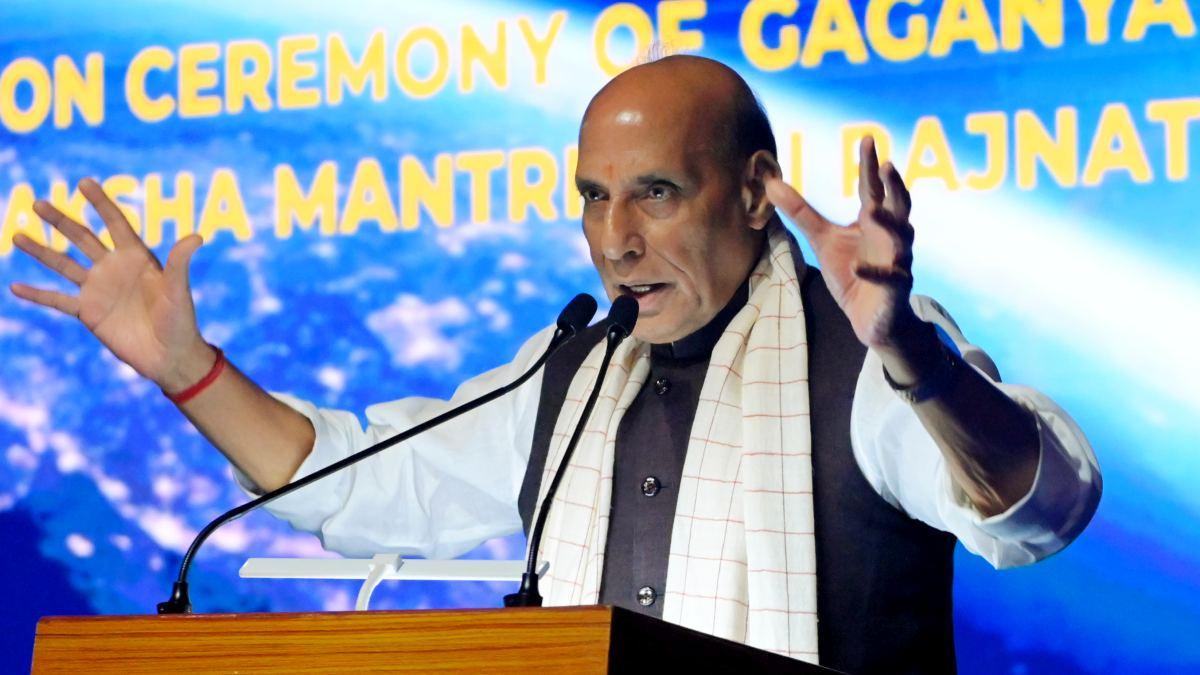
Defence Minister Rajnath Singh on Sunday approved the Defence Procurement Manual (DPM) 2025 under the Year of Reforms initiative, aimed at expediting revenue procurement for the armed services.
The move also seeks to support domestic industry through simplified processes, promote innovation, and ensure a level playing field between the public and private sectors.
The ministry of defence (MoD) is also working to finalise a revised version of the Defence Acquisition Procedure (DAP) 2020 -- a document that lays out the procurement procedures for capital acquisitions like jets, tanks, submarines and warships -- before the end of 2025.
Last promulgated in 2009, the DPM regulates the procurement of goods and services -- from defence items and spares to the repair, refit, and maintenance of military platforms -- by the defence services and other organisations under the MoD.
It lays down the guiding principles and provisions for revenue procurements in the MoD worth around ₹1 trillion in a financial year.
The DPM has been revised in consultation with the armed forces and other stakeholders.
According to an MoD release, the revised manual will ease the working capital issues faced by industries by providing supportive financing options and relaxing unnecessary penalties.
Several enabling provisions have been brought in to boost research and development (R&D) by industry, academia, and defence public sector undertakings (DPSUs).
'The new manual is aimed at achieving self-reliance in fulfilling the needs of the armed forces under revenue head (operations and sustenance segment),' said the MoD, adding that it would foster jointness among the three services, which is a stated goal of the government.
To ensure a level playing field, the revised manual has dispensed with the requirement of a no-objection certificate from select DPSUs before opting for open bidding. Going forward, tenders will be awarded purely on a competitive basis.
Assured guarantee of orders, in terms of quantity, will also be provided up to five years, and in special circumstances, up to an additional five years.
The armed services will also provide handholding by sharing technical knowhow and existing equipment.
In view of the goal of self-reliance in defence, a new chapter has been included to promote innovation and indigenisation.
The aim is the indigenisation of defence items and spares through in-house design and development, in collaboration with public and private industries and academia, particularly the Indian Institutes of Technology, the Indian Institute of Science, and other private institutions of repute.
The MoD said the revised document's objective is also to ensure the active participation of micro, small, and medium enterprises as well as startups.
Many provisions of development contracts have been relaxed to address the concerns of the industry.
For instance, no liquidity damages will be levied during the development phase. Moreover, while liquidity damages will be levied at a minimal rate of 0.1 per cent post-development of the prototype, the maximum damages to be levied have also been lowered to 5 per cent.
Only in the case of inordinate delays will the maximum damages be levied at 10 per cent.
'This will result in incentivising those suppliers who genuinely try to meet the deadline but make the supplies with little delay,' said the MoD.
The revised document empowers the Competent Financial Authorities at the field level or lower formations to make decisions, in consultation with their financial advisors, regarding granting an extension in the delivery period, irrespective of the quantum of delay, without approaching higher authorities.
Reforms push
- Encourages participation of MSMEs and startups
- Simplifies processes, eases financing, and reduces penalties for industry
- Removes mandatory NOC from DPSUs; tenders to be awarded via open competition
- Relaxes development contract norms; minimal liquidated damages at 0.1%, capped at 5%
Feature Presentation: Rajesh Alva/Rediff










 © 2026