

India’s Constitution is far more than a supreme legal framework for ideal governance.
It is a living chronicle. And represents our diversity, our sovereignty, our belief in socialism and our democratic ambition, while assuring justice, equality, liberty, secularism.
Drafted with the greatest care by visionary minds, lead by Dr B R Ambedkar, the Constitution of the Republic of India came into effect January 26, 1950. It is the longest constitution in the world.
A 90,000-word momentous document

1. From Resolution To Reality
The constitutional draft received formal approval in late November 1949 and officially took effect on 26 January 1950, marking the birth of India as a republic. Soon after, G V Mavlankar assumed office as the inaugural Speaker of the Lok Sabha.

2. A Nation Watched History Unfold
Nearly 53,000 ordinary Indians filled the public galleries of the Constituent Assembly, at Constitution Hall (Parliament House's central hall) for over almost three years, observing the intense discussions that shaped the creation of the country’s founding document, according to Press Information Bureau.

3. An Artistic Masterpiece
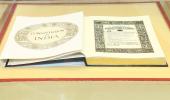
Every page was painstakingly illustrated by Shantiniketan artists, led by Acharya Nandalal Bose, with each section separated from the next by a beautiful miniature-style illustration of a period in India's history.
The elegant handwritten text -- some 90,000 words -- was completed by Prem Behari Narain Raizada in New Delhi.

4. Preserved As A National Treasure
The original manuscripts are stored in the Parliament Library and are inside specially-designed nitrogen-controlled cases to prevent deterioration.

5. The Women Behind The Constitution
Fifteen women sat in the Constituent Assembly, including Sarojini Naidu, Rajkumari Amrit Kaur, Hansaben Mehta, Sucheta Kripalani and Durgabai Deshmukh and were the voices that argued for equal rights at a time when much of the world denied women basic freedoms.

6. Signatures, Costs And The ‘Mini Constitution’
The drafting process cost roughly ₹6.4 million. Dr Rajendra Prasad was the first Indian to sign the final document. It is said freedom fighter and later politician Feroze Gandhi signed last, among the 284 members of the Constituent Assembly, as per PIB, who did so, including Prime Minister Jawaharlal Nehru.
Decades later, the 42nd Amendment of 1976 earned the nickname Mini Constitution for its sweeping and far-reaching changes.





 © 2026