
'Please don't worry about casualties. It is a professional hazard beyond our control,' wrote Kargil Hero Major Padmapani Acharya in his last letter from the battlefield.

"Thank you for remembering him. It has been 26 years now," says Mrs Charulatha Acharya, wife of Major Padmapani Acharya, Mahavir Chakra.
The Mahavir Chakra is India's second-highest gallantry award in wartime.
Major Acharya had just turned 31 on June 21, 1999. A week later, he was killed leading a daring assault in the Kargil War.
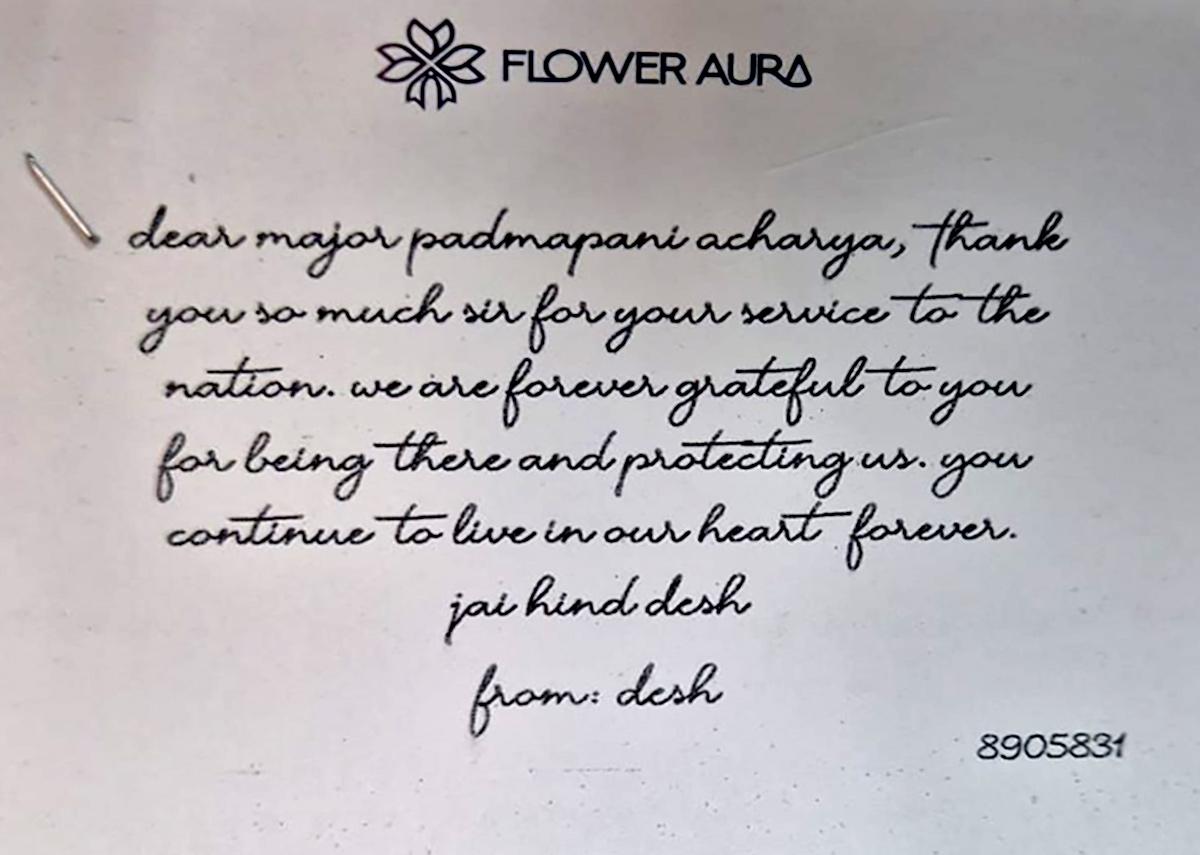
For the past 10 years, Mrs Charulatha has been receiving flowers and card on her husband's birthday from DESH, an organisation that honours military heroes.
'Forever grateful to you for protecting us. You continue to live in our hearts forever', says the card.
The gesture has touched her heart.
Major Acharya laid down his life during the capture of Three Pimples feature in the Drass sector during the Kargil War.
Twenty-six years ago, 527 Indian soldiers were killed in action during the months of May, June and July fighting the war in Kargil.
The battles of Tololing, Three Pimples, Point 4700 were some of crucial victories in Drass that paved the way for the final expulsion of Pakistani troops on July 26, 1999.
Major Acharya, who had just celebrated his birthday on the battlefield, was entrusted the task of capturing a heavily fortified enemy position.
As company commander, he led his men to capture the heavily fortified feature covered with mines under heavy machine gun and artillery fire.
As gunfire rained on them and inflicted heavy casualties, Major Acharya doggedly made his way up the mountain.
'The success of the battalion and the brigade's operations hinged on the early capture of this position,' wrote S S Gandhi in Portraits of Valour.
'Disregarding his personal safety, Major Acharya led through a hail of artillery shells. Even as his men were falling to murderous enemy fire, he continued to encourage them and charged at the enemy with his reserve platoon up the steep rock face.
Unmindful of the hail of bullets from the enemy's position, Major Acharya crawled up to the bunker and lobbed grenades. During this daring assault, he was seriously injured and unable to move. But he ordered his men to leave him and charge at the enemy, while he continued to fire at the enemy.
'The enemy position was finally over-run and the objective was captured. But Major Acharya succumbed to his injuries after completion of the mission.'
Besides Major Acharya, two other officers, Captain N Kengurusu, Captain Vijayant Thapar and ten soldiers from the 2 Rajputana Rifles battalion laid down their lives in the assault that day.
Three years ago, Mrs Charulatha Acharya finally gathered the courage to go to Drass and see the mountain from afar where her husband died in battle.
Her daughter Aparajita, born three months after the Major's death, had visited in 2019 on the 20th anniversary of the war.
'Tell a story from the Mahabharata to Charu everyday so that your grandchild imbibes good values,' Major Acharya wrote in his last letter to his father, an officer in the IAF.
For the past 26 years, the family has bravely confronted the loss every day.
The grace and courage of the soldier's wife is exemplary.
"It is tough. The scar never goes away, but we learn to live with the pain," Mrs Charulatha Acharya tells Rediff's Archana Masih as she remembers her husband whom she first met on a Jabalpur-Chennai train -- a soldier who believed that 'Combat is an honour of a lifetime'.
- Part 1 of the Interview: 'His Karma Was To Sacrifice His Life For The Nation'
June is the month of Major Acharya's birthday and death. It must be a difficult month for the family to deal with the memories.
It is tough. It is a painful month. Every year, the moment the month of June begins we want it to end soon.
If he was alive, like all families, we too would have planned his birthday, discussed what gift to give and looked forward.
He was 31 when he celebrated his last birthday. He had come home from his unit in February-March and the evening before he returned, my sister-in-law, mother-in-law and myself bought a kurta pajama for him.
Since he was mostly in uniform, he liked wearing kurta and pajamas at home. We thought it would make a good gift.
Our home in Hyderabad was very far from the city. Those days there were not many shops nearby. Shoppers Stop was one of the popular stores. We hopped into an auto and went there to pick up some gifts for him.
We gave it to him at night. He left early morning.

Maybe, he had a chance to wear it before he left for the Kargil War.
Yes, but sadly there are no photos. Those days there were no mobile cameras.

What do you do on his birthday?
Till my in-laws were alive they couldn't bring themselves to observe the birthday or martyrdom because no parent can see their child go before their eyes.
It is very painful. My daughter was born three months later and they did not want her to see the sadness.
In the initial years, volunteers organised a blood donation camp or some other humanitarian activity.
Sometimes we baked a cake at home and cooked the food that he liked.
He liked Indian food, especially sambhar and rice. My mother-in-law used to make a separate cooker of sambhar for him because he did not get to eat much of it in the north.
When he turned 50, Aparajita wanted to do something special. So she came up with a coffee table book with his pictures, letters, and Mahavir Chakra etc. [Our Babloo: The Hero of Drass]
People would often visit us and ask about him and want to see photographs so she suggested that we should compile a book.
Anyone who came to pay homage could then at least see a glimpse of his life.
We also had a fundraising event for soldiers.
For the past 10 years, DESH send flowers and card on his birthday.

I have seen some videos of your daughter. The way she puts her emotions into words when talking about her father is very heart warming. You have brought her up very well.
Thank you. The entire family has given her this upbringing. Maybe she got the gift of communication from her grandparents and father who had a great choice of words.
So sometimes like most parents I ask her to write this for that for me and she says 'Amma, you do it.' I tell her, 'No, you're good, you do it.'

You spent two-and-a-half years of married life with Major Acharya. What was the first place you joined him after marriage?
Gwalior.
He was 25 when he got commissioned and 28 when we married.
Since he had only spent three years in the army when we married, he was busy with many academic and military courses, so I stayed with my in-laws.
Three months after I joined him in Gwalior, he was sent to Delhi as commander of his contingent in the Republic Day parade.
Families were not allowed, but his commanding officer requested a temporary accommodation be provided for us.
On January 26, my in-laws also came to watch him lead the contingent.
So even though we were married for two-and-a-half years, we hardly stayed together.
Life in the infantry is like that.
How do you keep his memory alive?
We used to talk a lot about him within the family since Aparajita had not seen him. This was the way she came to know her father.
This book also must have been so helpful to so many people who wanted to know more about him.
Thanks for remembering him.
It's 26 years now.
Photographs curated by Manisha Kotian/Rediff
Feature Presentation: Aslam Hunani/Rediff









 © 2025