

When the government chooses to either ignore or use identity documents only when it suits them, it shakes people's sense of stability, observes Shyam G Menon.
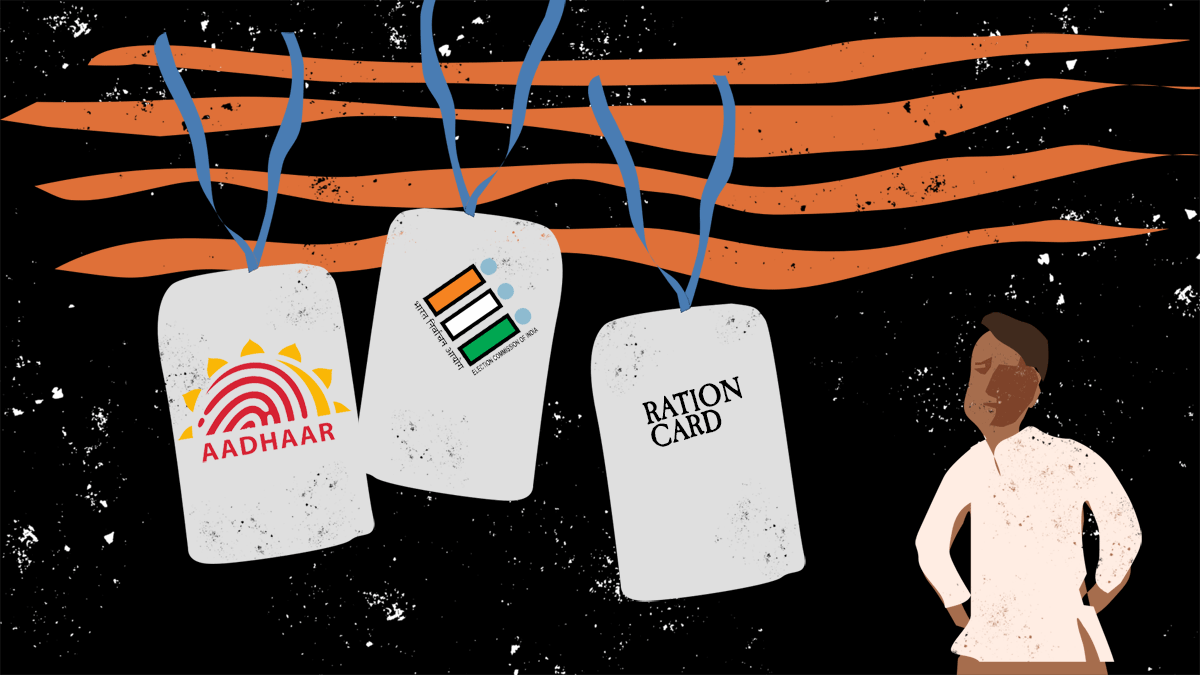
Finally, the voter ID card seemed to matter.
For me, that was the most memorable thing about July 29, 2025, a day that otherwise held little interest despite discussions on Operation Sindoor underway in Parliament.
As the debate over Operation Sindoor raged in the Lok Sabha, the citizen in me found himself tuned off the discussion and lost to mundane chores.
What killed interest was this sense of how things would be eventually reported.
One could foresee it in the media, that day's and the next -- everything that the Treasury benches said would be applauded and publicised; the Opposition would be a severely judged side act.
It's a boring pattern. And so, it was my tired, reluctant eye, which noticed in the news updates of the day, a report on what Home Minister Amit Shah said in Parliament about the terrorists killed in Operation Mahadev.
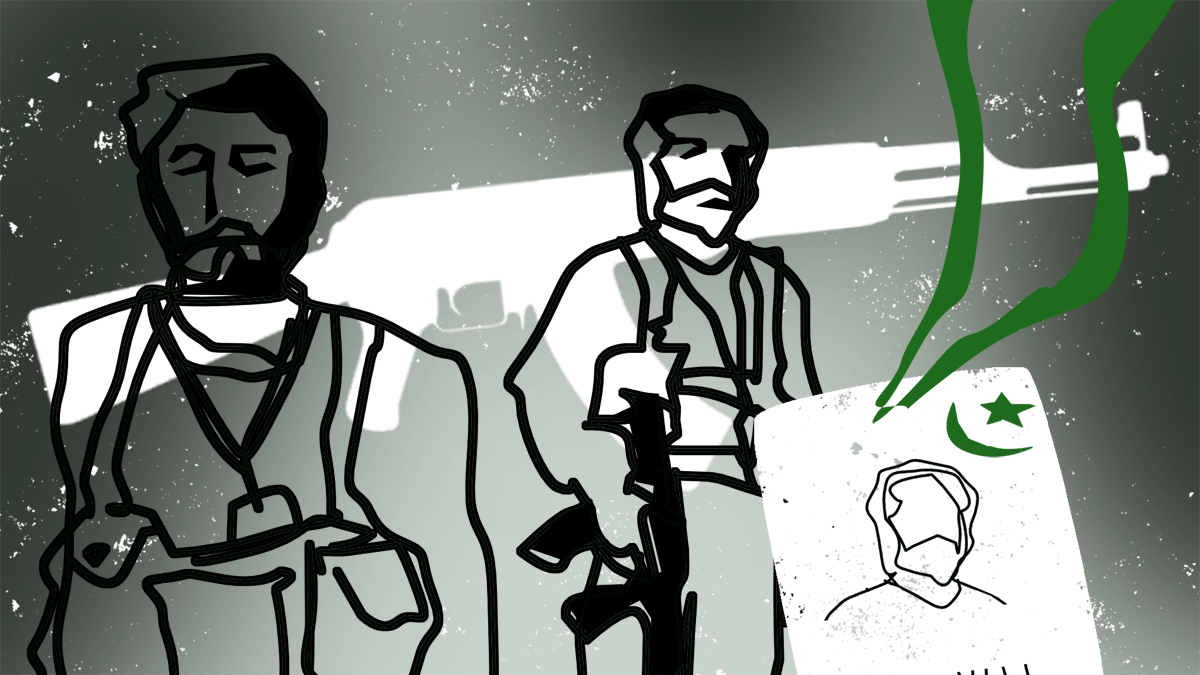
What caught my attention was a sentence in the relevant PTI report: 'The home minister said security forces had recovered Pakistani voter IDs of two of the killed terrorists as well as chocolates made in Pakistan and the weapons.'
All these were ingredients helpful to establish identity.
On July 30, I visited the Web site of the Bharatiya Janata Party to cross check the news report as the person being quoted was the home minister. The BJP Web site had a press release containing the salient points of what Shah said during the discussion on Operation Sindoor in Parliament.
One paragraph therein said: 'Hon'ble Union Home Minister said that he felt saddened when the former Home Minister of the country, Chidambaram, questioned the evidence proving that the terrorists came from Pakistan. He raised this question right before the Parliament was to discuss the matter.
'What does Chidambaram want to convey, and why does he want to shield Pakistan? Let me inform you that two of the three terrorists were found with Pakistani voter ID cards.
'The chocolates recovered from Dhok were also manufactured in Pakistan. By raising such a question, Chidambaram, a former Home Minister, is essentially giving a clean chit to Pakistan.
'He is even questioning the Indian strike on Pakistan. While our MPs went across the world and all nations acknowledged that Pakistan was behind the attack, Chidambaram's attempt to save Pakistan is now understood by every citizen of the country -- this conspiracy will not go unpunished.'
The highlighted text is as highlighted on the Web site. For those needing context -- Operation Sindoor was the Indian military operation against Pakistan (with the specific intention of dismantling terror infrastructure), which followed the April 2025 attack on tourists in Pahalgam by terrorists that left 26 civilians dead.
I don't question any of the proof tabled. Not even the chocolates, although I must confess to wondering whether the country of origin of any product used in times of globalisation, may be considered as proof of identity.
It can be confusing because so many of the things we use every day are made in so many different places.
Perhaps the late Raj Kapoor got it right when he sang of shoes made in Japan, trousers fashioned in the English style, a red hat from Russia and yet a heart that is Indian.
Shree 420 was released in September 1955. That long ago. Brilliant forecast of a future yet to be! Anyway, my mind, as I read of Shah's reference to the voter ID, was on the Special Intensive Revision (SIR), currently on in Bihar.
The exercise, which seeks to refine electoral rolls and initially declined to consider popular ID cards like Aadhar and voter ID as supportive documents, has been criticised by the political Opposition and sections of the Indian electorate.
Expectedly, it has been supported by those approving of the ruling party and the ruling government.
Once again, knowing well the image management and majoritarian guidance of opinion that would come into play, I elected to watch the SIR from a distance, resigned to a fate authored by the ruling party, which never tires of reminding us that it and its cohorts will rule us for decades.
The only time I grew concerned by the SIR was when the Election Commission appeared to dilute the value of our Aadhar cards and voter ID cards.
For each of these cards, citizens had set aside time, stood in line and patiently waited to obtain them. And when he or she got them, the average individual felt that much more secure in an Indian life that is otherwise a vicious rat race.
These documents have also since their introduction, settled in as ID cards used in day-to-day life.
As some observers pointed out in the wake of the SIR, given only citizens get to vote in an election, diluting the sanctity of voter ID cards after many years of their use by citizens at large, appeared illogical.
Having such hard-earned cards rubbished, appeared to me, stressful. After all, as stated in parliament in February 2024 by the then minister of state for external affairs, the total number of Indians owning valid passports was only 9,26,24,661.
This, in a country with over 146 crore people as of 2025. I was among those who felt relieved when the Supreme Court subsequently asked the Election Commission to consider including Aadhar and voter ID as valid ID proof even as the SIR exercise stayed on track.
It therefore engaged to see the home minister state in Parliament that Pakistani voter IDs were among things used to establish the identity of the killed terrorists as Pakistani.
At least in that context, voter IDs (among other items of evidence) seemed acceptable to Indian authorities to fix a person's identity. Advantage voter ID -- I thought.
By August 12, 2025, matters had grown more complicated. The Bihar SIR was about refining and revising the electoral roll.
The questioning of the validity of already issued ID cards was collateral damage with some semblance of a healing balm offered courtesy the Supreme Court's suggestion that Aadhar and voter ID be considered.
On August 7, Leader of the Opposition in the Lok Sabha Rahul Gandhi presented before the media, claims of fraud involving manipulated electoral rolls pertaining to one assembly seat in Karnataka.
He accused the Election Commission of colluding with the BJP to steal elections. In response, the chief electoral officers concerned issued notices to Rahul Gandhi and others who raised similar allegations.
If these allegations related to the sanctity of the voting process sullied, then less than a week later, the eligibility to vote came under a cloud bigger than the one experienced before in the wake of the Bihar SIR. On August 12, Live Law reported, 'In a significant order, the Bombay high court while denying bail to an alleged Bangladeshi national, held that merely having documents such as Aadhar Card, PAN Card or a Voter ID Card, does not make someone a citizen of India and in fact the concerned person must place on record the verification of these documents.'
Theoretically, I imagine, the court's observation opens up some questions. First, as mentioned earlier, voter ID cards have been used in elections before. If as a category they are held suspect, wouldn't it amount to questioning the validity of votes already cast using those cards and thereby, the validity of whole elections?
Second, the passport, which is the document now emerging lofty and high based on what critics of the lesser ID cards have to say, also has its share of fakes. In other words, the problem is counterfeiting and the urge to counterfeit.
Third, if only the passport is enshrined as acceptable to prove citizenship and thereby used for voting, then as the earlier quoted figure of total valid passports shows, the pool of the eligible will be a terribly small portion of India's adult population.
Worse, it is very likely that this pool will also align with economic inequality as most high net worth individuals and the financially well-off would already be passport holders.
This has happened before in history -- democracy's evolution has chapters wherein, the right to vote was reserved for a select eligible class till the push for universal adult franchise won the tussle.
Left unaddressed, what's happening in India risks nudging us to a state of selective franchise. It is a deeply worrying drift.
It is important that ID documents bridging the country's many divides, are considered till such time as everyone is aboard on the same platform.
I hope that the validity of our voter ID cards is preserved. Not just for the right to vote; being able to retain the validity of these cards is one headache less in a daily existence increasingly prone to life being decided by political agenda not all of us approve of.
Instead of allowing the citizen adequate stability to build his/her life, the general tenor has been to keep switching directions to ideological, political and administrative paradigms suiting whichever party is in power.
Rocking the boat, keeping it rocking perennially -- that is an old technique in the playbook for ruling a people.
Scared, people gravitate towards political masters for protection. We saw a lot of that in the past decade of BJP rule.
From demonetisation to SIR, the ground has been heaving and quaking periodically.
The distressing thing is how such playbooks have become the guiding light for rulers -- mainly the insecure Right-Wing sort -- globally.
For what it says of a citizenry or an electorate is that the people are merely a means for rulers and oligarchs to corner power.
Attributing that approach to a Machiavelli, Chanakya, Sun Tzu or some such strategic brilliance doesn't restore dignity to human beings reduced to the level of statistic for others to grab power and hold on to it.
Some more years of this madness and I would probably disappear inside me. All that remains for the outside world would be a body identifiable by whatever ID card the ruling dispensation of the day deems right as per its fancy. And my legacy? A bunch of ID cards, each signifying to a future archaeologist stumbling on my meagre possessions, the mad imagination of whoever ruled when I was alive.
It is called the times one lived in. There was, however, one silver lining to reflections around the Parliament debate. My friends told me that our Opposition leaders spoke well.
Shyam G Menon is a freelance journalist based in Mumbai.
Feature Presentation: Rajesh Alva/Rediff






 © 2026