
The numbers tell us the BJP's acceptability in Maharashtra is growing -- at the expense of the Shiv Sena, no matter what the faction, points out Aditi Phadnis.
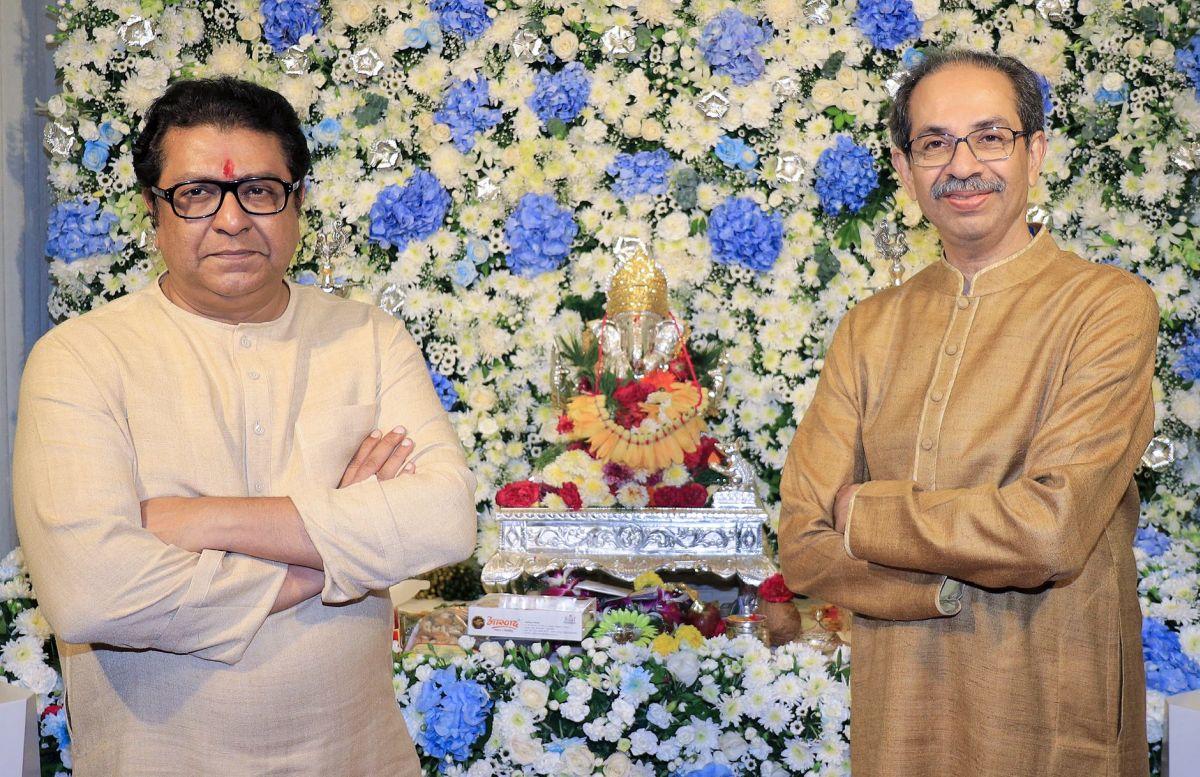
Ganesh Chaturthi is a traditional occasion for Ganpati diplomacy in Maharashtra. It is a time for estrangements to be buried, for differences to be resolved.
And so it was with the Thackeray family when Shiv Sena (Uddhav Balasaheb Thackeray) chief Uddhav Thackeray, with his family, visited Shivatirth, his cousin Raj's residence, for a Ganpati Puja after nearly 20 years.
Raj had walked out of the family bosom in 2006, after Bal Thackeray anointed his son Uddhav his successor.
Raj formed the Maharashtra Navnirman Sena, the political riposte to personal heartbreak.
While the politics might have begun to repair itself, it is hard to say if the personal hurt has been forgiven.
The political history of the MNS has been underwhelming. In the 2009 Lok Sabha elections, the MNS fielded 11 candidates. None was elected but they damaged the Shiv Sena in many seats.
In the assembly elections the same year, the MNS contested 143 seats and won 13. That was to be its lifetime high.
In the 2014 Lok Sabha polls, the party fielded 10 candidates, all of whom lost their security deposit.
In the assembly elections that year, the party contested 219 of the 288, forfeiting the deposit in 209 and winning just one.
Worse was to come. In the November 2024 assembly polls, voters in Mahim got together to defeat Amit, Raj's son, in what has been the heart of Sena thinking and politics.
They plumped for Uddhav's candidate, Mahesh Sawant, who won by more than 17,000 votes. This capped all past slights.
Out of family loyalty, Uddhav could have withdrawn his candidate. But Raj lost, even after the Bharatiya Janata Party announced its support to him.
It isn't as if Uddhav's Shiv Sena has done much better, although it did manage to serve a term in government.
A split in the Sena, which led to Eknath Shinde crossing the floor and joining the BJP, was a wakeup call.
And now, Raj and Uddhav have begun to realise that they are up against an existentialist enemy -- the BJP.
The BrihanMumbai Municipal Corporation election is set for early next year.
October-November might see polls in other local bodies. The impulse to unite in the face of a common adversary is evident.
But the move could attract the law of unintended consequences. Contrary to general belief, the BJP does not see family unity as necessarily damaging its chances.
The rivalry between Mr Shinde and Devendra Fadnavis is Maharashtra's worst kept secret and has been documented extensively.
Mr Shinde believes New Delhi has got its back, while Mr Fadnavis feels the party is behind him.
The sharp articulation of the idea that in Maharashtra you must respect the Maharashtrians is largely a slogan given by Raj.
It is a throwback to the old days when digging cricket pitches actually got you kudos and votes.
But a lot has changed in Maharashtra since then.
The BJP's vote base is upper caste Maharashtrians, but more than that the non-Marathi speaking voter: The Gujarati, the Uttar Pradesh and Bihari migrant, the Jain ... the sharper the call to define a Maharashtrian as a Marathi speaker, the more it will lead to the alienation of the other communities.
This was most clearly on view in two incidents: The Uddhav-led Sena and MNS's strong reaction to the introduction of Hindi as a third language by Mr Fadnavis in June (later withdrawn) and Raj's break with the BJP; and the Maharashtra government's decision to cover the Kabutarkhana, where 1.5 tonnes of grain is used every day to feed pigeons.
This decision too was reversed within days as Jains came out on the streets in protest, but not before the BJP-Shiv Sena rift was laid bare, with Sena members of the assembly publicly criticising the reversal.
It doesn't hurt the BJP at all to drive the Shiv Sena away -- and let the MNS and the Uddhav-led Shiv Sena unite so that they can poach on Mr Shinde's flock.
The numbers tell us the BJP's acceptability in Maharashtra is growing -- at the expense of the Shiv Sena, no matter what the faction.
Once the Shiv Sena's bastion, the BJP won 15 seats in Mumbai, including the shocker, Goregaon, a Sena heartland.
The reason? The younger voter in Maharashtra is more cosmopolitan. He finds the vision of the BJP more attractive. The Marathi Manoos appeal has less resonance.
When you add to this the changing demographic character of Maharashtra, political demands are now of a very different nature.
Maharashtra is now a cauldron of power politics if there ever was one. More twists and turns should be expected in the coming months.
Feature Presentation: Aslam Hunani/Rediff








 © 2025