

Tehran's dull treatment of a dry premise never makes us feel the complexity of the ongoing Middle East crisis nor the patriotic fervour in John Abraham’s voice, notes Sukanya Verma.

After holding back his heroic sentiments to a staggeringly subdued degree by his standards in The Diplomat, John Abraham flexes his patriotic chops in Tehran.
This Arun Gopalan-directed geopolitical thriller, penned by Bindni Karia, Ritesh Shah and Ashish Prakash Verma plots a clash between personal revenge and political strategies using a true event -- the 2012 Israel embassy car blast in New Delhi, Thailand and Georgia -- as a trigger.
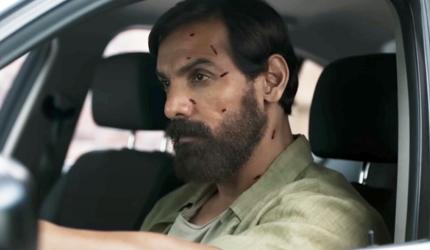
Having turned the daredevil, deadpan government agent into his calling card, John comfortably takes on the role of an Indian special cells officer Rajeev Kumar determined to nab the perpetrators when an attack, prompted by Israel-Iran’s hostilities, results in the death of a street kid his daughter’s age on his own soil.
As infuriating as this ‘collateral damage’ is, Tehran is never able to convincingly portray it as reason enough for his insubordination after his bosses withdraw their orders to nail the Iranian hand and pro-Palestine groups behind it.
Statecraft rears its ugly head as India’s reliance on Israel for ‘technology’ and Iran for ‘tel (oil)’ prevents it from avenging a little citizen’s life.
Though there’s no mention of the Dr Manmohan Singh-led government which was in power at the time frame within which this movie is set, bias-sized hints are dropped to suggest the ambition and apathy that colour the administration’s modus operandi, leaving self-appointed patriots to do the right thing in the face of uncertain support and a joke of a pay.
‘No one is clean here. I’m not here to judge,’ Rajeev shrugs.
Mostly though, it follows Hollywood’s stylish realism in the political thriller space wherein fiction, inspired by facts, provides the narrative its geographic canvas and subcontinental detailing.
Tehran wears a sprawling structure if not scale.
Even so, it’s rare to see Bollywood tread on global politics to this degree. A good deal of Tehran speaks Farsi and Hebrew and doesn’t spoon-feed its subtext.
On the flip side, the disturbing shortage of emotional connection in a story fuelled by sentiment lends the proceedings an emptiness that fails to capture the human vagaries and paradoxes at play.
Rajeev’s Justice League of men and women never rise beyond the cursory and his fleeting associations around locals of war-torn nations cannot convey a history of violence and trauma that has been eroding psyches, generation after generation.
Iran’s offensive, Israel’s artful streaks and India’s diplomatic ones are duly displayed but they’re little more than window display.
Occasionally though, Tehran lets loose in moments of whims and wrath -- scenes of a quartet of Iranian soldiers playing the violin, the gruesome execution of a rabbi, the Persian origins of the samosa...
But the dull treatment of a dry premise never makes us feel the complexity of the ongoing Middle-East crisis nor the patriotic fervour in John Abraham’s voice.
John’s rebellious Rajeev is not too different from jilted Jim when it comes to taking things in their own hand, yet throws a wholehearted SRK-style desh bhakti punch that could only land well in a movie like Pathaan, not Tehran.
Tehran streams on ZEE5.
Tehran Review Rediff Rating:









 © 2026