

In the slot of rural poor, there are those who struggle to pull themselves out of crumbling hovels, and there are the Jamtara-like bunch who turn to crime.
Neeraj Ghaywan's Homebound is about the former, whose quest for respect and dignity is thwarted because they are underprivileged, notes Deepa Gahlot.
There are regional, religious, financial, caste and class distinctions cutting across India.
Most smug urbans may not even be fully aware of the many shades of marginalisation.
In the slot of rural poor, there are those who struggle to pull themselves out of crumbling hovels, and there are the Jamtara-like bunch who turn to crime.
Neeraj Ghaywan's Homebound (produced by Dharma Productions, which calls for a hurrah!) is about the former, whose quest for respect and dignity is thwarted because they are underprivileged.
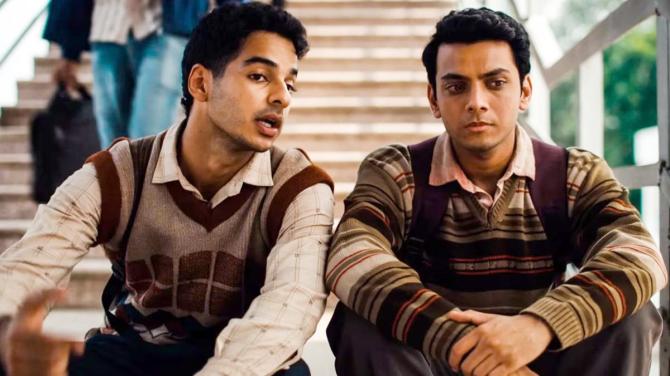
Set in a north Indian village, the film follows the lives of two friends, Shoaib (Ishaan Khatter) and Chandan (Vishal Jethwa).
They are dutiful sons to farm labourer parents, and hope to get into the police force to improve the lives of their families -- to repair a roof that leaks, get a much-needed surgery for a hobbling father, and a kind of social upliftment for themselves.
But Chandan's caste and Shoaib's religion come in the way.
For Chandan's sister, Vaishali (Harshika Parmar), the walls close in even more suffocatingly. Her education is halted, and she works at a menial job to support her family.
Homebound is based on a true story recounted in a New York Times essay by Basharat Peer, that grew out of a photograph of a young man cradling the head of his friend, who collapsed from exhaustion at the side of the road, on the long trek home during the COVID lockdown.
It conveys a gut-punch image of poverty, desperation and bureaucratic apathy.
The two young men and a woman, Sudha (Janhvi Kapoor) hope a uniform would offer them an identity beyond their low socio-econimic status. The applications run into lakhs for recruitments of a few thousand, so the competition is fierce, and it takes very long to get the results.
Chandan stubbornly refuses to enter in the reserved quota, and pretends, in a conversation with an officer, to be a Brahmin. The man, kinder than most, tells him that a pig wearing a lion's hide, remains a pig.
When hope starts dimming, Chandan gets a job in a textile mill in Surat, sharing cramped quarters with dozens of other workers.
Taunted for his Muslim identity by his co-workers in a job where he had been doing well, Shoaib also lands up in Surat.
This background is like a long prologue to the imminent tragedy that awaits when the pandemic hits. The mill shuts down and the worker friends, close to starvation, are forced to make the difficult journey home.
The irony is that their squalid home away from home in a distant state had offered them the opportunity to make a decent living; their own home just gave them grinding poverty and endemic discrimination.
A real life incident, reported in the media, is included -- that of Chandan's mother being forced out of her job as a cook in a school because upper caste parents cannot allow their kids to eat food cooked by a Dalit woman.
Ghaywan gives the young men some moments of joy, laughter and even love -- Chandan and Sudha have a tentative romance -- but does not otherwise sugarcoat their despair.
Their struggles are not romanticised, and when a dream does get fulfilled, it is too late, as if to say that the poor do not even have the right to better their existence.
There is a marked lack of self pity or melodrama, but the simmering anger at the daily injustice they put up with is not suppressed or sanitised.
The performances by Khatter and Jethwa are wonderfully empathetic. The fury, pain and hopelessness are expressed with a raw sincerity.
Homebound is shot without any fake embellishment. Pratik Shah's camera is unflinching in showing the ugliness of the spaces the underprivileged are forced to inhabit.
The film is deeply moving and the director's view of social reality is profoundly compassionate.
That it comes with film festival accolades and the Martin Scorcese stamp of approval should not matter. What matters is the achievement is that Ghaywan's independent voice is allowed to be heard over the current din of Bollywood blockbusters.











 © 2026