

NMIAL is spending close to Rs 18,000 crore to get the airport up and running.

Rising from reclaimed wetlands at the edge of India's financial capital, a lotus of metal and glass is taking shape -- set to extend the Mumbai Metropolitan Region's reach to the world.
Expected to open this year, the Navi Mumbai International Airport (NMIA) will greet passengers under a petal-shaped roof with flowing contours, echoing the design spirit of its twin aerodrome in Mumbai.
The airport will feature a central atrium resembling a pond where lotuses bloom, with concourses radiating outward like unfurling petals.
Its glass façades and latticework mimic lotus leaves.
Perforated screens -- colloquially referred to as jaalis -- allow natural light to drift through the terminal roof, softening its touch as it brushes the floors below.
At the heart of the city today, the Chhatrapati Shivaji Maharaj International Airport (CSMIA) has, for over a decade, let a thousand white peacocks unfurl their trains for flyers looking skyward.
The canopy of CSMIA's Terminal 2 is indented with a decorative pattern of openings.
It has been the region's sole airport, handling an annual footfall of 54.8 million passengers in 2024.

NMIA is expected to ease congestion at CSMIA by accommodating over 20 million passengers in its first phase.
With its inauguration, the Mumbai Metropolitan Region (MMR) will boast two distinct architectural airports, both rooted in India's design heritage and poised to stand alongside global benchmarks such as Changi in Singapore, Daxing in Beijing, and Hamad in Doha.
In Navi Mumbai, the lotus serves as the central design inspiration, guided by the team at London-based Zaha Hadid Architects (ZHA).
Between 2014 and 2019, ZHA designed Beijing's Daxing international airport.
The firm's late founder, Zaha Hadid, was a Pritzker Architecture Prize laureate.

NMIAL is spending close to Rs 18,000 crore (Rs 180 billion) to get the airport up and running.
The entire project is expected to be completed in five phases.
In December 2024, a validation landing tested new flight instruments installed at the aerodrome -- part of the certification process to ensure operational safety.
NMIA had conducted calibration of the Instrument Landing System and Precision Approach Path Indicator, subsequently drafting instrument approach procedures to prepare for the validation flight.
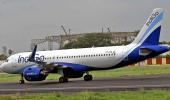
Earlier, in October, an Airbus C295 of the Indian Air Force marked the first touchdown at the aerodrome.
NMIAL is a joint venture, with Mumbai International Airport (MIAL) holding 74 per cent and the rest with the City and Industrial Development Corporation of Maharashtra.
MIAL itself is jointly owned by Adani Airport Holdings and the Airports Authority of India.
Photographs curated by Manisha Kotian/ Rediff
Feature Presentation: Ashish Narsale/Rediff




 © 2026