

'Mobius made EMs investable and India his most enduring belief.'
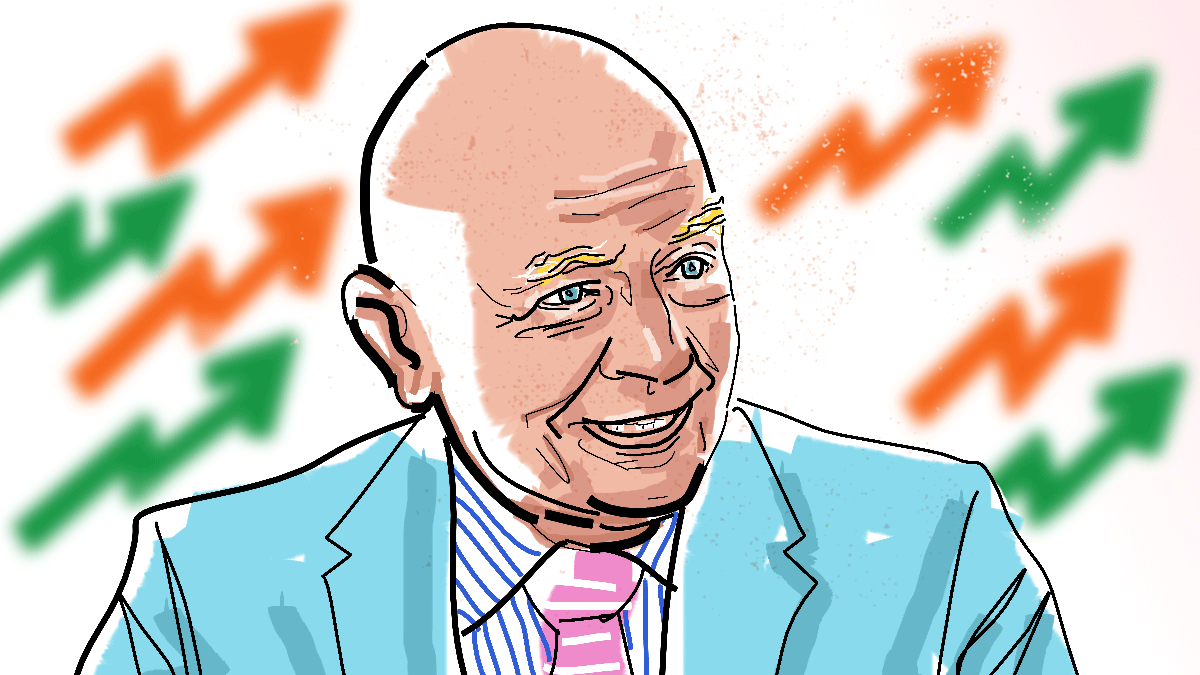
Key Points
- Mark Mobius, a pioneering emerging markets investor, died at 89 after a four-decade career shaping global investment strategies.
- He transformed emerging markets from niche allocations into mainstream portfolios, directing billions of dollars into countries including India.
- At Franklin Templeton, he launched one of the earliest EM funds, which evolved into a multi-billion-dollar global investment platform.
- Mobius believed volatility created opportunities, consistently advocating long-term investing in emerging markets despite sharp market swings.
- He remained active post-retirement, co-founding Mobius Capital Partners and maintaining a strong bullish stance on India's growth story.
Investment guru Mark Mobius, who championed investing in India and other emerging markets (EMs) from China to Brazil, died at the age of 89.
Widely regarded as one of the earliest and most influential proponents of investing in developing economies, Mobius played a pivotal role in turning EMs from a niche idea into a mainstream allocation for global investors.
His work also helped put countries such as India on the global investing map, channelling billions of dollars into these markets.
Over a career spanning more than four decades, Mobius built his reputation by investing in countries others deemed too risky.
'Mark opened the world's eyes to EMs and inspired generations of investors to think more globally, more boldly, and with greater imagination about what's possible. He changed how we invest and how we see opportunity across the world,' Jenny Johnson, chief executive officer of Franklin Templeton, said in a statement.
Franklin Templeton EM Fund Journey
Mobius joined Franklin Templeton in 1987, where he launched one of the first dedicated EM funds.
Over the next three decades, the fund scaled into a multi-billion dollar franchise, investing across EMs and frontier markets.
Known for his extensive travel and first-hand research, Mobius valued understanding local businesses, politics, and cultures rather than relying solely on research analysis.
He frequently visited India, drawing on on-the-ground insights. He maintained that successful investing required a grasp of the broader economic and social context.
In interactions with Business Standard, Mobius emphasised that volatility was intrinsic to EMs but remained bullish on the long-term prospects -- wisdom that will echo with many investors in the current context.
His broader belief was that sharp market swings often created mispricing, and therefore opportunity, for patient investors.
He also highlighted how liquidity cycles could fuel broad-based rallies.
"Many people feel rich because they made money through cryptocurrencies. When people feel that way, more money enters the system, eventually finding its way into stock markets. And that generates a bull market in every direction," he told Business Standard in 2019.
Even after stepping down as executive chairman of Templeton Emerging Markets Group in January 2018, Mobius remained active, co-founding Mobius Capital Partners, writing books on investing, and closely tracking developments across EMs.
In 2019, Mobius told Business Standard that his fund, with assets of $170 million, had earmarked about 20 per cent for India.
Mobius remained active in markets well into his later years, continuing to share his views through interviews and public appearances.
Those who knew him said he was generous with his time, offered thoughtful advice, and remained deeply curious -- making a conscious effort to engage with new people and understand local cultures wherever he travelled.
Speaking at an event organised by domestic brokerage PL Capital at the end of 2024, Mobius said he remained constructive on India's long-term prospects, citing structural reforms, infrastructure spending, rapid urbanisation, and rising consumption among younger demographics as key growth drivers.
He also highlighted opportunities in sectors such as defence manufacturing and underscored sustained demand for power and commodities.
"Mobius made EMs investable and India his most enduring belief, and he was its most articulate advocate," said Amisha Vora, chairperson and managing director, PL Capital, who interviewed him.
Mobius was candid about his own investing mistakes. He acknowledged that an excessive focus on valuation metrics such as price-to-earnings (P/E) or price-to-book ratios had, at times, led him to miss the bigger picture.
"We are not too worried about high P/E. The market always looks forward, so a high P/E can quickly become low," he told Business Standard in 2019.
Feature Presentation: Aslam Hunani/Rediff






