

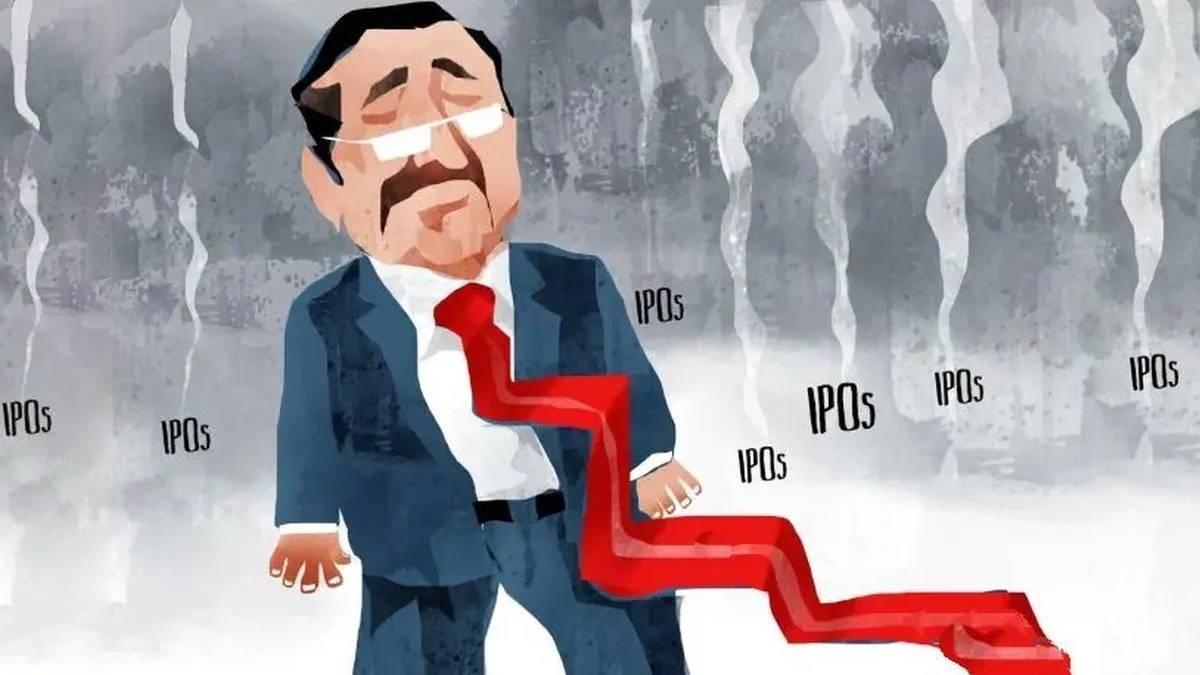
More than a third of 83 mainboard IPOs this year ended their debut sessions in the red, with losses of up to 35 per cent.
Primary market performance hinges on how well the secondary market does in a particular year. But this year has been an exception.
India's primary market is in the middle of an unprecedented boom, even as the secondary markets grapple with one headwind after another, from slowing corporate earnings to tariffs imposed by US President Donald Trump.
September alone saw more than two dozen companies go public -- the most in a single month since January 1997. The first whole week of October set a fresh record, with companies mobilising over Rs 30,000 crore, the highest-ever weekly mopup.
Nearly 200 companies have filed draft initial public offering (IPO) papers this year, setting the stage for an action-packed 2025.
One explanation for this boom is that investors found better returns in most new issuances than in the already listed ones. However, cracks are starting to appear.
According to IPO-tracking portal Chittorgarh.com, more than a third -- or 29 out of 83 mainboard IPOs this year -- ended their debut sessions in the red, with losses of up to 35 per cent.
And more than half of these listings have happened since September. Four of them tanked more than 20 per cent on listing day.
The average debut-day gain has fallen to 9 per cent in 2025 from 30 per cent a year ago.
Despite mixed post-listing performance and volatility in the secondary market, the IPO boom continues unabated.
So far this calendar year, nearly Rs 1.2 trillion has been raised, and the final haul is likely to surpass last year's record Rs 1.6 trillion.
Recently concluded issues, such as Tata Capital and LG Electronics India, have already set the tone for more big-ticket offerings.
Several large IPOs are in the pipeline, including those of ICICI Prudential AMC, Lenskart, PhonePe, PhysicsWallah, Meesho, and Pine Labs.
"Newly listed stocks will be subject to the same market gyrations as the already listed ones," said Ajay Garg, managing director of Equirus, an investment bank.
"The poor post-listing performance of some is unlikely to hurt sentiment much, as investors have become more institutionalised. The retail sentiment does get affected, but institutional investors are more discerning and are unfazed by short-term turbulence."
About 50 per cent of an IPO is reserved for individual investors. Investment bankers have been lobbying with the market regulator, the Securities and Exchange Board of India, to reduce this dependence on small investors.
The idea was briefly mooted by Sebi earlier this year, but was dropped due to fears of an investor backlash.
More retail participation won't hurt India Inc, which has lined up IPOs worth over Rs 3 trillion.
However, analysts warn that as the IPO cycle matures -- close to Rs 3 trillion has been mopped up since 2024 -- the risk of overpricing is rising sharply.
Some recent listings -- such as Glottis and Om Freight Forwarders -- have seen their share prices plunge more than 30 per cent below issue price, shaking investor confidence.
Even larger offerings like Tata Capital and WeWork India Management disappointed, ending flat on debut.
"The chances of losing money on issues that come at the fag end of the IPO boom are very high," said G Chokkalingam, founder of Equinomics Research, a Mumbai-based equity research and advisory firm.
"In the initial phase, investors make money, irrespective of valuations. But at the peak, pricing becomes aggressive, leaving little room for profit. The days of applying mindlessly and booking listing gains are over."
Pain over gain
There has been a notable deterioration in post-listing performance compared with 2024, when favourable market conditions and strong debut performances kept all stakeholders -- regulators, investment bankers, and investors -- satisfied.
Of the 91 mainboard listings last year, only 18 ended day one with losses, typically limited to 20 per cent.
The average gain then was a healthy 30 per cent, with shares of five companies more than doubling on debut.
"Poor-quality issues result in losses on day one," said V K Vijayakumar, chief investment strategist at Geojit Financial Services, a Kochi-headquartered investment services company. "Retail investors and traders looking only for listing gains will suffer -- that's par for the course."
While "many companies and bankers are trying to make hay while the IPO sun shines," he added, sound businesses will still find buyers.
"Caveat emptor (let the buyer beware) is the solution here. A 10 per cent discount would be ideal, but peer comparison is tricky. Wealth creation happens when investors stay invested for long periods."
Several large IPOs, including Tata Capital, LG Electronics India, and WeWork, are said to have scaled down their IPO valuation following institutional investor feedback.
Chokkalingam emphasised that companies planning IPOs need to "leave value on the table" if they want their issues to succeed.
"Investors should assess the durability of business models and the valuation comfort offered before investing," he added.
Many retail participants still chase IPOs purely for listing-day gains, often without examining fundamentals.
A 2024 study by Sebi showed that a majority of IPO allottees sell their shares within a week of listing, and nearly 70 per cent exit within a year.
The analysis -- covering 144 IPOs listed between April 2021 and December 2023 -- highlighted that most individuals apply for IPOs seeking quick gains.
A buyer-beware market
This herd behaviour, driven by grey-market premiums and short-term sentiment, often obscures a fundamental truth: Equities are inherently risky.
"It's an unfair expectation to think every IPO will list at a premium and continue to trade above issue price," said Pranav Haldea, managing director of Prime Database, a capital market data provider.
"An IPO is an equity instrument, not a fixed-income product. It's even riskier than investing in already listed companies, where more information is available."
According to Haldea, IPO investing boils down to two things -- quality and valuation.
"Even a good-quality company coming out with an IPO at an expensive valuation makes for a bad investment," he said.
"Most retail investors are lured by quick gains. That's fine if they exit early -- but if they hold on expecting perpetual upside, they risk losses."
The balance between optimism and realism, ultimately, comes down to pricing.
"No one is being forced to buy into an IPO," said a senior investment banker.
"It's in the interest of both the company and the merchant banker that an issue is fully subscribed. Many IPOs lapse because the valuations issuers expect don't align with what the market will bear."
Pricing typically follows extensive roadshows and investor interactions.
"When secondary markets are buoyant, you'll see a surge in IPOs -- some fairly priced, others aggressive," the banker said.
"It's all about supply and demand. Subscribers must invest in the right companies at the right valuation."
India's IPO market remains one of the busiest globally, reflecting strong equity performance and continued appetite for new-age businesses.
But investors have to tread cautiously. "It's a buyer-beware market. The buck stops with you," said an analyst.

Feature Presentation: Aslam Hunani/Rediff










 © 2026