

'Advanced skills is such a broad spectrum that a simple prompt engineer to a critical upper end LLM developer are clubbed under one.'
'In addition, some include their non-technical employees who can use AI tools under this talent base.'

India's top five information technology services companies collectively have more than 250,000 employees armed with the AI skills amid increasing focus on the technology to drive growth, even as industry insiders have expressed doubts over these skills being outcome-driven.
While these firms have already trained a majority of their workforce in foundational AI capabilities, the focus is now shifting to advanced skills -- seen as critical to delivering differentiated outcomes in clients' rapidly evolving technology environments.
However, some industry insiders are doubtful whether the companies are seeing any meaningful gains yet in revenue and profit when the IT industry is attempting a move to an outcome-based model rather than the traditional billable model.
"Advanced skills is a complex discussion and hard to know what they mean by it. It is such a broad spectrum that a simple prompt engineer to a critical upper end LLM developer are clubbed under one," pointed out Yugal Joshi, a partner at the Everest Group.
"In addition, some of these providers include their non-technical employees who can use AI tools under this talent base," Joshi added.
Tata Consultancy Services has about 114,000 people with AI skills, which the company believes will allow it to create a 'skills pyramid'.
"We will continue building a skills pyramid. But each level will have its own specialisation or dimension. For instance, agentic AI, or domain-specific areas like manufacturing and life sciences," said Milind Lakkad, CHRO, TCS, in an interview post Q1FY26 results.
"There will be skills which will be developed which are contextual to the industry and contextual to specific technology," Lakkad added.
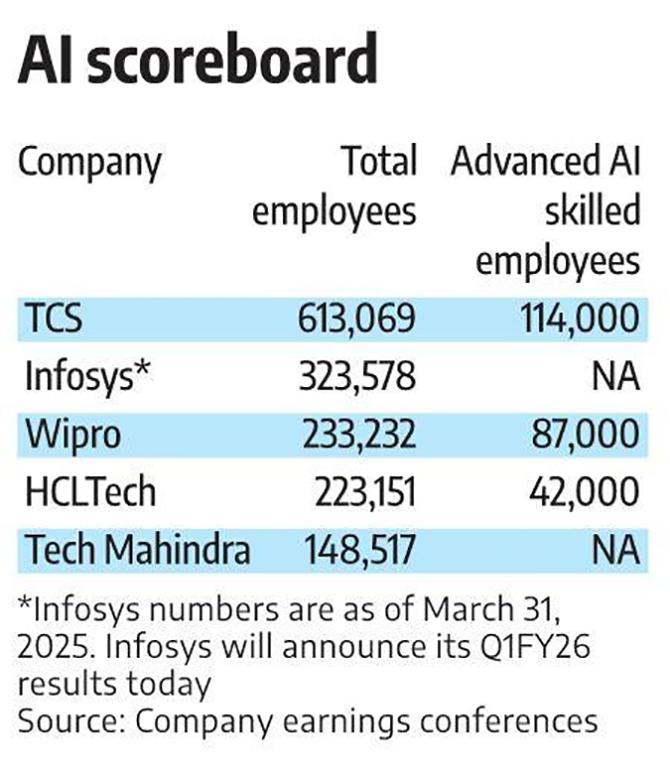
HCL Tech has about 42,000 employees who are trained as advanced GenAI users.
Of that, 12,000 are practitioners, who are working on Gen AI projects and that "momentum has picked up significantly over the last two quarters," HCL's Chief People Officer Ram Sundararajan said.
Wipro said more than 87,000 employees in the company possess advanced AI skills.
Infosys and Tech Mahindra, which do not provide the break-up, have about 290,000 and 77,000 employees, respectively who are trained in the basics.
Tech Mahindra Chief Executive Mohit Joshi said those numbers include "a critical mass in advanced training and certification."
Infosys has divided its workforce into AI-aware, AI-builders and AI-masters.
The last two categories are involved in using models that are available on cloud and building models grounds up or finetuning them.
However, the company does not specify the exact number of employees in these three segments.
That, analysts say, is a step in the right direction, but caution that there is a long way to go until they are driving real bottom-up AI transformation for their clients.
"From the standpoint of leveraging GenAI into computer programming areas like testing and app development, I see a lot of progress being made," Phil Fersht, CEO, HfS Research, told Business Standard, adding, "The big challenge for Indian-heritage providers is that they are far too IT-centric, and much of the demand for GenAI and agentic solutions is coming from the business."
"Indian IT firms need to upskill in business process areas beyond merely IT processes, if they want to get a bigger piece of the action as emerging AI-centric deals come up," Fersht added.
Expressing doubt over AI-skilled talent showing up in efficiency, Kamal Karanth, cofounder of specialist staffing firm Xpheno, says the replacement of 12 to 15 per cent talent who move out of an IT services firm and the increasing number of AI-trained talent they seem to have built pose a few questions.
Feature Presentation: Ashish Narsale/Rediff








 © 2026