

GST 2.0 may cushion consumers against US tariffs, but like the 2019 corporate tax cut, it risks being another tactical fix rather than a structural growth strategy, expects Debashis Basu.
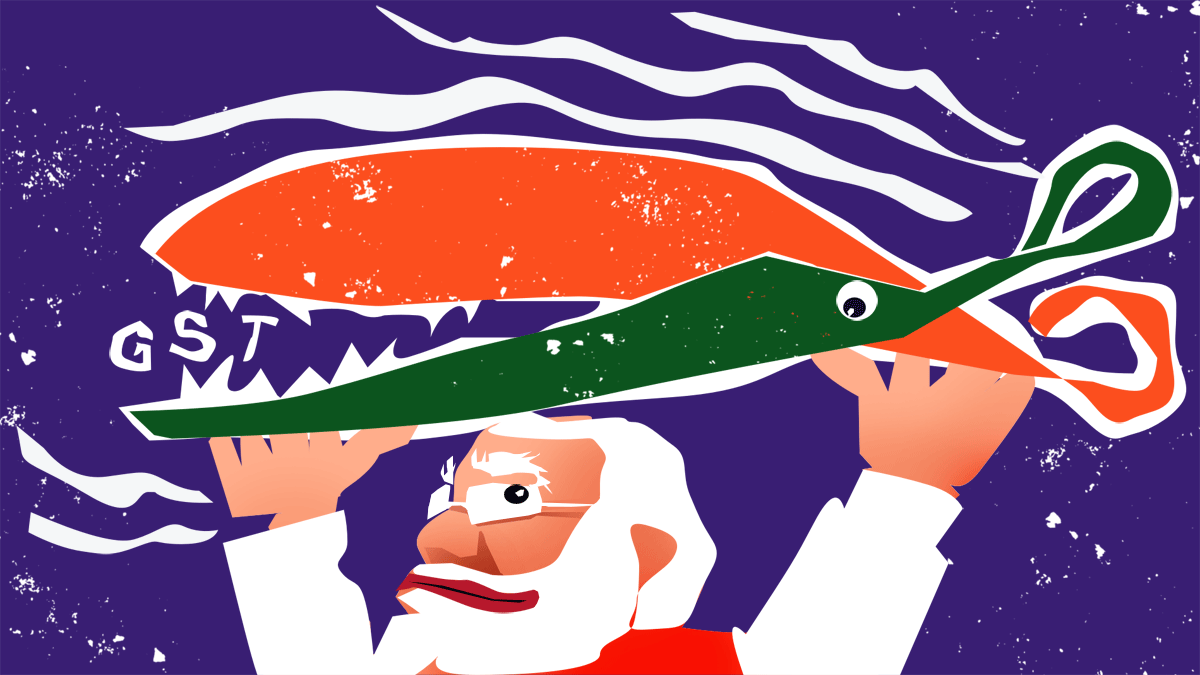
Prime Minister Narendra Modi used his Independence Day address to announce a sweeping simplification of India's goods and services tax (GST) regime.
The patchwork of the four main rates (5 per cent, 12 per cent, 18 per cent, and 28 per cent) will now be collapsed into two -- 5 per cent and 18 per cent. A punitive 40 per cent levy will remain for 'sin' goods such as tobacco.
The aim, the government said, is to ease compliance, reduce distortions, and put more money in consumers' hands.
To investors and economists, the announcement sounded eerily familiar.
Six years ago, on September 20, 2019, Union Finance Minister Nirmala Sitharaman stunned India Inc by slashing corporate tax rates from 30 per cent to 22 per cent, and from 25 per cent to 15 per cent for new manufacturers.
For firms such as Hindustan Unilever, Asian Paints, Nestle India, Bajaj Finance and HDFC Bank, the cuts meant a windfall.
The BSE Sensex soared 5.3 per cent that day, and 2.8 per cent the following Monday, its biggest two-day rally in years. Yet, the enthusiasm faded quickly.
Why? Because the tax cuts were just a knee-jerk reaction, a desperate response to a flagging economy.
Growth had slowed to 5 per cent in the first quarter of that year -- 3.5 per cent according to old calculations.
Exports were languishing, unemployment was rising, and auto sales had sunk to a two-decade low. The financial sector was in crisis, with shadow banks teetering.
The tax bonanza was supposed to spur companies to reinvest their savings, leading to employment opportunities being generated. But higher retained earnings don't drive the expansion plans of cash-rich companies, only strong secular demand does. No wonder the generous tax cuts did not translate into corporate expansion.
We are still waiting for the private capital expenditure upcycle; but, six years later, we are getting another sharp tax cut.
The economic setting in 2025 is less catastrophic, but hardly robust.
India Inc's core earnings shrank 3.3 per cent year-on-year (Y-o-Y) in April-June 2025-26 (Q1FY26), the second contraction in four quarters.
Revenue grew 7.3 per cent Y-o-Y, but excepting financial services and oil companies, growth was only 5.3 per cent. Profit before tax fell 7.4 per cent.
The earnings of 3,051 listed firms shrank. India's core sector output grew just 2 per cent Y-o-Y in July, down from 2.2 per cent in June.
Industrial output, too, dropped to a 10-month low of 1.5 per cent in June.
Slippages at Indian banks rose 26 per cent Y-o-Y in Q1FY26, driven by stress in microfinance and unsecured retail portfolios.
Fresh slippages reached ₹49,000 crore, up from ₹39,000 crore a year earlier.
Recoveries and upgrades fell 3.4 per cent to ₹28,000 crore, while writeoffs declined marginally to ₹26,500 crore.
Gross non-performing assets (GNPAs) rose 6.7 per cent to ₹4.8 trillion. The data suggests early signs of credit fatigue.
Foreign portfolio investors (FPIs), spooked by sluggish earnings and a sliding rupee, sold Indian equities worth ₹210 billion ($2.5 billion) in the first half of August alone, bringing outflows to ₹1.16 trillion ($14 billion) in 2025 till now.
Foreign institutional investors (FIIs) sharply reduced their exposure to Indian equities in July, making India the most underweight market among emerging market portfolios.
India's relative weighting fell to a negative 2.9 percentage points versus the MSCI Emerging Markets (EM) index. Meanwhile, China, Hong Kong, and South Korea saw increased allocations.
Can GST 2.0 reverse this picture? Cutting consumption tax for the masses is different from cutting corporation tax for rich companies.
The State Bank of India reckons that rationalisation could lift annual consumption by nearly ₹2 trillion, or about 8 per cent of the household demand.
In an economy where consumption contributes nearly 60 per cent of GDP, the hope is that higher household spending will ripple through manufacturing and services, spurring growth.
But the immediate trigger for the cuts is geopolitical. In a sharp escalation of tensions, the United States has branded India a 'prime enabler' of Russia's war machine because of its decision to purchase cheap Russian oil.
From August 27, Washington started imposing a 50 per cent tariff on around $50 billion worth of Indian exports -- more than half its $80 billion in annual shipments to the US.
Few importers will absorb such a price hike. Unless exporters find other buyers, a large chunk of sales will vanish.
This is where a lower consumption tax makes sense. Domestic consumption, courtesy GST 2.0, is intended as a buffer.
However, the mercurial American president can escalate his economic war by targeting Indian software exports, the H1B visa, and foreign remittances, which are critical to India's balance of payments and currency stability. But till that happens, GST 2.0 will help.
The trouble is that such tactical cuts do little to address India's deeper weaknesses.
If the 2019 tax cut policy had been part of a coherent philosophy, it would have been built into the Budget, and not come as a bolt from the blue. The same is true today.
A one-off reduction in consumption tax may cushion consumers against tariff shocks but does nothing to repair the structural impediments to growth.
India's persistent failure to capture global market share is illustrative.
Consider textiles, one of our top 10 exports: In 2010, China controlled 36 per cent of global exports; by 2018, its share slipped to 31.3 per cent due to rising wages.
Vietnam and Bangladesh seized the opening, doubling their shares to 6.2 per cent and 6.4 per cent respectively.
India's share fell slightly, from 3.3 per cent to 3.2 per cent. Taxes were not the issue; rather, the 'frictional costs' of doing business in India -- red tape, corruption, poor logistics, and inconsistent policies -- held firms back.
The corporate tax cut of 2019 was meant to signal a pro-growth turn. Instead, it ended up as an improvised fix. GST 2.0 risks being another.
There is one difference between the two situations, though. The 2019 cut fuelled an explosion of speculation about more Big Bang reforms being on the way. No one is expecting that anymore.
Debashis Basu is editor, www.moneylife.in and a trustee of the Moneylife Foundation. These are Debashis Basu's personal views.
Feature Presentation: Rajesh Alva/Rediff



